
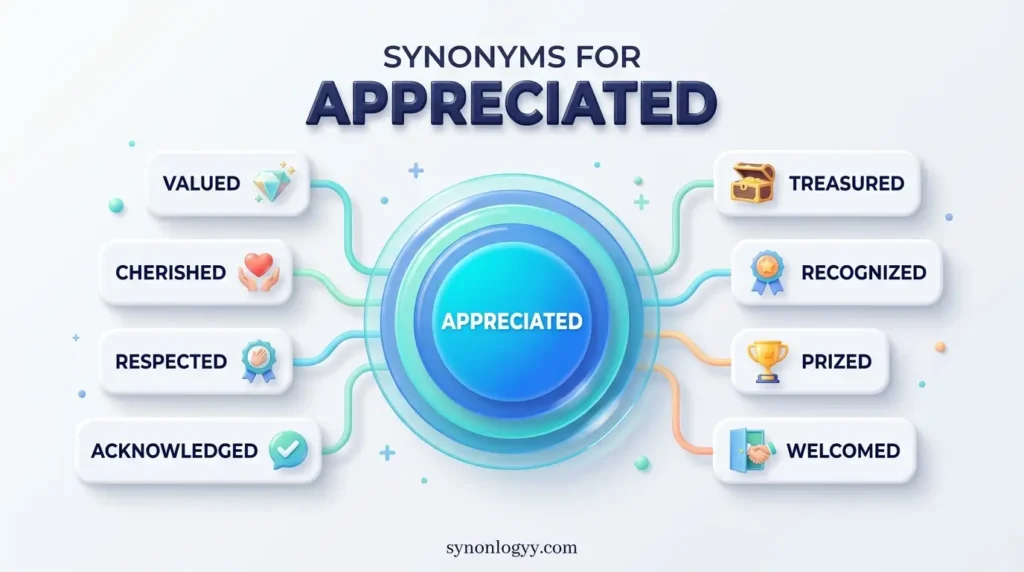
Synonyms for appreciated help you express thanks, respect, and recognition in clear ways. The word appreciated often means feeling valued or receiving thanks for something helpful.
Imagine helping a classmate with homework and hearing, “Your help is greatly appreciated.” That simple phrase shows gratitude and respect.
People use this word at school, work, home, and in daily conversations. However, repeating the same word can make your writing sound dull.
Learning similar words helps ESL learners build stronger vocabulary and speak with confidence. It also helps students and content writers express ideas with greater care.
Some alternatives show gratitude, while others express respect or recognition. This guide explains the meaning of appreciated, its pronunciation, grammar, history, and word forms.
You will also learn 30 synonyms with simple definitions and real examples. By the end, you can choose words that fit your message and tone.
Quick List: Appreciated Synonyms at a Glance
These 30 alternatives express gratitude, value, or recognition, depending on the context.
Thanked, valued, recognized, respected, acknowledged, admired, praised, welcomed, cherished, treasured, loved, honored, esteemed, commended, celebrated, rewarded,
regarded, understood, noticed, accepted, enjoyed, enjoyed by others, esteemed highly, held dear, thought highly of, given credit, shown gratitude, spoken highly of, received warmly, and held in high regard.
Usage note: Some expressions fit only certain contexts. For example, thanked focuses on gratitude, while valued focuses on worth.
Meaning of Appreciated
Definition
Appreciated (verb, past tense and past participle): recognized the value of someone or something, or felt grateful for help or kindness.
The word can describe gratitude, respect, or recognition. Its exact meaning depends on the sentence.
For example, a worker may feel appreciated when a manager praises their effort. A painting may be appreciated because people admire its beauty.
Examples
- My teacher appreciated my honest answer.
- Everyone appreciated the food at our family dinner.
Common Collocations
These phrases often appear in everyday speech and writing.
- Greatly appreciated: Your quick reply is greatly appreciated.
- Highly appreciated: Her careful work is highly appreciated.
- Much appreciated: Your support is much appreciated.
- Feel appreciated: I feel appreciated by my team.
- Appreciated by everyone: His kindness is appreciated by everyone.
Connotative Meaning
(Connotation means the feeling or idea a word suggests beyond its basic meaning.)
- Positive tone: Appreciated often suggests gratitude, respect, and warmth.
- Negative tone: It may suggest a lack of recognition when used negatively, as in “I never felt appreciated.”
- Neutral tone: It can simply describe recognizing the value of something, such as an appreciated feature of a product.
Etymology of Appreciated
The word appreciated comes from the verb appreciate. Its history traces back to Latin through French.
The Latin verb appretiare meant to set a price or value on something. It came from pretium, meaning “price” or “value.” French and later English developed related forms.
Over time, appreciate gained wider meanings. It came to describe understanding value, recognizing quality, and feeling gratitude.
Old English (450–1100)
The modern word appreciate did not come directly from Old English. Older English words expressed related ideas, such as valuing, praising, and thanking. However, these words had different histories.
Middle English (1100–1500)
During the Middle English period, French and Latin influenced English vocabulary. Words connected with price, worth, and judgment entered English through these influences. The exact history of every related form can differ.
Modern English (1500–Present)
The verb appreciate developed several common meanings. It can mean understanding worth, enjoying quality, or feeling grateful.
The form appreciated now appears in everyday speech, workplace messages, school writing, and formal communication.
For example, “Your patience is appreciated” expresses gratitude. “The painting is appreciated by collectors” highlights its recognized value.
Pronunciation of Appreciated (IPA)
- IPA (US): /əˈpriːʃiˌeɪtɪd/
- Syllables: ap-pre-ci-at-ed (five syllables in common pronunciation).
The stress falls mainly on the second syllable, pre. Say the word slowly first, then practice it in a complete sentence.
Example: “Your help is appreciated.”
Affixation Pattern of Appreciated
Root
The word comes from the Latin family associated with pretium, meaning price or value. In modern English, appreciate functions as a complete verb.
Prefix
The word has no productive English prefix in its modern form. Its historical Latin structure should not be confused with a modern English prefix pattern.
Suffix
The ending -ed forms the simple past tense and past participle of appreciate.
- Appreciate: base verb
- Appreciated: past tense or past participle
- Appreciating: present participle or gerund
Word Formations
| Word | Part of speech | Meaning |
|---|---|---|
| Appreciate | Verb | Recognize value or feel gratitude |
| Appreciated | Verb/adjective | Recognized, valued, or welcomed |
| Appreciating | Verb/gerund | Recognizing value or feeling gratitude |
| Appreciation | Noun | Recognition, gratitude, or understanding |
| Appreciative | Adjective | Showing gratitude or recognition |
| Appreciatively | Adverb | In a grateful or approving way |
| Unappreciated | Adjective | Not properly valued or recognized |
Examples:
- Appreciate: I appreciate your honest advice.
- Appreciated: Her work was appreciated by the group.
- Appreciating: He is appreciating the quiet evening.
- Appreciation: We showed appreciation for their help.
- Appreciative: The coach was appreciative of their effort.
- Appreciatively: She smiled appreciatively at the gift.
- Unappreciated: His efforts often went unappreciated.
30 Synonyms of Appreciated With Meaning & Examples
The best synonym depends on what you want to express. Some words show gratitude, while others focus on respect, praise, or value.
1. Thanked (verb)
Meaning: Expressed gratitude to someone for help or kindness.
Best used when / Tone: Direct, friendly, and common.
Examples:
- Maya thanked her neighbor for carrying the boxes.
- After the lesson, the student thanked his tutor.
2. Valued (verb)
Meaning: Recognized someone or something as important or useful.
Best used when / Tone: Warm, professional, and respectful.
Examples:
- Our manager valued every employee’s honest feedback.
- The family valued their grandmother’s advice.
3. Recognized (verb)
Meaning: Noticed or accepted the importance of someone’s effort or ability.
Best used when / Tone: Professional, neutral, and clear.
Examples:
- The school recognized her hard work at assembly.
- Local news recognized the team’s community service.
4. Respected (verb)
Meaning: Showed regard for someone’s qualities, choices, or abilities.
Best used when / Tone: Formal, sincere, and dignified.
Examples:
- Her classmates respected her calm leadership.
- The journalist respected the source’s privacy.
5. Acknowledged (verb)
Meaning: Showed that someone or something had been noticed or accepted.
Best used when / Tone: Formal, neutral, and professional.
Examples:
- The director acknowledged the staff’s extra effort.
- He acknowledged her message before the meeting.
6. Admired (verb)
Meaning: Felt respect or approval for someone’s qualities or achievements.
Best used when / Tone: Positive, strong, and personal.
Examples:
- Many young players admired the champion’s discipline.
- Her friends admired the way she handled pressure.
7. Praised (verb)
Meaning: Expressed approval for someone’s actions, work, or qualities.
Best used when / Tone: Positive, direct, and encouraging.
Examples:
- The teacher praised Liam for helping a new student.
- Critics praised the film’s moving final scene.
8. Welcomed (verb)
Meaning: Received something or someone with pleasure or approval.
Best used when / Tone: Friendly, warm, and inviting.
Examples:
- Residents welcomed the new park in their neighborhood.
- The editor welcomed fresh ideas from young writers.
9. Cherished (verb)
Meaning: Treated someone or something as deeply precious.
Best used when / Tone: Emotional, affectionate, and heartfelt.
Examples:
- She cherished the letters her father had written.
- The family cherished their yearly beach trips.
10. Treasured (verb)
Meaning: Considered someone or something very valuable or special.
Best used when / Tone: Affectionate, meaningful, and sincere.
Examples:
- He treasured the watch his grandfather gave him.
- The club treasured its long history of teamwork.
11. Loved (verb)
Meaning: Felt deep affection for someone or something.
Best used when / Tone: Emotional, informal, and personal.
Examples:
- The children loved their mother’s bedtime stories.
- Fans loved the singer’s surprise performance.
12. Honored (verb)
Meaning: Showed special respect for someone’s actions or achievements.
Best used when / Tone: Formal, respectful, and ceremonial.
Examples:
- The town honored its volunteers during the ceremony.
- The university honored a researcher for her discoveries.
13. Esteemed (verb)
Meaning: Regarded someone with high respect or admiration.
Best used when / Tone: Formal, polished, and respectful.
Examples:
- Students esteemed the professor for his fairness.
- The board esteemed her judgment during difficult decisions.
14. Commended (verb)
Meaning: Formally praised someone for good work or behavior.
Best used when / Tone: Formal, professional, and approving.
Examples:
- The supervisor commended Nina for meeting every deadline.
- Officials commended the rescue team for its courage.
15. Celebrated (verb)
Meaning: Publicly praised or recognized a person or achievement.
Best used when / Tone: Positive, public, and enthusiastic.
Examples:
- The city celebrated the artist’s lasting contribution.
- Her classmates celebrated her success at graduation.
16. Rewarded (verb)
Meaning: Gave something in return for effort or good behavior.
Best used when / Tone: Practical, positive, and result-focused.
Examples:
- The company rewarded staff for excellent customer service.
- His parents rewarded his steady progress with a bicycle.
17. Regarded (verb)
Meaning: Thought of someone or something in a particular way.
Best used when / Tone: Neutral, thoughtful, and often formal.
Examples:
- Many readers regarded the novel as a classic.
- Her colleagues regarded him as a reliable mentor.
18. Understood (verb)
Meaning: Recognized the meaning, feelings, or needs of someone or something.
Best used when / Tone: Empathetic, calm, and personal.
Examples:
- My sister understood why I needed some quiet time.
- The counselor understood the student’s fear of change.
19. Noticed (verb)
Meaning: Became aware of someone or something.
Best used when / Tone: Simple, neutral, and conversational.
Examples:
- Dad noticed the clean kitchen after dinner.
- The coach noticed her improvement during practice.
20. Accepted (verb)
Meaning: Received or approved of someone or something.
Best used when / Tone: Neutral, supportive, and context-dependent.
Examples:
- The team accepted his suggestion for a new schedule.
- She felt accepted by her new classmates.
21. Enjoyed (verb)
Meaning: Took pleasure in an experience, activity, or thing.
Best used when / Tone: Friendly, casual, and positive.
Examples:
- We enjoyed the quiet music at the cafe.
- Readers enjoyed the author’s clever humor.
22. Held dear (verb phrase)
Meaning: Considered someone or something deeply important and precious.
Best used when / Tone: Emotional, affectionate, and heartfelt.
Examples:
- She held dear the lessons from her childhood.
- The village held dear its annual harvest festival.
23. Thought highly of (verb phrase)
Meaning: Had a strong, positive opinion of someone.
Best used when / Tone: Conversational, respectful, and sincere.
Examples:
- My supervisor thought highly of my careful reports.
- Neighbors thought highly of the helpful shopkeeper.
24. Given credit (verb phrase)
Meaning: Recognized someone for their part in an achievement.
Best used when / Tone: Professional, fair, and direct.
Examples:
- The article gave credit to its original researcher.
- She gave credit to the team behind the project.
25. Shown gratitude (verb phrase)
Meaning: Expressed thankfulness for help, kindness, or support.
Best used when / Tone: Sincere, thoughtful, and slightly formal.
Examples:
- He showed gratitude by writing a personal note.
- The group showed gratitude to its patient volunteers.
26. Spoken highly of (verb phrase)
Meaning: Said good things about a person or their work.
Best used when / Tone: Conversational, positive, and respectful.
Examples:
- Former students spoke highly of their science teacher.
- Customers spoke highly of the repair service.
27. Received warmly (verb phrase)
Meaning: Was welcomed with kindness, pleasure, or approval.
Best used when / Tone: Friendly, social, and positive.
Examples:
- The visiting author was received warmly by students.
- Her apology was received warmly by the family.
28. Held in high regard (verb phrase)
Meaning: Was considered worthy of great respect.
Best used when / Tone: Formal, respectful, and professional.
Examples:
- The doctor was held in high regard locally.
- Her careful research was held in high regard.
29. Appreciated greatly (verb phrase)
Meaning: Was valued or received with strong gratitude.
Best used when / Tone: Warm, emphatic, and sincere.
Examples:
- The emergency supplies were appreciated greatly by residents.
- His steady support was appreciated greatly during recovery.
30. Thought well of (verb phrase)
Meaning: Was viewed favorably by other people.
Best used when / Tone: Neutral, polite, and conversational.
Examples:
- The new teacher was thought well of by parents.
- Her honest approach was thought well of by colleagues.
Choosing carefully: The list includes close synonyms and related expressions, but they are not all interchangeable. Thanked focuses on gratitude, praised expresses approval, and valued highlights importance. Choose the word that matches the meaning you intend.
Synonym Comparison Table
The following table compares ten useful alternatives for common writing situations.
| Synonym | Tone | Formality | Best for |
|---|---|---|---|
| Thanked | Grateful | Neutral | Expressing thanks |
| Valued | Respectful | Neutral | Showing importance |
| Recognized | Objective | Formal | Achievements and effort |
| Respected | Sincere | Neutral to formal | Personal regard |
| Acknowledged | Neutral | Formal | Confirming contributions |
| Admired | Positive | Neutral | Qualities and achievements |
| Praised | Encouraging | Neutral | Compliments and feedback |
| Cherished | Affectionate | Neutral | Precious memories |
| Honored | Dignified | Formal | Awards and ceremonies |
| Commended | Approving | Formal | Workplace recognition |
Prototype Meaning of Appreciated
The most typical meaning of appreciated involves feeling valued or receiving gratitude. People often picture someone being thanked for help or recognized for hard work.
For example, a student may feel appreciated when a teacher praises their effort. An employee may feel appreciated when a manager notices their extra work.
The word can also describe the value people place on objects, ideas, or experiences. A painting may be appreciated for its beauty.
Good advice may be appreciated because it helps someone make a wise choice.
The shared idea is recognition of worth. However, the sentence determines whether that worth means gratitude, respect, enjoyment, or understanding.
Prototype Categorization of the 30 Synonyms
Grouping synonyms by meaning helps you choose a word that fits your purpose. Here are the main categories and their best uses.
- Gratitude: Thanked, shown gratitude, appreciated greatly. Use these when someone feels thankful for kindness, help, or support.
- Value and importance: Valued, cherished, treasured, held dear. Use these to show that a person, object, or memory matters deeply.
- Respect and esteem: Respected, esteemed, held in high regard, thought highly of, thought well of. Use these when describing a strong positive opinion of someone.
- Praise and recognition: Recognized, acknowledged, praised, commended, celebrated, honored, given credit. Use these for achievements, effort, and public or workplace recognition.
- Warm reception and acceptance: Welcomed, accepted, received warmly. Use these when a person, idea, or action receives a positive response.
- Personal affection and enjoyment: Loved, enjoyed. Use these when describing affection or pleasure rather than formal recognition.
- Awareness and understanding: Noticed, understood, regarded. Use these when the focus is awareness, interpretation, or a person’s view.
- Rewards and outcomes: Rewarded. Use this when appreciation leads to a gift, benefit, or other response to effort.
- Positive reputation: Spoken highly of. Use this when others express good opinions about someone.
- Respectful emotional regard: Admired, cherished, treasured. Use these for strong approval, affection, or a sense of special worth.
These categories help writers avoid choosing words based only on similar definitions. They also make vocabulary practice easier because related words share a clear purpose. Remember that similar words are not always interchangeable; the sentence and intended feeling determine the best choice.
Antonyms of Appreciated
Antonyms express the opposite meaning. The right opposite depends on whether appreciated means valued, respected, or thanked.
- Unappreciated (adjective): Not valued or recognized. Example: She felt unappreciated after working all weekend.
- Ignored (verb): Paid no attention to someone or something. Example: The manager ignored his helpful suggestion.
- Overlooked (verb): Failed to notice or recognize something. Example: Her hard work was overlooked during the meeting.
- Disregarded (verb): Treated something as unimportant. Example: The committee disregarded the team’s concerns.
- Undervalued (verb): Considered someone or something less valuable than deserved. Example: Many people undervalued her creative skills.
- Dismissed (verb): Rejected an idea or treated it as unimportant. Example: The editor dismissed his first proposal.
- Criticized (verb): Expressed disapproval of someone or something. Example: Reviewers criticized the film’s weak ending.
- Condemned (verb): Strongly expressed disapproval. Example: The public condemned the unfair decision.
- Disrespected (verb): Treated someone without proper respect. Example: The player felt disrespected by the rude comment.
- Rejected (verb): Refused to accept someone or something. Example: The group rejected her offer of help.
Short Questions and Answers
What does appreciated mean?
Appreciated means recognized as valuable, important, or worthy of gratitude. It often describes someone who receives thanks for help or effort.
It can also describe something people enjoy or admire. For example, “Your support is appreciated” means your support is valued and welcomed.
When should appreciated be used?
Use appreciated when you want to show gratitude or recognize value. It works well in personal messages, school assignments, workplace emails, and formal notices.
You can say, “Your patience is appreciated,” to thank someone politely. Choose another word when you need a more exact meaning.
Is appreciated positive or negative?
Appreciated usually has a positive meaning because it suggests gratitude, value, or recognition. However, a sentence can use it to describe something missing.
For example, “Her work was never appreciated” expresses disappointment. The word itself is generally positive, but the surrounding words affect its tone.
How is appreciated different from similar words?
Appreciated can express gratitude or recognition of value. Thanked focuses on expressing gratitude, while praised means showing approval.
Respected highlights regard for someone’s qualities. Valued shows importance. These words overlap, but each emphasizes a different part of the meaning.
What is the best synonym for appreciated in formal writing?
Acknowledged, recognized, and valued are useful choices in formal writing. Use acknowledged when confirming a contribution, recognized when highlighting an achievement, and valued when showing importance.
The best option depends on the sentence and the message you want readers to understand.
What is a simple word to use instead of appreciated?
Thanked is a simple alternative when the sentence expresses gratitude. For example, “I appreciated her help” can become “I thanked her for her help.”
If you mean that someone matters, valued may fit better. Always check that the replacement preserves your original meaning.
Conclusion
Learning synonyms for appreciated helps you express gratitude, respect, and recognition with greater care. These words make your speaking and writing clearer.
They also help you avoid repetition in schoolwork, emails, stories, and online content. A simple word like thanked works well for gratitude, while valued highlights importance.
Words such as admired and praised express respect or approval in different ways.
For ESL learners, practicing these alternatives builds vocabulary and improves confidence. Content writers can also use them to make sentences more natural and precise.
Start by learning three new words each day. Write one original sentence for each word and use it in conversation. With daily practice, you will find it easier to choose the right word for every situation.