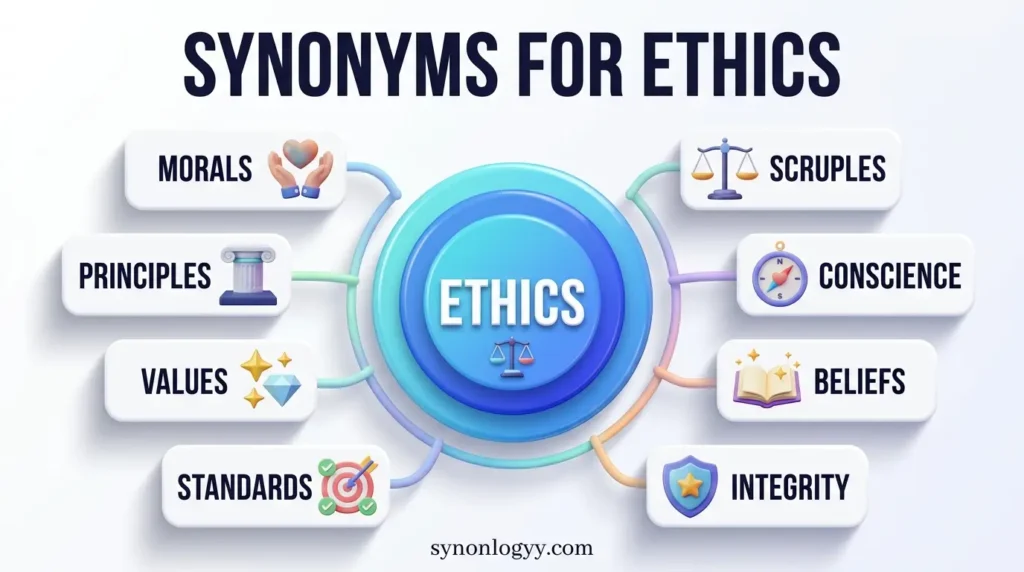
Synonyms for ethics help you describe moral rules, values, and right behavior. Ethics means the principles that guide people toward right and wrong.
Imagine finding a lost wallet at school. Returning it shows honesty and respect for others. These values are part of ethics.
People often use this word in schools, workplaces, business, and daily life. It helps us discuss fair choices and responsible actions. However, repeating the same word can make writing less clear.
Learning similar words helps ESL learners build stronger vocabulary. It also helps students and content writers explain ideas with greater care.
Some alternatives focus on morals, while others describe rules or personal values. This guide covers the meaning, history, pronunciation, and grammar of ethics.
You will also learn 30 synonyms with simple meanings and real examples. These tips will help you choose the right word for each situation.
Quick List: Ethics Synonyms at a Glance
These words relate to ethics, moral values, and standards for right behavior, but each has its own shade of meaning.
Morality, morals, principles, values, integrity, righteousness, virtue, conscience, moral code, code of conduct, standards, guidelines, beliefs, ideals, fairness, honesty, justice, decency, responsibility, accountability, professionalism, probity, uprightness, rectitude, honor, good character, ethical standards, moral principles, social responsibility, professional conduct.
Meaning of Ethics
Definition
Ethics (noun): The principles and rules that help people decide what is right and wrong.
Ethics can guide personal choices and professional behavior. It helps people think about fairness, honesty, and the effects of their actions.
Different cultures and professions may follow different ethical standards.
Examples
- Medical ethics guide doctors when making difficult treatment choices.
- The company follows strong ethics when handling customer data.
Common Collocations
These phrases often appear in education, business, and professional writing.
- Professional ethics: Professional ethics guide our daily work.
- Business ethics: Business ethics shape fair company decisions.
- Ethical standards: Ethical standards protect people from harm.
- Code of ethics: Every worker received a code of ethics.
- Ethics committee: The ethics committee reviewed the study.
Connotative Meaning
(Connotation means the feeling or idea a word brings to mind.)
- Positive tone: Ethics suggests fairness, honesty, care, and responsible choices.
- Negative tone: Poor ethics suggests unfair actions, abuse of trust, or a lack of moral care.
- Neutral tone: Ethics can describe the study of moral questions without praising or blaming anyone.
The word often carries a positive meaning in daily speech. In academic writing, it can also name a field of study. Its exact meaning depends on the subject and context.
Etymology of Ethics
The word ethics comes from Greek ēthikos, meaning moral or relating to character. This Greek word comes from ēthos, meaning character, custom, or habit.
The term passed into English through Latin ethica and French influence. It became a name for the study of moral principles and right conduct.
Today, people use it in philosophy, medicine, education, business, and public life.
Old English (450–1100)
The modern word ethics was not a standard Old English term. Old English had other words for moral behavior, custom, and character. The word’s roots come from Greek rather than Old English.
Middle English (1100–1500)
The word entered English through learned writing and the study of classical philosophy. Greek and Latin works helped shape its use. It became linked to questions about right conduct and good character.
Modern English (1500–Present)
Today, ethics can mean the study of right and wrong. It can also refer to the rules that guide a group or profession. For example, medical ethics and business ethics address different kinds of moral choices.
The word remains closely tied to character, values, and conduct. However, ethics can involve hard choices where people disagree about what is right.
Pronunciation of Ethics (IPA)
- IPA (US): /ˈɛθɪks/
- IPA (UK): /ˈɛθɪks/
- Syllables: Two syllables.
- Simple pronunciation: ETH-iks.
The first syllable sounds like the start of ethical. The second syllable sounds like icks. Place stress on the first syllable when saying the word.
Affixation Pattern of Ethics
Root
Ethic: A principle or belief about right and wrong. The word comes from Greek roots linked to character and custom.
Prefix
There is no prefix in the basic word ethics. Its meaning comes from the root rather than an added beginning.
Suffix
The ending -s marks the plural form of ethic. In common use, ethics often names a field or system of moral principles. It can take a singular verb when it refers to a field of study.
Word Formations
- Ethic (noun): A moral principle or guiding belief.
- Ethics (noun): Moral principles or the study of right and wrong.
- Ethical (adjective): Relating to moral principles or right conduct.
- Ethically (adverb): In a way that follows moral principles.
- Unethical (adjective): Not following accepted moral principles.
- Unethically (adverb): In a way that breaks moral standards.
- Ethicist (noun): A person who studies or advises on ethical questions.
Examples:
- Her work ethic helped her finish each task.
- The doctor made an ethical choice.
- The firm acted ethically during the review.
- The manager rejected the unethical request.
- The company handled the issue unethically.
- An ethicist joined the panel to discuss the case.
These forms share a common root, but their roles differ. Use ethics for principles or their study. Use ethical to describe an action, and ethically to explain how someone acts.
30 Synonyms of Ethics With Meaning & Examples
The best synonym depends on what you mean by ethics. Some words describe moral rules, while others focus on personal character or fair conduct.
The examples below show how each word works in context.
1. Morality (noun)
Meaning: Morality is the set of ideas about what is right and wrong.
Best used when / Tone: General, academic, widely useful.
Examples:
- The class discussed morality through stories about difficult choices.
- Her sense of morality guided her decision to return the money.
2. Morals (noun)
Meaning: Morals are beliefs about right and wrong behavior.
Best used when / Tone: Common, personal, conversational.
Examples:
- His parents taught him strong morals from childhood.
- The film asks viewers to think about their morals.
3. Principles (noun)
Meaning: Principles are basic beliefs that guide decisions and actions.
Best used when / Tone: General, professional, direct.
Examples:
- She refused to change her principles for a promotion.
- The coach taught principles of fairness and respect.
4. Values (noun)
Meaning: Values are beliefs about what matters most in life.
Best used when / Tone: Common, personal, broad.
Examples:
- Their family values shaped how they treated guests.
- The company lists honesty among its core values.
5. Integrity (noun)
Meaning: Integrity means being honest and following strong moral principles.
Best used when / Tone: Positive, formal, character-focused.
Examples:
- The judge earned respect through years of integrity.
- At work, integrity means admitting mistakes instead of hiding them.
6. Righteousness (noun)
Meaning: Righteousness is the quality of acting in a morally right way.
Best used when / Tone: Formal, strong, sometimes religious.
Examples:
- The story praises righteousness in the face of greed.
- His sense of righteousness led him to defend the weaker student.
7. Virtue (noun)
Meaning: Virtue is a good moral quality, such as honesty or kindness.
Best used when / Tone: Positive, formal, traditional.
Examples:
- Patience is a virtue that helps families solve problems.
- The teacher praised courage as a virtue in the school assembly.
8. Conscience (noun)
Meaning: Conscience is the inner sense that helps someone judge right and wrong.
Best used when / Tone: Personal, thoughtful, emotional.
Examples:
- Her conscience troubled her after she blamed her brother.
- He followed his conscience and reported the missing funds.
9. Moral code (noun)
Meaning: A moral code is a set of rules about right and wrong.
Best used when / Tone: Clear, formal, explanatory.
Examples:
- The group followed a moral code built on respect.
- A soldier’s moral code shaped how he treated prisoners.
10. Code of conduct (noun)
Meaning: A code of conduct lists the behavior expected from a group.
Best used when / Tone: Formal, workplace, institutional.
Examples:
- Every new employee signed the code of conduct.
- The sports club updated its code of conduct after complaints.
11. Standards (noun)
Meaning: Standards are accepted levels of behavior or quality.
Best used when / Tone: Neutral, professional, practical.
Examples:
- The school set standards for fair student treatment.
- High standards helped the clinic protect patient privacy.
12. Guidelines (noun)
Meaning: Guidelines are instructions that help people make suitable choices.
Best used when / Tone: Neutral, practical, policy-focused.
Examples:
- The research team followed guidelines for working with children.
- Clear guidelines helped staff handle private records safely.
13. Beliefs (noun)
Meaning: Beliefs are ideas that someone accepts as true or important.
Best used when / Tone: General, personal, broad.
Examples:
- Her beliefs shaped how she cared for older relatives.
- The debate explored beliefs about fairness and human rights.
14. Ideals (noun)
Meaning: Ideals are high standards or goals that people hope to follow.
Best used when / Tone: Positive, thoughtful, aspirational.
Examples:
- The campaign promoted ideals of equality and peace.
- He kept his ideals even when the project became difficult.
15. Fairness (noun)
Meaning: Fairness means treating people in a just and equal way.
Best used when / Tone: Common, positive, practical.
Examples:
- Fairness mattered when the teacher graded each student’s work.
- The manager reviewed the schedule to ensure fairness for all workers.
16. Honesty (noun)
Meaning: Honesty means telling the truth and avoiding deceit.
Best used when / Tone: Simple, direct, widely understood.
Examples:
- Honesty helped the child explain what broke the window.
- The shop built customer trust through honesty about prices.
17. Justice (noun)
Meaning: Justice means treating people fairly and giving them what they are due.
Best used when / Tone: Formal, social, legal.
Examples:
- The lawyer worked for justice after the unfair dismissal.
- The students discussed justice during their history lesson.
18. Decency (noun)
Meaning: Decency means behaving in a way that shows respect and basic goodness.
Best used when / Tone: Common, warm, everyday.
Examples:
- Simple decency led the neighbor to help carry groceries.
- The host showed decency by welcoming every guest.
19. Responsibility (noun)
Meaning: Responsibility means having a duty to act carefully and accept the results.
Best used when / Tone: General, practical, professional.
Examples:
- Responsibility meant checking the facts before sharing the news.
- The team accepted responsibility for the mistake.
20. Accountability (noun)
Meaning: Accountability means being answerable for your actions and choices.
Best used when / Tone: Formal, workplace, leadership-focused.
Examples:
- Accountability helped the council explain its spending.
- The project leader took accountability for the missed deadline.
21. Professionalism (noun)
Meaning: Professionalism means acting with skill, respect, and proper work standards.
Best used when / Tone: Formal, workplace, career-focused.
Examples:
- Her professionalism showed during the tense client meeting.
- The nurse displayed professionalism while handling a difficult complaint.
22. Probity (noun)
Meaning: Probity means strong honesty and moral soundness.
Best used when / Tone: Very formal, legal, public service.
Examples:
- The report praised the official’s probity during the inquiry.
- Probity matters when public workers manage shared funds.
23. Uprightness (noun)
Meaning: Uprightness means behaving in an honest and morally sound way.
Best used when / Tone: Formal, traditional, character-focused.
Examples:
- Neighbors admired her uprightness during the land dispute.
- His uprightness made him a trusted school leader.
24. Rectitude (noun)
Meaning: Rectitude means firm commitment to moral correctness.
Best used when / Tone: Formal, literary, strong.
Examples:
- The biography describes the judge’s moral rectitude.
- Rectitude guided her choices during the public inquiry.
25. Honor (noun)
Meaning: Honor means strong respect for honesty, duty, and moral behavior.
Best used when / Tone: Positive, traditional, formal.
Examples:
- He kept his word because honor mattered to him.
- The award recognized honor and service in the community.
26. Good character (noun phrase)
Meaning: Good character means having traits such as honesty, kindness, and fairness.
Best used when / Tone: Simple, positive, personal.
Examples:
- The coach valued good character as much as talent.
- Her good character showed when she helped a rival.
27. Ethical standards (noun phrase)
Meaning: Ethical standards are rules that define acceptable moral behavior.
Best used when / Tone: Formal, professional, academic.
Examples:
- The lab raised its ethical standards for human studies.
- Ethical standards guided the journalist’s use of private sources.
28. Moral principles (noun phrase)
Meaning: Moral principles are beliefs that guide judgments about right and wrong.
Best used when / Tone: Formal, clear, educational.
Examples:
- The lesson explored moral principles through real court cases.
- Her moral principles shaped how she treated her employees.
29. Social responsibility (noun phrase)
Meaning: Social responsibility means considering how actions affect other people and society.
Best used when / Tone: Professional, community-focused, modern.
Examples:
- The business showed social responsibility by reducing waste.
- Social responsibility guided the charity’s plan to support local families.
30. Professional conduct (noun phrase)
Meaning: Professional conduct means behaving properly and responsibly in a work role.
Best used when / Tone: Formal, workplace, policy-focused.
Examples:
- The board reviewed professional conduct after the complaint.
- Professional conduct requires respect for clients and coworkers.
Synonym Comparison Table
| Synonym | Tone | Formality | Best for |
|---|---|---|---|
| Morality | General | Neutral | Ideas about right and wrong |
| Morals | Personal | Neutral | Individual beliefs about behavior |
| Principles | Clear | Neutral | Rules that guide choices |
| Values | Personal | Neutral | Beliefs about what matters |
| Integrity | Positive | Formal | Honesty and strong character |
| Virtue | Positive | Formal | Specific good moral qualities |
| Conscience | Thoughtful | Neutral | Inner judgment of right and wrong |
| Code of conduct | Official | Formal | Rules for groups or workplaces |
| Accountability | Professional | Formal | Taking responsibility for actions |
| Ethical standards | Technical | Formal | Rules in a field or organization |
Choose morality when discussing right and wrong in general. Use integrity for a person’s honesty and code of conduct for written rules. The best choice depends on what your sentence describes.
Prototype Meaning of Ethics
The most typical meaning of ethics is a set of principles that guides right and wrong behavior.
People often picture honesty, fairness, respect, and responsibility when they hear the word.
Ethics can guide choices at home, school, work, and in public life. It can also refer to the formal study of moral questions.
For example, medical ethics helps health workers think through difficult care decisions.
Business ethics helps companies consider fair treatment and honest dealings. These uses share a focus on responsible choices, but they are not identical.
Some synonyms describe personal qualities, while others name rules or standards. Choose the term that matches the main idea you want to express.
Prototype Categorization of the 30 Synonyms
The 30 alternatives fit into several useful groups. Each group focuses on a different part of ethical thought or behavior.
- Moral beliefs and right conduct: Morality, morals, principles, values, beliefs, moral principles. Use these words to discuss what people believe is right or wrong.
- Personal character: Integrity, virtue, righteousness, conscience, decency, uprightness, rectitude, honor, good character, probity. These terms describe moral strength, honesty, and inner judgment.
- Rules and expected behavior: Moral code, code of conduct, standards, guidelines, ethical standards, professional conduct. Use these terms for rules that guide people in groups, schools, or workplaces.
- Fair treatment and justice: Fairness, justice, honesty. These words fit situations involving equal treatment, truth, and fair decisions.
- Duty and responsibility: Responsibility, accountability, social responsibility. Use these terms when people must consider the effects of their actions and answer for their choices.
- Workplace and professional behavior: Professionalism, professional conduct, ethical standards, accountability. These terms work well in business, medicine, education, and other fields.
- High goals and moral ideals: Ideals, honor, virtue, righteousness. Use these words when discussing moral goals or standards people hope to follow.
These groups help writers match a word to the exact point they want to make. A person’s integrity is not the same as an organization’s code of conduct.
Similar words may overlap, but they are not always interchangeable. Always consider the context, tone, and meaning before choosing an alternative.
Antonyms of Ethics
Ethics has no single perfect antonym because it can refer to both moral principles and their study. These contrasting terms describe behavior or attitudes that oppose ethical conduct.
- Immorality (noun): Behavior that goes against accepted moral standards. Example: The story shows how greed can lead to immorality.
- Unethical behavior (noun phrase): Actions that break accepted moral standards. Example: The company faced complaints about unethical behavior.
- Dishonesty (noun): A lack of truthfulness. Example: Dishonesty damaged trust between the business partners.
- Corruption (noun): The abuse of power for personal gain. Example: The report exposed corruption in the public office.
- Deceit (noun): The act of misleading someone through lies. Example: Deceit ended the agreement between the two firms.
- Injustice (noun): Unfair treatment or a lack of fairness. Example: The court case drew attention to injustice.
- Hypocrisy (noun): Claiming to follow standards that one’s actions do not support. Example: Voters criticized the leader’s hypocrisy.
- Irresponsibility (noun): A failure to act with proper care or duty. Example: Irresponsibility led to the loss of important records.
- Exploitation (noun): Unfairly using another person for personal gain. Example: The report described the exploitation of young workers.
- Misconduct (noun): Behavior that breaks accepted rules or duties. Example: The school investigated misconduct during the examination.
Short Questions and Answers
What does ethics mean?
Ethics means the principles used to judge right and wrong behavior. It helps people make choices based on honesty, fairness, and responsibility.
The word can also describe the study of moral questions. People often discuss ethics in business, medicine, education, and daily life.
When should ethics be used?
Use ethics when discussing moral principles, right conduct, or the study of moral questions. It works well in academic, professional, and everyday contexts.
For a specific situation, terms such as integrity, fairness, or code of conduct may express your meaning more clearly.
Is ethics positive or negative?
Ethics usually has a positive meaning because it relates to responsible and fair behavior. However, the word itself is neutral when naming a field of study or a set of rules.
Phrases such as poor ethics suggest behavior that fails to meet moral standards.
How is ethics different from similar words?
Ethics refers to principles or the study of right and wrong. Morality focuses on beliefs about right and wrong, while integrity describes honest personal behavior.
Values are beliefs about what matters, and a code of conduct lists expected actions for a group.
What is the best synonym for ethics in formal writing?
Morality is a useful alternative when discussing right and wrong in general. For workplace rules, ethical standards or code of conduct may fit better.
If you describe a person’s honesty, integrity is often more precise. Always match the word to your intended meaning.
What is a simple word to use instead of ethics?
Morals is a simple alternative when talking about beliefs about right and wrong. Values works when discussing what people consider important.
For rules at work or school, standards may fit better. The best choice depends on the sentence and its main idea.
Conclusion
Learning synonyms for ethics helps you discuss right and wrong with greater care. Words such as morality, integrity, and fairness describe different parts of ethical behavior.
Choosing the right term makes your writing clearer and reduces repeated words. It also helps you explain ideas with more confidence.
For ESL learners, these alternatives build vocabulary and improve reading skills. Students can use them in essays, while content writers can make their work more precise.
Remember that some words describe personal character, while others refer to rules or shared values. Check each word’s meaning before using it in a new context.
Practice with one new word each day. Write a sentence, check its meaning, and use it in conversation. With steady practice, you can improve your English and express your ideas clearly.