
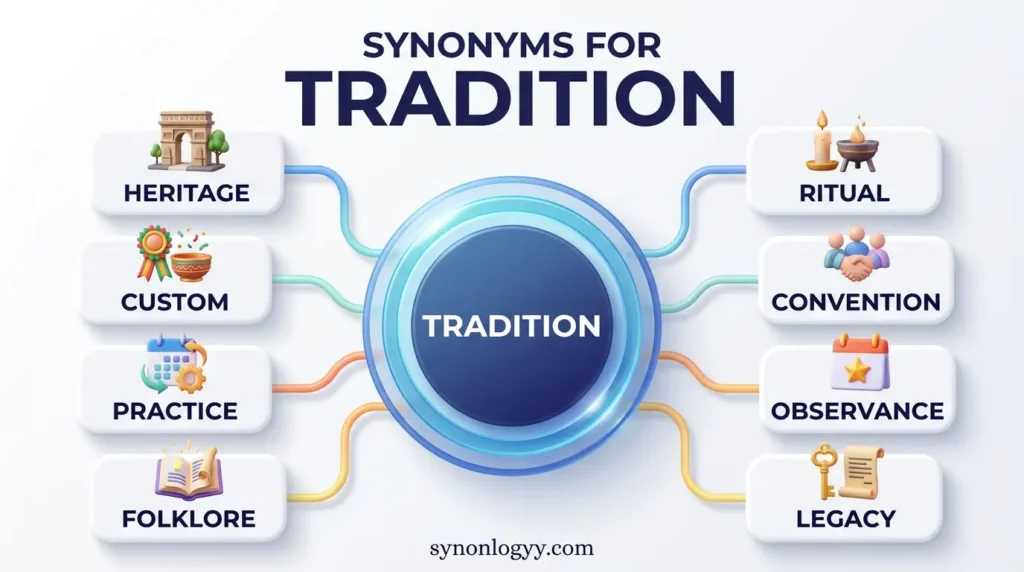
Tradition means a belief, custom, or way of doing things that people pass from one generation to the next.
For example, a family may have a tradition of eating dinner together every Sunday. People also follow traditions during weddings, festivals, and other special events.
The word tradition is common in daily life, culture, history, and writing. However, using the same word again and again can make your writing sound dull.
Learning synonyms helps you express your ideas in fresh and clear ways. It also helps English learners build vocabulary and speak with more confidence.
In this guide, you will learn 30 synonyms for tradition, their simple meanings, and examples. You will also explore the word’s history, pronunciation, grammar, antonyms, and different meanings.
This will help you choose the right word for schoolwork, essays, blog posts, and everyday conversations.
Meaning of Tradition
Definition
Tradition (noun): A belief, custom, or practice that people follow and pass down through generations.
Examples
- It is our family tradition to decorate the house at Christmas.
- The village keeps its old traditions alive through music and dance.
Connotative Meaning
Connotation (the feeling or idea a word suggests beyond its basic meaning).
- Positive tone: A sense of belonging, pride, and respect for the past.
- Negative tone: A practice that may seem old-fashioned or resistant to change.
- Neutral tone: A custom or practice followed by a group over time.
Etymology
The word tradition comes from the Latin word traditio, meaning “handing over” or “delivery.” It is linked to the Latin verb tradere, meaning “to hand over” or “to pass on.”
- Old English (450–1100): The modern word tradition was not commonly used in Old English. Related ideas were expressed through words for customs, teachings, and inherited practices.
- Middle English (1100–1500): The word entered English through Old French tradicion, from Latin traditio. It was often linked to the passing down of religious teachings and beliefs.
- Modern English (1500–present): Tradition grew to mean customs, beliefs, and practices passed from one generation to another, within families, communities, and societies.
Pronunciation (IPA)
- IPA: /trəˈdɪʃən/
- Syllables: tra-di-tion (3 syllables)
Affixation Pattern of Tradition
- Root: Tradit- — linked to the idea of handing down or passing on.
- Prefix: None in the standard modern word.
- Suffix: -ion — forms a noun that names an action, process, or result.
Word formations
- Tradition (noun): A custom passed down over time.
- Traditional (adjective): Based on or following tradition.
- Traditionally (adverb): In a way that follows tradition.
- Traditionalist (noun): A person who supports traditional beliefs or practices.
- Traditionalism (noun): Support for established customs and beliefs.
- Nontraditional (adjective): Not following established customs.
- Untraditional (adjective): Different from what is traditional.
- Traditions (plural noun): More than one tradition.
30 Synonyms of Tradition With Meaning & Examples
These words are related to tradition, but they do not all mean exactly the same thing. Choose the word that best fits your sentence.
1. Custom (Noun)
Meaning: A common way of behaving that a group follows over time.
Examples:
- It is a local custom to greet elders with respect.
- The family follows a custom of sharing food with neighbors.
2. Practice (Noun)
Meaning: An action or way of doing something that people follow regularly.
Examples:
- Giving gifts is a common practice during the festival.
- The school has a practice of honoring its former teachers.
3. Convention (Noun)
Meaning: A usual or accepted way of doing something in a group or society.
Examples:
- Wearing formal clothes is a convention at many business events.
- The writer followed the conventions of academic writing.
4. Ritual (Noun)
Meaning: An action or series of actions performed in a set way, often for cultural or religious reasons.
Examples:
- Lighting candles is part of the wedding ritual.
- The morning ritual brings peace to her day.
5. Heritage (Noun)
Meaning: The culture, history, and customs passed down from earlier generations.
Examples:
- The museum protects the country’s rich heritage.
- Traditional music is an important part of our heritage.
6. Legacy (Noun)
Meaning: Something valuable, such as a belief or practice, left by earlier generations.
Examples:
- Her grandmother left a legacy of kindness.
- The festival is a lasting legacy of the town’s past.
7. Rite (Noun)
Meaning: A formal act or ceremony linked to religion or an important life event.
Examples:
- The coming-of-age rite marks a new stage of life.
- The ceremony included an ancient religious rite.
8. Ceremony (Noun)
Meaning: A formal event held to mark a special occasion.
Examples:
- The wedding ceremony followed local customs.
- The school holds a ceremony every year to honor its founders.
9. Observance (Noun)
Meaning: The act of following or marking a custom, rule, or special day.
Examples:
- The observance of the holiday brings families together.
- Their observance of the old custom continues today.
10. Usage (Noun)
Meaning: A customary or accepted way of doing or saying something.
Examples:
- This greeting reflects a common usage in the region.
- Language usage can change over time.
11. Habit (Noun)
Meaning: An action that a person does regularly, often without thinking.
Examples:
- Reading together at bedtime became a family habit.
- She has a habit of calling her parents every Sunday.
12. Norm (Noun)
Meaning: A behavior or practice that a group considers usual or acceptable.
Examples:
- Respecting older people is a social norm in many communities.
- The new rule challenged the old workplace norm.
13. Convention (Noun)
Meaning: An established social rule or expectation that people generally follow.
Examples:
- It was a convention to bring a small gift when visiting.
- The event followed the usual social conventions.
14. Precedent (Noun)
Meaning: An earlier action or example that guides later actions.
Examples:
- The decision set a precedent for future leaders.
- The court looked at a legal precedent from an earlier case.
15. Folklore (Noun)
Meaning: Traditional stories, beliefs, and customs shared by a community.
Examples:
- Local folklore tells stories about a hidden lake.
- The book explores the folklore of the region.
16. Culture (Noun)
Meaning: The shared beliefs, customs, arts, and ways of life of a group.
Examples:
- Food plays a major role in their culture.
- The festival celebrates the culture of the community.
17. Inheritance (Noun)
Meaning: Something passed down from earlier generations, including customs or beliefs.
Examples:
- Their language is an important cultural inheritance.
- The family treats its old recipes as an inheritance from the past.
18. Institution (Noun)
Meaning: An established custom, practice, or system that has an important place in society.
Examples:
- The annual fair has become a local institution.
- The monarchy is a long-standing institution in that country.
19. Doctrine (Noun)
Meaning: A set of beliefs or principles taught and accepted by a group.
Examples:
- The religious doctrine has guided the community for centuries.
- Students studied the doctrine behind the movement.
20. Principle (Noun)
Meaning: A basic belief or rule that guides how people act.
Examples:
- Honesty is a principle passed down in her family.
- The group follows the principle of helping those in need.
21. Tenet (Noun)
Meaning: A central belief or idea held by a group.
Examples:
- Respect for nature is a key tenet of their philosophy.
- The teacher explained a basic tenet of the faith.
22. Routine (Noun)
Meaning: A regular series of actions done in the same way.
Examples:
- Their Sunday lunch has become a family routine.
- The daily routine includes a short prayer.
23. Pattern (Noun)
Meaning: A repeated way of acting or doing something.
Examples:
- The pattern of family gatherings continued for years.
- The community has a pattern of celebrating each harvest.
24. Way (Noun)
Meaning: A particular method or style of doing something.
Examples:
- This is our family’s way of celebrating birthdays.
- The village has its own way of welcoming guests.
25. Form (Noun)
Meaning: An established type or style of an activity or practice.
Examples:
- The dance is an old form of cultural expression.
- This form of storytelling has survived for generations.
26. Formality (Noun)
Meaning: A formal action or procedure followed because it is expected.
Examples:
- The greeting was a formality at the official event.
- Exchanging gifts became a formality during the annual meeting.
27. Rule (Noun)
Meaning: A statement that guides or controls how people should act.
Examples:
- The family has a rule of eating together on holidays.
- The old rule has guided the group for many years.
28. Heritage practice (Noun phrase)
Meaning: An activity maintained to preserve a community’s cultural history.
Examples:
- Weaving is a heritage practice in the village.
- The school teaches a heritage practice to younger students.
29. Old custom (Noun phrase)
Meaning: A practice that has been followed for a long time.
Examples:
- The town still follows an old custom during harvest season.
- Sharing bread with guests is an old custom in the region.
30. Handed-down practice (Noun phrase)
Meaning: An activity or method passed from one generation to the next.
Examples:
- Making this dish is a handed-down practice in our family.
- The craft remains a handed-down practice among local artists.
Quick tip: Custom, practice, and convention are useful general alternatives. Use heritage for culture and history, ritual for repeated symbolic acts, and legacy for something meaningful left by the past.
Prototype Meaning
The most typical meaning of tradition is a custom, belief, or practice passed from older generations to younger ones.
When people hear this word, they may think of family gatherings, holiday meals, wedding customs, religious ceremonies, or cultural festivals.
Tradition often connects people to their past and gives them a sense of identity and belonging. It can be a small family habit or a major practice shared by an entire nation.
Prototype Categorization
The 30 synonyms above fit into several semantic categories. Understanding these groups helps you select a word that matches your meaning and tone.
- Customs and social practices: Custom, practice, convention, usage, norm, old custom. These words describe accepted ways of behaving in a group.
- Religious and formal activities: Ritual, rite, ceremony, observance, formality. Use these for special events, sacred acts, and formal occasions.
- Culture and history: Heritage, folklore, culture, inheritance, heritage practice, handed-down practice. These words highlight the connection between the past and the present.
- Beliefs and ideas: Doctrine, principle, tenet. These words focus on the ideas that guide a group or community.
- Repeated actions: Habit, routine, pattern, way, form. These describe actions or methods that people repeat over time.
- Established systems and examples: Institution, precedent, rule. These words refer to lasting systems, accepted guidelines, or earlier examples that influence later behavior.
- What the past leaves behind: Legacy. This word emphasizes the lasting effect or value of something passed down.
Choosing synonyms by category helps writers avoid repetition while keeping their meaning clear. Remember that related words are not always interchangeable.
For example, heritage refers to what a group inherits from its past, while ritual refers to a specific repeated act.
Antonyms of Tradition
Tradition has no single perfect antonym. The best opposite depends on whether you mean old customs, established beliefs, or repeated practices.
1. Innovation (Noun)
Meaning: A new idea, method, or product.
Example: Innovation helped the company change its old methods.
2. Novelty (Noun)
Meaning: The quality of being new or unusual.
Example: The design stood out because of its novelty.
3. Change (Noun)
Meaning: The act of becoming different.
Example: The community welcomed change after many years.
4. Modernity (Noun)
Meaning: The quality of being modern rather than following older ways.
Example: The building combines modernity with classic design.
5. Revolution (Noun)
Meaning: A major and often sudden change in a system or way of life.
Example: The industrial revolution changed traditional work patterns.
6. Unconventionality (Noun)
Meaning: The quality of not following usual customs or accepted practices.
Example: Her unconventionality made her work stand out.
7. Originality (Noun)
Meaning: The quality of being new, creative, or different from what already exists.
Example: The artist’s originality impressed the judges.
Short Questions and Answers
What does tradition mean?
Tradition is a custom, belief, or practice passed down through generations.
When should tradition be used?
Use tradition when discussing long-standing family customs, cultural practices, religious beliefs, or social habits.
Is tradition positive or negative?
Tradition is usually neutral. It can have a positive meaning when it preserves culture and brings people together, but it may sound negative when it prevents useful change.
How is tradition different from similar words?
Tradition refers to a practice or belief passed down over time. Custom is a common way of behaving, ritual is a repeated symbolic act, and heritage refers to the culture and history inherited from earlier generations.
Conclusion
Learning the meaning of tradition and its synonyms can improve your English vocabulary and make your writing more effective.
Words such as custom, practice, heritage, ritual, and legacy help you express different ideas without repeating the same word.
Each synonym has its own meaning, so choosing the right one makes your message clearer and more natural.
These words are useful in essays, schoolwork, blog posts, speeches, and everyday conversations. Understanding their differences also helps you read with greater confidence and express your thoughts more precisely.
Try learning a few synonyms each day and using them in your own sentences. With regular practice, you can build a stronger vocabulary, improve your speaking and writing skills, and feel more confident when using English.

