The word us is a pronoun that means the speaker and one or more other people. For example, a student might say, “The teacher helped us with our homework.”
Here, us refers to the student and other people in the group. We use this word every day when we talk about family, friends, work, and shared experiences.
Learning synonyms for us can help you find better ways to express the same idea. However, us is a personal pronoun, so it does not have many direct synonyms.
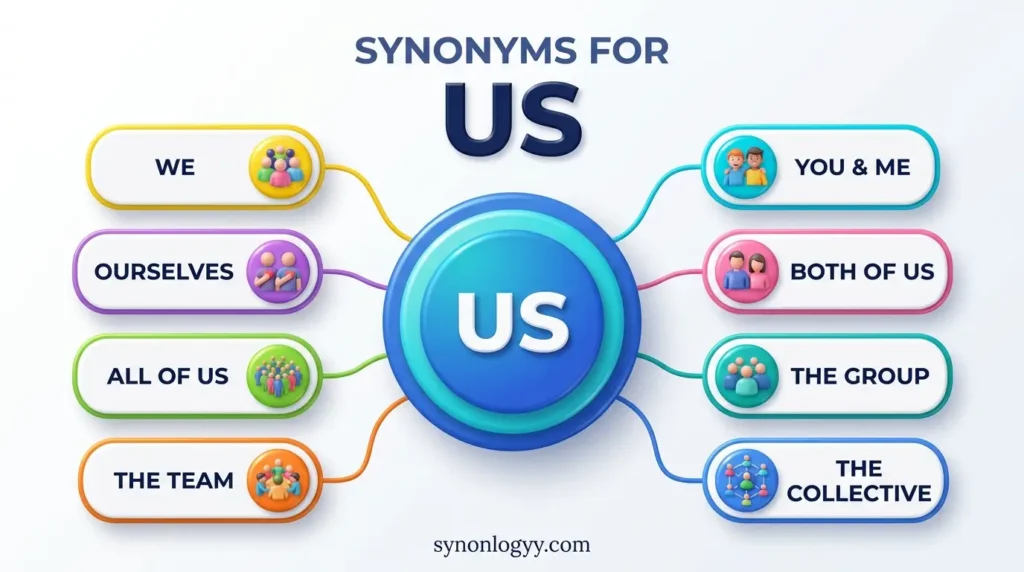
Words and phrases such as our group, all of us, you and me, and the team may work in certain situations, but they are not always interchangeable.
This guide explains the meaning, origin, pronunciation, and grammar of us. It also provides 30 related alternatives, examples, and tips to help you choose the right expression.
Meaning of Us
Definition
Us (Pronoun): A word used to refer to the speaker and one or more other people when they receive an action or are affected by it.
Examples
- My friends invited us to dinner.
- The coach taught us a new skill.
Connotative Meaning
Connotation (the feelings or ideas a word suggests beyond its basic meaning):
- Positive tone: Us can suggest unity, friendship, and belonging.
- Negative tone: It can suggest an exclusive group when people use it to separate themselves from others.
- Neutral tone: It simply refers to the speaker and other people.
Etymology
The word us comes from Old English ūs, the object form of we. Its roots go back to early Germanic languages and an older Indo-European pronoun.
- Old English (450–1100): Ūs was used as the object form of we.
- Middle English (1100–1500): The word developed into the form us, with spelling and pronunciation changes over time.
- Modern English (1500–Present): Us remains the standard object pronoun for referring to the speaker and other people.
Pronunciation (IPA)
- IPA: /ʌs/ in most American English accents; /əs/ is also common in unstressed speech.
- Syllables: One syllable.
- Pronunciation tip: The vowel sounds like the vowel in cup in many English accents.
Affixation Pattern of Us
- Root: Us
- Prefix: None.
- Suffix: None.
Word Formations
Us does not form a large family of words through prefixes or suffixes. These related pronoun forms are useful to learn:
- We (pronoun): The subject form of us. Example: We are ready.
- Us (pronoun): The object form. Example: They helped us.
- Our (determiner): Shows that something belongs to the speaker and others. Example: Our house is clean.
- Ours (pronoun): Shows ownership. Example: This seat is ours.
- Ourselves (reflexive pronoun): Refers back to the group. Example: We prepared ourselves.
30 Synonyms for Us With Meaning & Examples
Important: Us has no exact synonym that fits every sentence. The following are related words and phrases that can replace it in specific contexts. Always check the meaning and grammar before using an alternative.
1. All of Us (Pronoun Phrase)
Meaning: Every person in the group that includes the speaker.
Examples:
- All of us enjoyed the trip.
- The teacher asked all of us to sit down.
2. We (Pronoun)
Meaning: The subject form used to refer to the speaker and other people.
Examples:
- We went to the park.
- We finished the project together.
Note: Use we as the subject, not as a direct replacement for us in every sentence.
3. Our Group (Noun Phrase)
Meaning: The people who belong to the same group as the speaker.
Examples:
- Our group won the contest.
- The guide showed our group the way.
4. Our Team (Noun Phrase)
Meaning: The speaker and other people working toward a shared goal.
Examples:
- The coach praised our team.
- The manager invited our team to lunch.
5. Our Family (Noun Phrase)
Meaning: The speaker and their family members.
Examples:
- The news made our family happy.
- The host welcomed our family.
6. Our Friends (Noun Phrase)
Meaning: The speaker and other people who share a friendship.
Examples:
- The neighbors invited our friends.
- The teacher met our friends after school.
7. You and Me (Pronoun Phrase)
Meaning: The person being spoken to and the speaker.
Examples:
- The photo shows you and me.
- The coach chose you and me for the task.
8. You and Us (Pronoun Phrase)
Meaning: The person being spoken to and the speaker’s group.
Examples:
- The plan will help you and us.
- The guide invited you and us to join the tour.
9. Everyone in Our Group (Noun Phrase)
Meaning: Every person who belongs to the speaker’s group.
Examples:
- Everyone in our group received a badge.
- The rules apply to everyone in our group.
10. Each of Us (Pronoun Phrase)
Meaning: Every person in the group considered one at a time.
Examples:
- Each of us received a gift.
- The task gave each of us a chance to learn.
11. Both of Us (Pronoun Phrase)
Meaning: The speaker and one other person.
Examples:
- The teacher helped both of us.
- The decision affected both of us.
12. The Two of Us (Pronoun Phrase)
Meaning: The speaker and one other person considered together.
Examples:
- The guide led the two of us to the exit.
- The story reminded the two of us of home.
13. All the Members (Noun Phrase)
Meaning: Every person who belongs to a group.
Examples:
- The leader thanked all the members.
- The award was presented to all the members.
14. The Team (Noun Phrase)
Meaning: A group of people who work or act together.
Examples:
- The coach encouraged the team.
- The new plan helped the team improve.
15. The Group (Noun Phrase)
Meaning: A number of people considered together.
Examples:
- The guide led the group inside.
- The event brought the group together.
16. The Family (Noun Phrase)
Meaning: A group of related people.
Examples:
- The host welcomed the family.
- The news surprised the family.
17. The Class (Noun Phrase)
Meaning: A group of students learning together.
Examples:
- The teacher praised the class.
- The new activity excited the class.
18. The Committee (Noun Phrase)
Meaning: A group chosen to discuss or manage a task.
Examples:
- The chairperson thanked the committee.
- The proposal gave the committee more work.
19. The Staff (Noun)
Meaning: The people who work for an organization.
Examples:
- The manager thanked the staff.
- The new policy affected the staff.
20. The Community (Noun)
Meaning: People who live in or share a particular place or interest.
Examples:
- The project helped the community.
- The news brought the community together.
21. The Participants (Noun)
Meaning: People who take part in an activity or event.
Examples:
- The host welcomed the participants.
- The trainer gave the participants a short break.
22. The Audience (Noun)
Meaning: People who watch or listen to a show, speech, or event.
Examples:
- The speaker thanked the audience.
- The performance amazed the audience.
23. The Players (Noun)
Meaning: People who take part in a game or sport.
Examples:
- The coach congratulated the players.
- The new strategy helped the players.
24. The Volunteers (Noun)
Meaning: People who offer to help without being forced.
Examples:
- The organizer thanked the volunteers.
- The event gave the volunteers useful experience.
25. The Children (Noun)
Meaning: Young people in a particular group.
Examples:
- The teacher took the children outside.
- The story taught the children a lesson.
26. The Guests (Noun)
Meaning: People invited to a place or event.
Examples:
- The host welcomed the guests.
- The meal pleased the guests.
27. The Neighbors (Noun)
Meaning: People who live near the speaker or their group.
Examples:
- The news surprised the neighbors.
- The storm forced the neighbors to leave their homes.
28. The People Involved (Noun Phrase)
Meaning: The people who take part in or are affected by a situation.
Examples:
- The decision affected the people involved.
- The manager listened to the people involved.
29. Our Side (Noun Phrase)
Meaning: The speaker’s team or group in a contest, debate, or conflict.
Examples:
- The referee warned our side.
- The final goal helped our side win.
30. People Like Us (Noun Phrase)
Meaning: People who share similar experiences, qualities, or circumstances with the speaker.
Examples:
- The story inspires people like us.
- The program offers support to people like us.
Prototype Meaning
The main meaning of us is the speaker together with one or more other people, viewed as the object of an action or the person or group affected by something.
For example, in “She helped us,” the word us refers to the speaker and other people who received help.
People often use it when talking about shared plans, feelings, experiences, or tasks.
Although many phrases can refer to the same group, the best choice depends on who is included and how the sentence is built.
Prototype Categorization
The alternatives can be grouped by the type of people they describe. These categories help writers choose a clear phrase instead of repeating us.
- The whole group: All of us, everyone in our group, all the members. Use these when you mean every person.
- A group of two: Both of us, the two of us, you and me. Use these when referring to two people.
- Shared identity: Our group, our team, our family, our friends, our side, people like us. Use these when the group has a shared connection.
- Formal or organized groups: The committee, the staff, the participants, the volunteers. Use these in work, school, and formal writing.
- Social or public groups: The community, the audience, the guests, the neighbors, the children, the players, the class. Use these when the people have a specific role or relationship.
- People connected to a situation: The group, the team, the family, the people involved. Use these when the context makes the group’s identity clear.
- Subject and object forms: We and us. Use we for the subject of a sentence and us for the object.
These categories help you avoid grammar mistakes. For example, say “They helped us,” but “We helped them.” The right pronoun depends on the role it plays in the sentence.
Antonyms of Us
Us is a pronoun, so it has no direct antonym. These words and phrases can express contrast, depending on the context.
1. Them (Pronoun)
Meaning: People or things being spoken about, rather than the speaker’s group.
2. They (Pronoun)
Meaning: The subject form used for people or things other than the speaker’s group.
3. Others (Pronoun)
Meaning: People who are separate from the group being discussed.
4. Outsiders (Noun)
Meaning: People who do not belong to a particular group.
5. Opponents (Noun)
Meaning: People who compete against or disagree with a group.
Short Questions and Answers
What does us mean?
Us refers to the speaker and one or more other people when they receive an action or are affected by something.
When should us be used?
Use us as an object pronoun, such as in “Please help us” or “She spoke to us.”
Is us positive or negative?
Us is neutral. It can suggest unity and belonging in some situations, but it may also create a sense of separation between groups.
How is us different from similar words?
Us is an object pronoun, while we is a subject pronoun. Phrases such as all of us and our group can refer to the same people but add emphasis or describe the group more clearly.
Conclusion
Learning alternatives to us can improve your English vocabulary and help you express ideas more clearly.
Phrases such as all of us, both of us, our team, and the people involved can add detail and reduce repetition.
However, these expressions are not exact synonyms in every sentence, so it is important to understand their meanings and grammar.
The key is to choose words that fit the people and situation you are describing. Practicing these expressions can improve your writing, speaking, and confidence in English.
Try making a few sentences each day with we, us, and related phrases. With regular practice, you will learn to use pronouns correctly and express shared experiences in a more natural way.