Synonyms easy to learn are words that share a similar meaning. They help you express your thoughts in clear and simple ways.
For example, instead of saying “The test was easy,” you can say “The test was simple.” Both sentences tell readers that the test was not hard.
The word easy is common in daily English. People use it when they talk about school, work, home tasks, and everyday problems.
Learning words with similar meanings helps you speak with confidence. It also helps you write better sentences without using the same word again and again.
For ESL learners, students, and content writers, synonyms make English more useful. However, not every similar word fits every sentence.
This guide explains the meaning of easy, its pronunciation, grammar, history, and 30 useful synonyms. You will also find examples, antonyms, and tips for choosing the right word.
Quick List: Easy Synonyms at a Glance
These 30 words can replace easy in different situations, depending on the meaning you need.
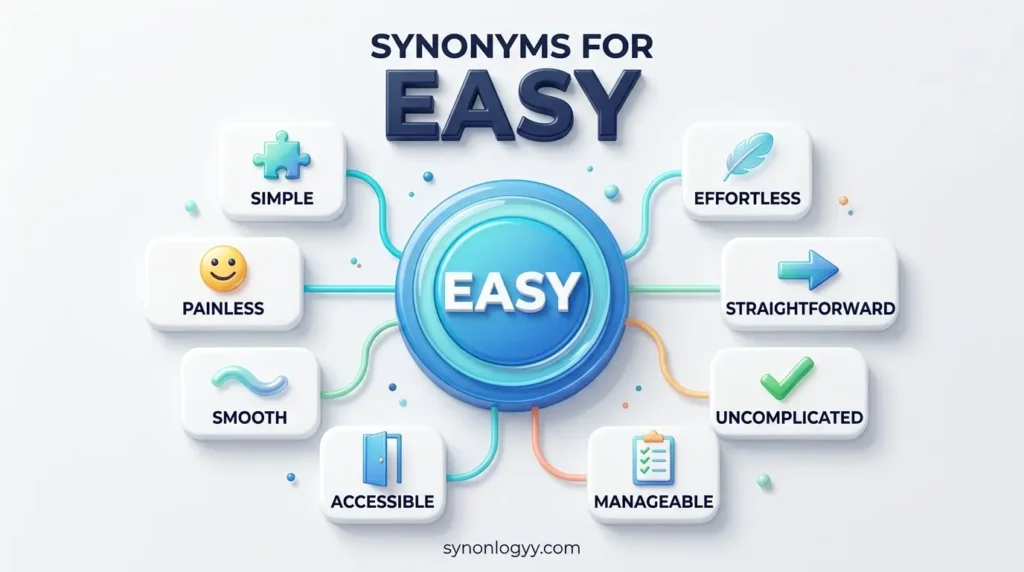
Simple, effortless, straightforward, uncomplicated, clear, painless, manageable, undemanding, trouble-free, smooth, convenient, accessible, achievable, attainable, feasible, practical,
elementary, basic, plain, obvious, natural, informal, relaxed, comfortable, light, gentle, undemanding, unchallenging, user-friendly, easygoing.
Note: “Undemanding” appears only once in the numbered list below. Some words fit specific meanings of “easy,” so check their examples before using them.
Meaning of Easy
Definition
Easy (adjective): Not difficult to do, understand, achieve, or experience.
The word can describe a task, a question, a person, or a situation. It can also describe something that requires little effort.
Examples
- This math problem is easy to solve.
- My grandmother found an easy way to open the jar.
Common Collocations
These word pairs often appear in everyday English.
- Easy task: This is an easy task.
- Easy answer: She gave an easy answer.
- Easy access: The room offers easy access.
- Easy choice: Buying the blue shirt was an easy choice.
- Easy to use: This app is easy to use.
Connotative Meaning
Connotation is the feeling or idea a word suggests beyond its basic meaning.
- Positive tone: Easy can suggest comfort, success, or convenience.
- Negative tone: Easy can suggest a lack of challenge or effort.
- Neutral tone: Easy can simply describe something that is not difficult.
For example, an easy exam may please a student. An easy job may sound boring to someone who wants a challenge. The meaning depends on the situation.
Etymology of Easy
The word easy entered English through Old French. It came from the Old French word aisie, linked to comfort and convenience.
Its earlier roots trace back to Vulgar Latin adjacens, meaning “lying near” or “nearby,” though the exact historical path involves changes in meaning and form.
Over time, the word developed its modern sense of something that requires little effort.
- Old English (450–1100): The modern word easy was not a regular Old English form. People used other words to express ideas such as comfort and lack of difficulty.
- Middle English (1100–1500): Forms related to Old French aisie entered English. They developed into words used to describe comfort, convenience, and a lack of trouble.
- Modern English (1500–Present): Easy became a common word for tasks, ideas, choices, and situations that require little effort.
Today, the word appears in everyday speech, education, business, and digital content. Its meaning remains flexible because it can describe both mental and physical effort.
Pronunciation of Easy (IPA)
- IPA (US): /ˈiːzi/
- Syllables: Two — ea-sy
- Stress: The first syllable receives the main stress.
- Sound tip: The first sound is like the “ee” in see. The final sound is like the “zee” in busy.
Say it slowly: EE-zee.
Practice with this sentence: “The easy lesson helped me learn.”
Affixation Pattern of Easy
Understanding word forms helps you use easy correctly in different sentences.
- Root: Easy
- Prefix: None in the base word.
- Suffix: The ending -y is part of the established adjective. It is not usually added to a modern English root as a productive suffix in this word.
- Word formations:
- Easy (adjective): This lesson is easy.
- Easily (adverb): She solved the puzzle easily.
- Easiness (noun): The easiness of the task surprised us.
- Uneasy (adjective): He felt uneasy before the meeting.
- Uneasily (adverb): She smiled uneasily at the question.
- Uneasiness (noun): His uneasiness was clear.
- Ease (noun): She completed the work with ease.
- Ease (verb): A short break can ease stress.
- Eased (verb, past tense): The new rule eased the process.
- Easing (verb form or noun): The easing of restrictions helped families.
- Easier (comparative adjective): This method is easier than the old one.
- Easiest (superlative adjective): This is the easiest question.
These forms have different roles. Use easy to describe a thing, easily to describe an action, and ease as a noun or verb.
30 Synonyms of Easy With Meaning & Examples
The best synonym depends on what you mean by easy. Some words describe low effort, while others describe clear ideas or convenient methods.
1. Simple (adjective)
Meaning: Something is simple when it is easy to understand or do.
Best used when / Tone: Everyday, neutral, widely useful.
Examples:
- The teacher gave us a simple rule to follow.
- A simple recipe helped Dad prepare dinner.
2. Effortless (adjective)
Meaning: Something is effortless when it needs almost no effort.
Best used when / Tone: Positive, expressive.
Examples:
- Her effortless dance moves impressed the crowd.
- With practice, he made the difficult task look effortless.
3. Straightforward (adjective)
Meaning: Something is straightforward when it is clear and easy to handle.
Best used when / Tone: Neutral, professional.
Examples:
- The manager explained the straightforward hiring process.
- Following the map was straightforward for our group.
4. Uncomplicated (adjective)
Meaning: Something is uncomplicated when it has few problems or parts.
Best used when / Tone: Neutral, slightly formal.
Examples:
- We chose an uncomplicated plan for the school trip.
- Her uncomplicated instructions helped new staff members.
5. Clear (adjective)
Meaning: Something is clear when people can understand it without confusion.
Best used when / Tone: Neutral, educational.
Examples:
- The guide gave clear steps for setting up the printer.
- His clear explanation helped the class understand fractions.
6. Painless (adjective)
Meaning: Something is painless when it causes little trouble or discomfort.
Best used when / Tone: Informal, reassuring.
Examples:
- The website made paying the bill painless.
- A short review made exam preparation almost painless.
7. Manageable (adjective)
Meaning: Something is manageable when a person can deal with it successfully.
Best used when / Tone: Practical, reassuring.
Examples:
- Breaking the project into parts made it manageable.
- The family kept its monthly budget manageable.
8. Undemanding (adjective)
Meaning: Something is undemanding when it requires little effort or skill.
Best used when / Tone: Neutral, descriptive.
Examples:
- The librarian gave me an undemanding task during my first week.
- After a busy shift, he wanted an undemanding evening.
9. Trouble-free (adjective)
Meaning: Something is trouble-free when it happens without problems.
Best used when / Tone: Positive, practical.
Examples:
- Careful planning made the family trip trouble-free.
- The new update gave users a trouble-free setup.
10. Smooth (adjective)
Meaning: Something is smooth when it happens without difficulty or delay.
Best used when / Tone: Positive, conversational.
Examples:
- The meeting went smoothly despite the late start.
- Our move to the new office was smooth.
11. Convenient (adjective)
Meaning: Something is convenient when it fits your needs or saves time.
Best used when / Tone: Practical, everyday.
Examples:
- Online banking is convenient for busy workers.
- The store’s location makes shopping convenient for neighbors.
12. Accessible (adjective)
Meaning: Something is accessible when people can reach, use, or understand it.
Best used when / Tone: Inclusive, professional.
Examples:
- The library offers accessible books for young readers.
- The website makes health information accessible to everyone.
13. Achievable (adjective)
Meaning: Something is achievable when a person can reach it through effort.
Best used when / Tone: Positive, encouraging.
Examples:
- The coach set achievable goals for the new team.
- Saving five dollars each week felt achievable.
14. Attainable (adjective)
Meaning: Something is attainable when it can be reached or gained.
Best used when / Tone: Formal, goal-focused.
Examples:
- The scholarship made college more attainable for her.
- With steady practice, fluency became an attainable goal.
15. Feasible (adjective)
Meaning: Something is feasible when it can be done in practice.
Best used when / Tone: Formal, business-focused.
Examples:
- The team checked whether the launch date was feasible.
- A weekend visit was feasible within our budget.
16. Practical (adjective)
Meaning: Something is practical when it works well in real situations.
Best used when / Tone: Neutral, useful.
Examples:
- A backpack is a practical choice for daily travel.
- The teacher suggested a practical way to remember new words.
17. Elementary (adjective)
Meaning: Something is elementary when it involves basic knowledge or simple skills.
Best used when / Tone: Educational, sometimes formal.
Examples:
- The course teaches elementary computer skills.
- For an expert, these calculations were elementary.
18. Basic (adjective)
Meaning: Something is basic when it covers the main or simplest parts.
Best used when / Tone: Neutral, instructional.
Examples:
- The booklet explains basic rules of grammar.
- New cooks should learn basic knife skills first.
19. Plain (adjective)
Meaning: Something is plain when it is simple and has few extra details.
Best used when / Tone: Neutral, direct.
Examples:
- The speaker used plain language for the audience.
- We chose a plain design for the classroom poster.
20. Obvious (adjective)
Meaning: Something is obvious when it is easy to notice or understand.
Best used when / Tone: Direct, sometimes impatient.
Examples:
- The answer became obvious after the final clue.
- It was obvious that the dog wanted food.
21. Natural (adjective)
Meaning: Something is natural when it happens without seeming forced or difficult.
Best used when / Tone: Positive, conversational.
Examples:
- After months of practice, speaking English felt natural.
- Her natural smile made the welcome feel warm.
22. Informal (adjective)
Meaning: Something is informal when it follows relaxed rather than formal rules.
Best used when / Tone: Social, casual.
Examples:
- The team held an informal chat after lunch.
- He chose informal clothes for the garden party.
Informal is a synonym only when easy means relaxed or not strict. It does not mean “not difficult” in every sentence.
23. Relaxed (adjective)
Meaning: Something is relaxed when it feels calm and free from pressure.
Best used when / Tone: Warm, casual.
Examples:
- The relaxed interview helped the nervous student speak.
- Our relaxed Sunday morning began with fresh coffee.
24. Comfortable (adjective)
Meaning: Something is comfortable when it feels pleasant or causes little strain.
Best used when / Tone: Positive, personal.
Examples:
- She felt comfortable asking questions in class.
- The comfortable pace helped the runners finish.
25. Light (adjective)
Meaning: Something is light when it requires little effort or has low intensity.
Best used when / Tone: Casual, practical.
Examples:
- The doctor recommended light exercise after the long rest.
- I did some light reading before bedtime.
26. Gentle (adjective)
Meaning: Something is gentle when it is mild and does not cause much strain.
Best used when / Tone: Soft, caring.
Examples:
- The nurse used a gentle method to clean the wound.
- A gentle slope made the hill easier to climb.
27. Unchallenging (adjective)
Meaning: Something is unchallenging when it offers little difficulty or mental effort.
Best used when / Tone: Neutral, sometimes negative.
Examples:
- The experienced player found the opening level unchallenging.
- She wanted a more challenging role than her old job.
28. User-friendly (adjective)
Meaning: Something is user-friendly when people can use it without much trouble.
Best used when / Tone: Technical, practical.
Examples:
- The new phone has a user-friendly menu.
- Clear buttons made the booking website user-friendly.
29. Easygoing (adjective)
Meaning: An easygoing person stays calm and does not get upset easily.
Best used when / Tone: Friendly, informal.
Examples:
- Our easygoing coach never shouted at the players.
- Her easygoing nature helped new students feel welcome.
Easygoing describes a person’s nature, not the difficulty of a task.
30. Unstrained (adjective)
Meaning: Something is unstrained when it happens without tension or force.
Best used when / Tone: Formal, context-specific.
Examples:
- Their unstrained conversation continued throughout dinner.
- The singer’s unstrained voice sounded calm and clear.
Unstrained is a narrower choice than simple or effortless. Use it when you mean that something feels relaxed or free from tension.
Synonym Comparison Table
The following table compares ten useful alternatives to easy. Choose the word that matches your exact meaning.
| Synonym | Tone | Formality | Best for |
|---|---|---|---|
| Simple | Neutral | Everyday | Tasks and ideas |
| Effortless | Positive | General | Actions needing little effort |
| Straightforward | Clear | Professional | Processes and instructions |
| Uncomplicated | Neutral | Semi-formal | Plans and systems |
| Manageable | Reassuring | General | Workloads and problems |
| Convenient | Practical | General | Services and choices |
| Feasible | Analytical | Formal | Plans and proposals |
| Clear | Direct | General | Explanations and directions |
| Basic | Neutral | General | Skills and knowledge |
| User-friendly | Positive | Technical | Apps and websites |
Remember that synonyms share meanings but do not always fit the same sentence. For example, feasible means possible in practice, while simple means not complicated.
Prototype Meaning of Easy
The prototype meaning of easy is something that needs little effort, skill, or thought. Most people picture a simple task, a clear question, or a problem that takes little time to solve. For example, a child may find a basic puzzle easy because it has few pieces. A worker may find a familiar task easy because they have done it many times.
This central meaning helps explain why words like simple, straightforward, and effortless are common synonyms. However, each word highlights a different feature. Simple focuses on few parts, straightforward focuses on clarity, and effortless focuses on the lack of effort.
Prototype Categorization of the 30 Synonyms
Synonyms become easier to learn when you group them by meaning. These categories help you choose words that fit your message.
- Low effort: Effortless, painless, light, undemanding, unstrained. Use these when something takes little work or causes little strain.
- Clear and uncomplicated: Simple, straightforward, uncomplicated, clear, plain, basic, elementary. Choose these for lessons, instructions, ideas, and tasks without much complexity.
- Possible and manageable: Manageable, achievable, attainable, feasible, practical. Use these when a task or goal can be completed in real life.
- Smooth and convenient: Trouble-free, smooth, convenient. Choose these for services, travel, processes, and daily activities that happen with little trouble.
- Comfortable and relaxed: Relaxed, comfortable, gentle, informal, easygoing. These words fit people, moods, interactions, and situations that feel calm.
- Easy to understand or use: Accessible, user-friendly, obvious. Use these for information, technology, and ideas that people can understand or use without much trouble.
- Low challenge: Unchallenging. Choose this when something does not offer much difficulty. It can sound negative when a person wants more excitement or growth.
- Natural and unforced: Natural. Use this when an action or skill feels normal rather than forced or awkward.
These groups help writers focus on the exact shade of meaning they want. A simple task may be easy to understand, while a feasible plan may be possible to complete. Similar words are not always interchangeable, so check the sentence before choosing a synonym.
Antonyms of Easy
Antonyms are words with opposite or contrasting meanings. The best opposite depends on how easy is used.
- Difficult (adjective): Hard to do or understand. Example: The final exam was difficult.
- Hard (adjective): Requiring much effort or skill. Example: This puzzle is hard to solve.
- Challenging (adjective): Requiring skill, effort, or thought. Example: The new job is challenging.
- Complicated (adjective): Having many parts that are hard to understand. Example: The instructions were complicated.
- Complex (adjective): Made of connected parts that need careful thought. Example: The case involved a complex legal issue.
- Demanding (adjective): Requiring much time, energy, or attention. Example: Caring for the puppy was demanding.
- Arduous (adjective): Requiring long and tiring effort. Example: The hikers faced an arduous climb.
- Strenuous (adjective): Requiring great physical or mental effort. Example: The team completed a strenuous workout.
- Troublesome (adjective): Causing problems or difficulty. Example: The faulty printer became troublesome.
- Confusing (adjective): Hard to understand or follow. Example: The confusing map led us astray.
Short Questions and Answers
What does easy mean?
Easy means that something is not difficult to do, understand, or achieve. It may require little effort, skill, or time. For example, a simple question can be easy to answer.
The exact meaning depends on the task, person, or situation being described.
When should easy be used?
Use easy when you want to describe something that requires little effort or skill. It works well in daily conversation, schoolwork, and informal writing.
For example, you can say, “This lesson is easy.” In formal writing, a more precise word may explain the meaning better.
Is easy positive or negative?
Easy is usually neutral, but its tone depends on context. It sounds positive when a task feels simple or convenient. It may sound negative when someone expects a challenge.
For example, an easy test may please beginners but disappoint advanced students.
How is easy different from similar words?
Easy is a broad word for something that requires little effort. Simple means not complicated, while effortless means needing almost no effort.
Straightforward describes something clear and easy to handle. Feasible means possible to do in practice, even if it is not simple.
What is the best synonym for easy in formal writing?
Straightforward, feasible, manageable, and uncomplicated can work well in formal writing. The best choice depends on the sentence.
Use straightforward for clear processes, feasible for practical plans, and manageable for workloads or problems that can be handled.
What is a simple word to use instead of easy?
Simple is often the best everyday replacement for easy. Both words work when a task does not require much thought or effort.
For example, “The answer is easy” can become “The answer is simple.” However, simple can also describe something with few parts or details.
Conclusion
Learning easy synonyms helps you express ideas with greater care and confidence. Words like simple, effortless, and straightforward can make your writing clearer.
Other choices, such as feasible and manageable, help explain whether a task or plan can be completed. Each word has its own meaning, tone, and best use.
For ESL learners, these words build stronger speaking and writing skills. Students can explain lessons more clearly, while content writers can avoid repeated words.
The key is to choose a synonym that fits the sentence rather than replacing words without thought. Read examples, practice using new words, and notice how people use them in real life.
Make daily vocabulary practice a habit, and your English will grow stronger over time.