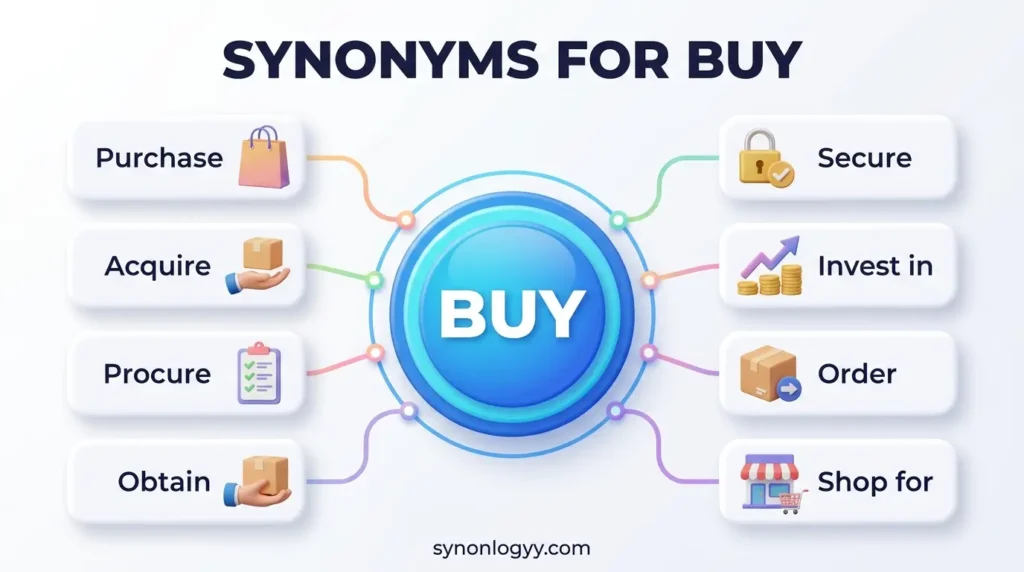
Synonyms for buy help you describe the act of getting something by paying money. Imagine shopping for shoes, ordering lunch, or choosing a new phone.
You may use the word “buy” in each situation. However, other words can make your meaning clearer and your writing more interesting.
The word “buy” is common in daily English. People use it when shopping, making deals, and spending money. Learning alternatives helps ESL learners speak with greater confidence.
It also helps students and content writers avoid repeating the same word.
Some alternatives sound formal, while others fit casual talks or business deals. For example, “purchase” sounds more formal than “buy.”
The word “invest in” can suggest spending money for future benefits.
This guide covers 30 synonyms, simple meanings, real examples, pronunciation, grammar, and word history.
You will also learn how to choose the best word for each situation.
Quick List: Buy Synonyms at a Glance
These words describe buying in different ways, from everyday shopping to formal deals.
Purchase, acquire, shop for, pay for, obtain, procure, order, pick up, get, invest in, secure, snap up, stock up on, take, spend money on, make a purchase, buy up, lay out money for, pay cash for, purchase from, treat yourself to, spring for, go in for, bargain for, bid for, win, subscribe to, commission, finance, lease.
Note: Some expressions are close alternatives rather than exact synonyms. Their meanings depend on the item, payment, and situation.
Meaning of Buy
Definition
Buy (verb): To get something by paying money for it.
People buy food, clothes, books, services, and many other things. The word can describe a small purchase or a large business deal.
Examples
- I buy fresh fruit every Saturday.
- Dad will buy a new laptop tomorrow.
Common Collocations
These phrases often appear with the word “buy.”
- Buy groceries: We buy groceries every Friday.
- Buy a ticket: She bought a ticket online.
- Buy a house: They plan to buy a house.
- Buy a gift: I will buy a gift.
- Buy a product: Customers buy this product often.
Connotative Meaning
Connotation is the feeling or idea a word brings to mind beyond its basic meaning.
- Positive tone: Buying something useful can suggest comfort, joy, or success.
- Negative tone: Buying too much can suggest waste or poor spending habits.
- Neutral tone: Buying milk at a store is a simple transaction.
The word “buy” is usually neutral. The situation and the speaker’s attitude can change its tone.
Etymology of Buy
The word “buy” has a long history in English. It comes from Old English bycgan, which meant to buy or purchase something.
The word kept its basic meaning over many centuries. Today, it describes paying money to obtain goods or services.
- Old English (450–1100): Bycgan meant to buy or purchase.
- Middle English (1100–1500): The word developed into forms such as byen and buyen.
- Modern English (1500–Present): The spelling became “buy,” and the word remained common in daily speech.
The word also appears in familiar expressions. For example, “buy time” means to gain more time. “Buy into an idea” means to accept or support it.
Pronunciation of Buy (IPA)
- IPA (US): /baɪ/
- Syllables: One syllable
- Rhymes with: Sky, fly, try, and why
- Part of speech: Verb and noun
The vowel sound in “buy” is the same as the sound in “my.” Start with the /a/ sound and move toward /ɪ/.
As a verb, “buy” describes an action. As a noun, “buy” can describe something purchased at a good price.
Example: “That jacket was a great buy.”
Affixation Pattern of Buy
- Root: Buy
- Prefix: None in the basic word.
- Suffix: None in the basic word.
- Word formations: Buying, bought, buyer, buyable, buyout, and buyback.
Here is how these forms work:
- Buy (verb): I buy fresh bread daily.
- Buying (verb form or gerund): Buying food online saves time.
- Bought (past tense and past participle): She bought a new bag.
- Buyer (noun): The buyer checked the car carefully.
- Buyable (adjective): This item is buyable through the website.
- Buyout (noun): The company announced a major buyout.
- Buyback (noun): The firm approved a share buyback.
“Buyable” is a valid word, but “available for purchase” may sound more natural in formal writing.
30 Synonyms of Buy With Meaning and Examples
The best synonym depends on what you buy and how you pay. The following words and phrases cover everyday shopping, formal transactions, and special buying situations.
1. Purchase (verb)
Meaning: To get something by paying money for it.
Best used when / Tone: Formal, professional, and neutral.
Examples:
- Customers can purchase tickets through our website.
- The school purchased new computers for its library.
“Purchase” is one of the closest synonyms for “buy.” It works well in business writing, reports, and official notices.
2. Acquire (verb)
Meaning: To gain ownership or control of something.
Best used when / Tone: Formal, broad, and professional.
Examples:
- The museum acquired a rare painting at auction.
- Our company acquired a smaller software firm last year.
“Acquire” often describes valuable items, skills, property, or businesses. It does not always mean buying because people can acquire things in other ways.
3. Shop for (phrasal verb)
Meaning: To look for something you want to buy.
Best used when / Tone: Everyday, friendly, and practical.
Examples:
- We shop for fresh vegetables at the local market.
- Maya spent Sunday shopping for a wedding dress.
Use “shop for” when someone searches for an item. It describes the process rather than the completed purchase.
4. Pay for (verb phrase)
Meaning: To give money in exchange for something.
Best used when / Tone: Neutral and direct.
Examples:
- I paid for everyone’s lunch after the meeting.
- The parents paid for their child’s music lessons.
“Pay for” focuses on the money given. It can also describe covering a cost without personally buying the item.
5. Obtain (verb)
Meaning: To get something through effort, payment, or another method.
Best used when / Tone: Formal and neutral.
Examples:
- Researchers obtained special tools for the science lab.
- You must obtain a permit before starting construction.
“Obtain” is broader than “buy.” Use it when the way something is received is less important than getting it.
6. Procure (verb)
Meaning: To obtain something, often through careful planning or formal steps.
Best used when / Tone: Formal, business, and technical.
Examples:
- The hospital procured new equipment for its emergency unit.
- Our manager procured supplies before the project began.
“Procure” often appears in business, government, and supply management. It may involve comparing vendors, negotiating terms, and arranging delivery.
7. Order (verb)
Meaning: To request goods or services for delivery or collection.
Best used when / Tone: Everyday, commercial, and practical.
Examples:
- Liam ordered a pizza through the restaurant’s app.
- The office ordered fifty notebooks for its staff.
Ordering does not always mean the item has been paid for or received. It describes making a request to a seller.
8. Pick up (phrasal verb)
Meaning: To buy or collect something, often during a short trip.
Best used when / Tone: Informal and conversational.
Examples:
- I’ll pick up some bread on my way home.
- Nina picked up a charger before her train left.
This phrase suits small, everyday purchases. It can also mean collecting something that was ordered or prepared earlier.
9. Get (verb)
Meaning: To obtain or receive something.
Best used when / Tone: Informal, simple, and common.
Examples:
- We got a new table for the dining room.
- Omar gets his coffee from a nearby café.
“Get” is easy for English learners because people use it in many situations. However, it is less precise than “purchase” or “pay for.”
10. Invest in (verb phrase)
Meaning: To spend money on something expected to bring value or benefits.
Best used when / Tone: Businesslike, thoughtful, and positive.
Examples:
- The bakery invested in a better oven.
- She invested in online courses to improve her skills.
Use this phrase when the purchase supports a future goal. It often suggests long-term value rather than a simple expense.
11. Secure (verb)
Meaning: To obtain something desired, sometimes through effort or competition.
Best used when / Tone: Formal and purposeful.
Examples:
- The collector secured the final painting at auction.
- Our team secured a supply deal with the manufacturer.
“Secure” emphasizes successfully obtaining something. It does not always mean paying for it, so use it when the result matters most.
12. Snap up (phrasal verb)
Meaning: To buy something quickly because it is desirable or available for a short time.
Best used when / Tone: Informal, lively, and enthusiastic.
Examples:
- Fans snapped up concert tickets within minutes.
- Shoppers snapped up the discounted winter coats.
This phrase often suggests strong demand or a limited supply. It works well in news stories and casual conversations about bargains.
13. Stock up on (phrasal verb)
Meaning: To buy a large amount of something for future use.
Best used when / Tone: Practical and informal.
Examples:
- Before the storm, families stocked up on bottled water.
- Our café stocks up on coffee beans every month.
Use this expression when people buy supplies in advance. It usually involves several items or a larger quantity than usual.
14. Take (verb)
Meaning: To accept or buy something that is offered, especially in a deal.
Best used when / Tone: Informal, direct, and context-dependent.
Examples:
- I’ll take the blue sweater at that price.
- The customer took the seller’s final offer.
“Take” can express a decision to buy or accept an offer. It is not a general replacement for “buy” in every sentence.
15. Spend money on (verb phrase)
Meaning: To use money to pay for something.
Best used when / Tone: Neutral, explanatory, and direct.
Examples:
- Our class spent money on art supplies.
- He spends too much money on video games.
This phrase focuses on the cost rather than ownership. It is useful when discussing budgets, habits, or personal spending choices.
16. Make a purchase (verb phrase)
Meaning: To complete a transaction in which something is bought.
Best used when / Tone: Formal, commercial, and neutral.
Examples:
- Please make a purchase before the sale ends.
- Online members receive points after each purchase.
This phrase is common in websites, receipts, and customer service messages. It sounds more formal than simply saying “buy something.”
17. Buy up (phrasal verb)
Meaning: To purchase all or most of the available supply.
Best used when / Tone: Business, news, and market discussions.
Examples:
- Investors bought up nearby land before construction began.
- Collectors bought up every copy of the limited edition.
“Buy up” highlights the quantity purchased. It can suggest a strong market move or concern about limited supply.
18. Lay out money for (verb phrase)
Meaning: To spend money on something, often a noticeable amount.
Best used when / Tone: Informal and expressive.
Examples:
- We laid out money for new kitchen cabinets.
- She laid out extra money for better concert seats.
This phrase draws attention to the cost. It often appears when the expense feels large or worth discussing.
19. Pay cash for (verb phrase)
Meaning: To buy something using cash instead of credit or another payment method.
Best used when / Tone: Neutral and specific.
Examples:
- My uncle paid cash for his used bicycle.
- The customer paid cash for the garden tools.
Use this phrase when the payment method matters. It is not a full synonym for “buy” because it adds a specific detail.
20. Purchase from (verb phrase)
Meaning: To buy something from a particular seller or source.
Best used when / Tone: Formal and informative.
Examples:
- We purchase office paper from a local supplier.
- The artist purchased rare fabrics from an overseas shop.
This phrase identifies where an item comes from. It works well in business reports and discussions about suppliers.
21. Treat yourself to (verb phrase)
Meaning: To buy or enjoy something special as a reward.
Best used when / Tone: Warm, personal, and positive.
Examples:
- After her exams, Sara treated herself to a spa day.
- He treated himself to a new watch after his promotion.
Use this expression when a purchase feels like a reward. It often suggests pleasure rather than need.
22. Spring for (phrasal verb)
Meaning: To pay for something, often as a special or generous choice.
Best used when / Tone: Informal and friendly.
Examples:
- My brother sprang for premium seats at the game.
- The manager sprang for dinner after a long shift.
This phrase is common in casual American English. It often suggests that someone willingly pays for something extra or expensive.
23. Go in for (phrasal verb)
Meaning: To choose, support, or take part in something; in some contexts, to favor a type of purchase.
Best used when / Tone: Conversational and context-dependent.
Examples:
- She goes in for classic furniture rather than modern designs.
- My parents go in for durable kitchen appliances.
“Go in for” is not a direct synonym for every act of buying. It works better when describing a preference or buying style.
24. Bargain for (verb phrase)
Meaning: To discuss terms or prices in an attempt to reach a deal.
Best used when / Tone: Practical and negotiation-focused.
Examples:
- The vendor bargained for a better price at the market.
- They bargained for lower rates before signing the contract.
This phrase emphasizes negotiation, not the final purchase itself. In many situations, “bargain with the seller” or “negotiate the price” sounds more natural.
25. Bid for (verb phrase)
Meaning: To offer a price to buy something, often in a competition.
Best used when / Tone: Formal, commercial, and auction-related.
Examples:
- Several collectors bid for the antique clock.
- The company bid for a contract to supply school meals.
A bid is an offer, not always a completed purchase. Use this phrase when several people or firms compete for an item or deal.
26. Win (verb)
Meaning: To gain something through a contest, auction, or competition.
Best used when / Tone: Neutral, competitive, and result-focused.
Examples:
- A local dealer won the painting at auction.
- The shop won the contract to supply office furniture.
“Win” can describe successfully obtaining something for payment. However, it is not a general synonym for buying because winning may involve no payment.
27. Subscribe to (verb phrase)
Meaning: To pay regularly for access to a service or publication.
Best used when / Tone: Digital, professional, and service-related.
Examples:
- I subscribe to an online language-learning platform.
- Their studio subscribes to professional design software.
This phrase suits recurring payments for digital tools, magazines, and memberships. It describes an ongoing arrangement rather than a single purchase.
28. Commission (verb)
Meaning: To pay someone to create or provide something for you.
Best used when / Tone: Formal, creative, and professional.
Examples:
- The hotel commissioned a local artist to paint a mural.
- Our editor commissioned an illustrator for the children’s book.
“Commission” works when you arrange and pay for custom work. It is especially common in art, publishing, design, and professional services.
29. Finance (verb)
Meaning: To provide or arrange money for a purchase or project.
Best used when / Tone: Financial, formal, and business-related.
Examples:
- The bank financed their new family car.
- A loan helped the shop finance its new equipment.
“Finance” often refers to funding a purchase through a loan or another financial arrangement. It does not always mean the person providing the money owns the item.
30. Lease (verb)
Meaning: To pay for the right to use property or equipment for a set period.
Best used when / Tone: Legal, formal, and business-related.
Examples:
- The startup leased office space near the city center.
- We leased a printer for the new branch.
“Lease” is not an exact synonym for “buy.” It usually means paying to use something without buying full ownership.
Synonym Comparison Table
The following ten alternatives are useful for everyday English, schoolwork, and professional writing.
| Synonym | Tone | Formality | Best for |
|---|---|---|---|
| Purchase | Neutral | Formal | Business and official writing |
| Acquire | Professional | Formal | Assets, property, or businesses |
| Shop for | Casual | Informal | Looking for products |
| Pay for | Direct | Neutral | Explaining costs |
| Obtain | Professional | Formal | Getting needed items |
| Procure | Technical | Very formal | Supply management |
| Order | Practical | Neutral | Requesting goods |
| Get | Casual | Informal | Everyday conversation |
| Invest in | Positive | Neutral to formal | Long-term value |
| Snap up | Excited | Informal | Popular items and bargains |
Choose “purchase” for a formal report. Use “get” in a casual conversation. Choose “invest in” when you want to highlight future value.
Prototype Meaning of Buy
The prototype meaning of “buy” is to exchange money for a product or service. Most people picture a customer paying a shopkeeper for an item.
For example, someone may buy bread at a bakery or pay online for a new phone.
This basic meaning connects most common uses of the word. However, context can add details about price, speed, purpose, or payment.
A person might “snap up” a bargain, “procure” business supplies, or “invest in” better equipment.
The central idea remains a transaction or the act of obtaining something through payment. When choosing a synonym, start with this basic meaning.
Then decide which extra detail your sentence needs.
Prototype Categorization of the 30 Synonyms
Synonyms become easier to understand when grouped by meaning. These categories show which words work best in different situations.
- Direct buying words: Purchase, get, take, make a purchase. Use these for ordinary transactions or a clear decision to accept an offer.
- Getting or obtaining something: Acquire, obtain, secure, win. Use these when gaining ownership or achieving a result matters most.
- Shopping and ordering: Shop for, order, pick up. Use these when searching for, requesting, or collecting goods.
- Business and formal buying: Procure, purchase from, commission. Use these for supplies, vendors, custom work, and professional transactions.
- Spending and payment: Pay for, spend money on, lay out money for, pay cash for. Use these when the amount or method of payment matters.
- Buying quickly or in quantity: Snap up, buy up, stock up on. Use these for popular products, bulk purchases, or supplies bought in advance.
- Personal treats and preferences: Treat yourself to, spring for, go in for. Use these for rewards, generous spending, or preferred products.
- Negotiation and competition: Bargain for, bid for. Use these when buyers negotiate prices or compete for an item.
- Long-term value and funding: Invest in, finance. Use these for purchases linked to future benefits or financial arrangements.
- Ongoing access or temporary use: Subscribe to, lease. Use these for recurring services or paid use without full ownership.
These groups help writers choose words based on meaning and tone. They also make vocabulary practice more useful. Remember that similar words are not always interchangeable.
For example, “lease” means renting the right to use something, while “buy” usually means gaining ownership.
Antonyms of Buy
The antonyms of “buy” describe opposite actions or different parts of a transaction. Some are direct opposites, while others depend on context.
- Sell (verb): To give something to another person for money. Example: Maya sells handmade bags online.
- Return (verb): To give a purchased item back to the seller. Example: I returned the shoes because they hurt.
- Refund (verb): To pay money back to a customer. Example: The store refunded my payment yesterday.
- Give away (verb phrase): To let someone have something without payment. Example: Our neighbor gave away old furniture.
- Donate (verb): To give money or goods to help others. Example: They donated books to the school.
- Borrow (verb): To use something that belongs to someone else, usually temporarily. Example: I borrowed a camera from my cousin.
- Rent (verb): To pay for temporary use of something. Example: We rented a car for the weekend.
- Reject (verb): To refuse an offer or item. Example: The buyer rejected the seller’s first offer.
- Decline (verb): To politely refuse something offered. Example: She declined the offer to buy the painting.
- Keep (verb): To continue having something instead of giving it away or selling it. Example: He kept the old bicycle.
“Sell” is the clearest opposite of “buy” in a normal transaction. Other words describe different ways of refusing, transferring, or using goods.
Short Questions and Answers
What does buy mean?
“Buy” means to get a product or service by paying money. People buy everyday items such as food, clothes, books, and furniture.
The word can also describe larger purchases, such as cars or homes. Its basic meaning involves a transaction between a buyer and a seller.
When should buy be used?
Use “buy” when you want to describe paying money for a product or service. It works well in everyday speech, emails, stories, and simple business writing.
Choose a more specific alternative when you need to highlight the payment method, quantity, purpose, or formality of a transaction.
Is buy positive or negative?
“Buy” is usually a neutral word. Its meaning depends on the situation and the speaker’s attitude. Buying food for a family may sound helpful, while buying unnecessary items may suggest waste.
Phrases such as “treat yourself to” often sound positive, while “spend too much on” may sound negative.
How is buy different from similar words?
“Buy” is a general word for paying money to get something. “Purchase” sounds more formal, while “shop for” describes searching for an item.
“Acquire” focuses on gaining ownership, and “invest in” suggests future value. The best choice depends on the exact meaning you want to express.
What is the best synonym for buy in formal writing?
“Purchase” is usually the best direct synonym for “buy” in formal writing. It fits reports, business emails, notices, and professional documents.
“Procure” may suit supply management, while “acquire” often works for assets or businesses. Choose the word that matches the transaction and its context.
What is a simple word to use instead of buy?
“Get” is a simple alternative to “buy” in casual English. For example, “I need to get some milk” sounds natural in conversation.
However, “get” can also mean receive or obtain something without paying. Use “buy” when payment is an important part of the meaning.
Conclusion
Learning synonyms for buy helps you express ideas with greater clarity. The word “buy” works in many situations, but other choices can add useful details.
For example, “purchase” suits formal writing, while “snap up” describes buying something quickly. “Invest in” highlights a possible future benefit.
Understanding these differences helps ESL learners build stronger vocabulary. It also helps students and content writers avoid repeating the same words.
The right synonym can make a sentence sound more natural, precise, and engaging.
Start by learning a few common alternatives each day. Write your own examples and use them in conversations. Check each word’s meaning before replacing “buy” in a sentence.
With regular practice, you can improve your writing, speak with confidence, and choose words that fit each situation.