Viable means able to work, succeed, or be done successfully. Imagine a small business owner who wants to open a coffee shop.
Before spending money, they need to know if the idea is viable. In simple words, they need to know if it can work.
The word viable is common in business, education, science, and everyday conversations. However, using the same word too often can make your writing feel dull. Learning viable synonyms helps you express your ideas in fresh and clear ways.
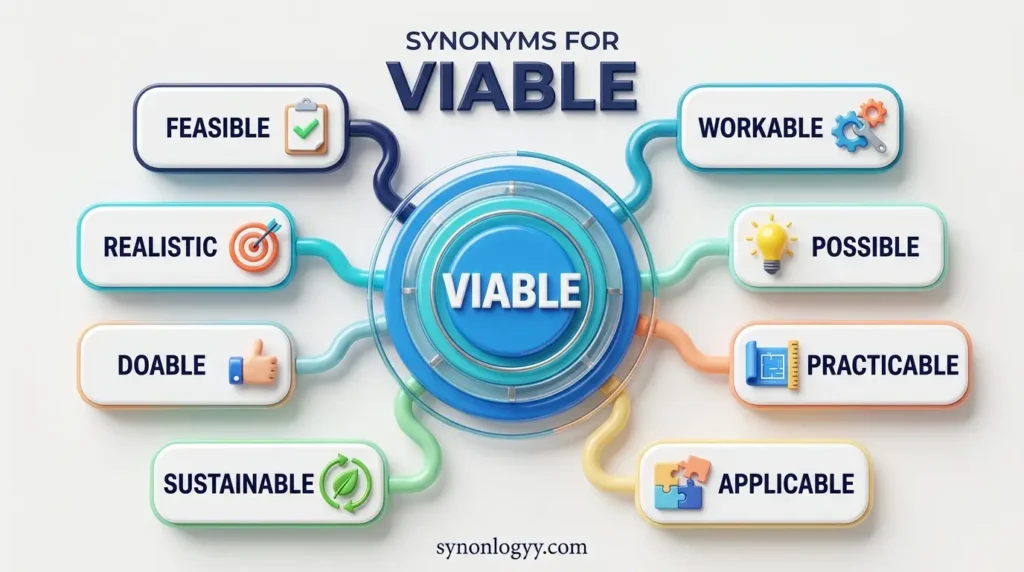
Words such as feasible, workable, practical, and possible have similar meanings, but each fits a different situation. This guide explains the meaning of viable, its history, pronunciation, grammar, and 30 useful synonyms.
You will also learn how to use these words in sentences and choose the best alternative for your writing.
Meaning of Viable
Definition
Viable (Adjective): Able to work, survive, or succeed under the right conditions.
Examples
- We need a viable plan to reduce costs.
- The team found a viable solution to the problem.
Connotative Meaning
(Connotation: the feeling or idea a word suggests beyond its basic meaning.)
- Positive tone: Suggests promise, success, or a good chance of working. Example: “Her business idea is viable.”
- Negative tone: Can suggest doubt when a plan is described as not viable. Example: “The project is not viable without more funding.”
- Neutral tone: Simply describes whether something can work. Example: “The study tested whether the method was viable.”
Etymology
The word viable comes from French viable, meaning capable of living. It is linked to the French word vie, meaning “life,” and ultimately to Latin vita, meaning “life.”
- Old English (450–1100): Viable was not an Old English word. English used other words to express ideas about life and survival.
- Middle English (1100–1500): The word was not yet in common English use. French and Latin influenced English vocabulary during this period.
- Modern English (1500–Present): Viable entered English through French and became associated with the ability to live, survive, or succeed. Today, it also describes workable plans, business ideas, and practical solutions.
Pronunciation (IPA)
- IPA: /ˈvaɪ.ə.bəl/
- Syllables: vi-a-ble (3 syllables)
Affixation Pattern of Viable
- Root: vi- — linked through Latin and French to the idea of life.
- Prefix: None.
- Suffix: -able — indicates ability or suitability.
Word Formations
- Viable (adjective): Able to work or succeed.
- Viability (noun): The ability to work, survive, or succeed.
- Viably (adverb): In a way that is viable; this form is rare.
- Nonviable (adjective): Not able to work, survive, or succeed.
- Nonviability (noun): The state of not being viable.
30 Synonyms of Viable With Meaning & Examples
The following words are useful alternatives to viable. They share some meanings with it, but they are not interchangeable in every sentence.
1. Feasible (Adjective)
Meaning: Possible to do or achieve with the available time, money, and resources.
Examples:
- The team created a feasible plan for the project.
- Is it feasible to finish the work today?
2. Workable (Adjective)
Meaning: Able to work well enough to achieve a goal.
Examples:
- We need a workable plan for the next week.
- Their solution is simple and workable.
3. Practical (Adjective)
Meaning: Suitable for real-life use or action.
Examples:
- She suggested a practical way to save money.
- This is a practical solution for small homes.
4. Possible (Adjective)
Meaning: Able to happen or be done.
Examples:
- It is possible to complete the task today.
- We are looking for every possible option.
5. Achievable (Adjective)
Meaning: Able to be reached or completed through effort.
Examples:
- Set an achievable goal for this month.
- The team believes the target is achievable.
6. Attainable (Adjective)
Meaning: Possible to reach or gain.
Examples:
- A better score is attainable with regular practice.
- Their sales target is attainable.
7. Realistic (Adjective)
Meaning: Based on what is likely to happen in real life.
Examples:
- We need a realistic budget for the trip.
- Her plan is realistic and easy to follow.
8. Sustainable (Adjective)
Meaning: Able to continue over time without causing serious harm or using up needed resources.
Examples:
- The company needs a sustainable business model.
- Solar power can support a more sustainable future.
9. Effective (Adjective)
Meaning: Able to produce the result that is wanted.
Examples:
- This is an effective way to teach children.
- We need an effective plan to solve the problem.
10. Functional (Adjective)
Meaning: Working as intended or serving a useful purpose.
Examples:
- The designer created a functional kitchen.
- The website is simple but fully functional.
11. Operable (Adjective)
Meaning: Able to be operated or used.
Examples:
- The machine is now operable after repairs.
- The system must remain operable during the test.
12. Workable in Practice (Adjective Phrase)
Meaning: Suitable for actual use, not just as an idea.
Examples:
- The proposal looks good and is workable in practice.
- We need a plan that is workable in practice.
13. Sound (Adjective)
Meaning: Based on good judgment, strong reasoning, or reliable principles.
Examples:
- The manager offered a sound business plan.
- They made a sound decision after careful thought.
14. Credible (Adjective)
Meaning: Believable and worthy of trust.
Examples:
- The researcher presented a credible explanation.
- We need a credible plan to restore public trust.
15. Promising (Adjective)
Meaning: Showing signs that something may succeed.
Examples:
- The new business has a promising future.
- Early results show a promising treatment approach.
16. Profitable (Adjective)
Meaning: Able to earn more money than it costs.
Examples:
- The shop became profitable within two years.
- They are searching for a profitable business idea.
17. Economical (Adjective)
Meaning: Using money or resources carefully and efficiently.
Examples:
- This is an economical way to heat the house.
- We need an economical solution to the problem.
18. Cost-Effective (Adjective)
Meaning: Producing good results for the money spent.
Examples:
- Online lessons are a cost-effective option.
- The company chose a cost-effective marketing plan.
19. Efficient (Adjective)
Meaning: Working well without wasting time, effort, or resources.
Examples:
- The team found an efficient way to manage orders.
- We need a more efficient process.
20. Suitable (Adjective)
Meaning: Right for a particular purpose or situation.
Examples:
- This room is suitable for a small meeting.
- We need a suitable location for the event.
21. Appropriate (Adjective)
Meaning: Right or acceptable for a given situation.
Examples:
- The teacher chose an appropriate activity.
- We need an appropriate response to the problem.
22. Viable in the Long Term (Adjective Phrase)
Meaning: Able to remain successful or useful over a long period.
Examples:
- The company needs a viable option in the long term.
- We must find a plan that remains viable in the long term.
23. Tenable (Adjective)
Meaning: Able to be defended or maintained with good reasons.
Examples:
- Her argument is tenable in light of the evidence.
- The team needs a tenable position during the debate.
24. Defensible (Adjective)
Meaning: Able to be supported with reasonable evidence or arguments.
Examples:
- The report offers a defensible conclusion.
- We need a defensible reason for the decision.
25. Convincing (Adjective)
Meaning: Strong enough to make people believe or accept something.
Examples:
- He gave a convincing reason for the change.
- The proposal presents a convincing case for investment.
26. Valid (Adjective)
Meaning: Acceptable, sound, or supported by proper reasoning or rules.
Examples:
- The team raised a valid concern.
- Her research offers a valid explanation.
27. Reliable (Adjective)
Meaning: Able to be trusted to work well or give consistent results.
Examples:
- We need a reliable system for storing data.
- This method is reliable when used correctly.
28. Robust (Adjective)
Meaning: Strong and able to handle stress, change, or difficulty.
Examples:
- The company developed a robust security system.
- We need a robust plan for unexpected problems.
29. Adaptable (Adjective)
Meaning: Able to change to suit new conditions.
Examples:
- A small business must be adaptable.
- The team created an adaptable learning plan.
30. Serviceable (Adjective)
Meaning: Good enough to be used for its intended purpose.
Examples:
- The old laptop is still serviceable.
- They found a serviceable solution at a low cost.
Prototype Meaning
The prototype meaning of viable is something that can work, survive, or succeed under the conditions available. When people hear this word, they often imagine a plan, idea, business, or solution that has a real chance of success.
For example, a viable business can earn enough money to continue operating, while a viable solution can solve a problem with the resources available.
The main idea is not just that something is possible, but that it can work in real life.
Prototype Categorization
The 30 synonyms can be grouped by their main meanings. This helps writers choose the right word instead of replacing viable with a word that only partly matches.
- Possibility and feasibility: Feasible, possible, workable, achievable, attainable. Use these when discussing whether something can be done.
- Practical use: Practical, functional, operable, suitable, appropriate, serviceable. These words describe things that can be used for a purpose.
- Success and results: Effective, promising, profitable, convincing. Use them when focusing on results, potential, or success.
- Planning and sound judgment: Realistic, sound, credible, tenable, defensible, valid. These fit plans, arguments, and decisions that have good reasons behind them.
- Long-term success: Sustainable, viable in the long term, adaptable, robust, reliable. Use these when a plan or system must last, adjust, or keep working.
- Cost and resource use: Economical, cost-effective, efficient. These words focus on saving money, time, effort, or resources.
- General suitability: Workable in practice. This phrase is useful when an idea must succeed outside theory or discussion.
Choosing a synonym by category makes your writing clearer. For example, use feasible for a task that can be completed, profitable for a business that earns money, and sustainable for a plan that can continue over time.
Antonyms of Viable
Antonyms are words with opposite meanings. The best choice depends on whether viable refers to success, practical use, or survival.
1. Unworkable (Adjective)
Meaning: Not able to work successfully.
2. Impossible (Adjective)
Meaning: Not able to happen or be done.
3. Impractical (Adjective)
Meaning: Not suitable for real-life use.
4. Unfeasible (Adjective)
Meaning: Not possible or practical under the available conditions.
5. Unachievable (Adjective)
Meaning: Not possible to reach or complete.
6. Unsustainable (Adjective)
Meaning: Unable to continue over time without serious problems.
7. Ineffective (Adjective)
Meaning: Not producing the desired result.
8. Unprofitable (Adjective)
Meaning: Not earning enough money to cover costs or make a profit.
9. Nonfunctional (Adjective)
Meaning: Not working as intended.
10. Unreliable (Adjective)
Meaning: Not dependable or consistent.
Short Questions and Answers
What does viable mean?
Viable means able to work, survive, or succeed under the available conditions. For example, a viable plan has a realistic chance of working.
When should viable be used?
Use viable when discussing plans, ideas, businesses, solutions, or living things that can work or survive. For example, “We need a viable solution to the problem.”
Is viable positive or negative?
Viable is usually positive or neutral. It suggests that something can work or succeed. However, the phrase not viable expresses a negative judgment about its chances or suitability.
How is viable different from similar words?
Viable means capable of working or succeeding. Feasible focuses on whether something can be done. Practical focuses on real-life usefulness, while sustainable means able to continue over time.
Conclusion
Learning viable and its synonyms can improve your English vocabulary and help you express ideas with greater accuracy.
Words such as feasible, workable, practical, and achievable can make your writing more varied and clear. However, each synonym has its own meaning, so it is important to choose one that fits the context.
Using the right word can strengthen your essays, business reports, emails, and everyday conversations. It can also help you avoid repetition and explain complex ideas in simple language.
To build confidence, practise learning a few new synonyms each day. Write your own sentences, compare similar words, and read examples in different contexts.
Over time, you will find it easier to choose the right word and communicate your ideas clearly. The more you practise, the more natural and effective your English will become.


