
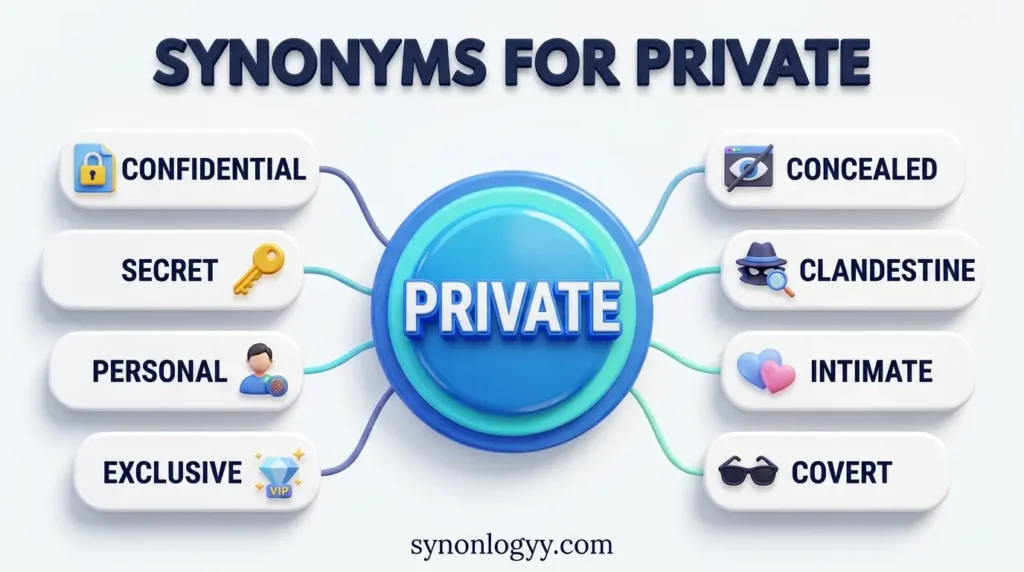
Synonyms for private include personal, confidential, secret, individual, secluded, exclusive, and nonpublic.
The best alternative depends on whether you mean something personal, information that must remain confidential, a place away from others, or an activity restricted to a particular group.
Although these words share aspects of the meaning of private, they are not interchangeable in every sentence.
Understanding their differences helps you choose the most accurate word for emails, essays, professional writing, and everyday conversations.
Quick Answer: What Are the Best Synonyms for Private?
Here are some useful alternatives to private, grouped by their most common meanings.
| Synonym | Meaning or Context | Example |
|---|---|---|
| Personal | Relating to an individual | This is my personal opinion. |
| Confidential | Intended to be kept secret | The report contains confidential information. |
| Secret | Hidden from others | They held a secret meeting. |
| Individual | Relating to one person | Each student received individual attention. |
| Secluded | Away from other people | They stayed in a secluded cabin. |
| Exclusive | Restricted to selected people | She attended an exclusive event. |
| Nonpublic | Not available to the general public | The company shared nonpublic information. |
| Discreet | Careful to avoid unwanted attention | Please be discreet about the matter. |
| Intimate | Personal or involving close relationships | They enjoyed an intimate dinner. |
| Restricted | Limited to authorized people or uses | Access to the file is restricted. |
| Personal-use | Intended for an individual’s use | The device is for personal use. |
| Internal | Intended for use within an organization | This is an internal company document. |
| Undisclosed | Not revealed to others | The parties agreed to an undisclosed location. |
| Sealed | Closed or protected from access | The court records remained sealed. |
| Sole | Belonging to or used by one person or entity | She has sole access to the account. |
These alternatives suit different situations. For example, confidential is more precise for sensitive information, while secluded describes a place away from other people.
What Does Private Mean?
Private is an adjective that describes something belonging to an individual, intended for personal use, kept from public knowledge, or not open to everyone.
The exact meaning depends on the context.
- Personal: Private thoughts are personal thoughts that someone may not wish to share.
- Confidential: Private records may contain information that should not be disclosed without permission.
- Not public: A private event may be open only to invited guests.
- Separate from public ownership: A private company is not necessarily owned by the government or traded publicly on a stock exchange.
- Away from others: A private room may offer solitude or freedom from interruption.
The word can be neutral, positive, or sensitive in tone. A private conversation may suggest trust, a private garden may suggest peace, and private information may require careful protection.
Synonyms for Private by Meaning
1. Private as Personal
When private means relating to an individual rather than the public, these alternatives may be appropriate.
- Personal: Connected to someone’s own life, feelings, opinions, or affairs.
- Individual: Relating to one person rather than a group.
- Personalized: Adapted to someone’s particular needs or preferences.
- Own: Belonging to or associated with a particular person.
- Intimate: Deeply personal, often involving close relationships or private feelings.
Examples:
- I prefer to keep my personal life separate from my professional life.
- Each employee has an individual account.
- She shared her own thoughts about the proposal.
- They had an intimate conversation about their future.
Best choice: Use personal for someone’s life or affairs and individual when emphasizing one person rather than a group.
2. Private as Confidential or Secret
When something must not be disclosed publicly, choose a word that reflects the required level of secrecy.
- Confidential: Intended to be shared only with authorized people.
- Secret: Deliberately kept unknown to others.
- Discreet: Careful about revealing information or attracting attention.
- Undisclosed: Not revealed or made known.
- Classified: Officially designated as restricted information, particularly in government and security contexts.
- Restricted: Available only to people who meet particular conditions or have permission.
Examples:
- Please keep the client’s details confidential.
- They planned a secret celebration.
- The manager handled the complaint discreetly.
- The company did not reveal the undisclosed terms of the agreement.
- The document contains classified information.
Best choice: Confidential is usually the strongest general choice for sensitive professional information. Classified should be reserved for information formally designated that way.
3. Private as Not Open to the Public
These alternatives describe events, facilities, services, or organizations that are not generally accessible to everyone.
- Exclusive: Limited to selected people or members.
- Restricted: Subject to access limitations.
- Nonpublic: Not open or available to the general public.
- Members-only: Available only to members.
- Invitation-only: Open only to people who have been invited.
- Internal: Intended for use within an organization or group.
Examples:
- The hotel hosted an exclusive reception.
- The area is restricted to authorized personnel.
- The organization issued a nonpublic statement.
- The club operates a members-only lounge.
- They organized an invitation-only event.
- The manager circulated an internal memo.
Best choice: Use exclusive for selected groups, restricted for controlled access, and nonpublic when contrasting something with public information or access.
4. Private as Secluded or Away from Others
When private describes a place or setting where people can avoid interruptions, these words may fit.
- Secluded: Situated away from other people or busy areas.
- Isolated: Separated from others, sometimes with a sense of distance or loneliness.
- Sheltered: Protected from outside conditions or exposure.
- Quiet: Free from much noise or disturbance.
- Undisturbed: Not interrupted or interfered with.
- Hidden: Not easily seen or discovered.
Examples:
- They rented a secluded cottage near the lake.
- The village is relatively isolated from major cities.
- We found a quiet corner to talk.
- She wanted an undisturbed place to study.
- The entrance led to a hidden courtyard.
Best choice: Use secluded for a peaceful location away from others. Isolated may imply separation or loneliness, while quiet emphasizes a lack of noise.
5. Private as Individually Owned or Operated
In business, property, and institutional contexts, private often contrasts with public or government-owned.
Useful alternatives include:
- Privately owned: Owned by an individual or nongovernmental entity rather than the public sector.
- Independent: Operating separately from another organization or authority.
- Proprietary: Owned by a person or organization, often referring to technology, information, or products.
- Non-governmental: Not part of the government.
- Personal: Owned or used by an individual, where the context supports this meaning.
Examples:
- They invested in a privately owned business.
- She works for an independent research firm.
- The company developed proprietary software.
- The organization operates as a nongovernmental institution.
These terms have different implications. An independent business is not necessarily privately owned in every possible sense, and proprietary information is not automatically confidential under every circumstance.
Private Synonyms: Comparison Table
The following table compares common alternatives and helps you select the most suitable word.
| Word | Main Meaning | Tone or Context | Example |
|---|---|---|---|
| Personal | Relating to an individual | Everyday | My personal notes are in the folder. |
| Confidential | Not to be disclosed freely | Professional | This is a confidential document. |
| Secret | Intentionally concealed | Everyday or sensitive | It was a secret arrangement. |
| Discreet | Careful about revealing information | Polite or professional | Please be discreet when discussing the issue. |
| Secluded | Away from other people | Descriptive | They found a secluded beach. |
| Exclusive | Limited to selected people | Social or commercial | The invitation is for an exclusive gathering. |
| Restricted | Limited by rules or permission | Formal | The archive has restricted access. |
| Nonpublic | Not accessible or disclosed publicly | Formal | The company released nonpublic data. |
| Intimate | Personal or involving close familiarity | Emotional or social | They shared an intimate moment. |
| Independent | Separate from external control | Business or organizational | She runs an independent practice. |
| Proprietary | Owned by a person or organization | Technical or commercial | The software uses proprietary technology. |
| Undisclosed | Not revealed | Formal | They met at an undisclosed location. |
Private vs. Personal vs. Confidential vs. Secret
These four words are closely related, but each emphasizes something different.
Private vs. Personal
Private emphasizes separation from public access or knowledge. Personal emphasizes a connection to an individual.
- Private account: An account whose content is not available to everyone.
- Personal account: An account associated with an individual’s own use or identity.
A personal account may be public, and a private account may belong to a business or organization.
Private vs. Confidential
Private is broad, while confidential specifically suggests that information should be protected from unauthorized disclosure.
- Private conversation: A conversation not intended for public participation.
- Confidential conversation: A conversation in which information is expected to remain protected.
The terms can overlap, but confidential is generally more precise when secrecy or professional obligations matter.
Private vs. Secret
Private does not necessarily mean deliberately hidden. Secret usually means something is intentionally kept unknown.
- Private meeting: A meeting closed to the public.
- Secret meeting: A meeting whose existence or details are deliberately concealed.
A private meeting can be officially announced without revealing its discussion.
Private vs. Discreet
Private describes the nature or access of something. Discreet describes careful behavior intended to avoid revealing information or drawing attention.
- Private discussion: A discussion not open to everyone.
- Discreet discussion: A discussion handled carefully and without unnecessary attention.
Use discreet when describing how someone behaves rather than simply who is allowed access.
Which Synonym for Private Should You Use?
The best alternative depends on what you want to communicate.
| Situation | Recommended Word | Why It Fits |
|---|---|---|
| Personal life and affairs | Personal | Focuses on an individual’s life |
| Sensitive documents | Confidential | Emphasizes protection from disclosure |
| Hidden plans | Secret | Highlights deliberate concealment |
| A peaceful location | Secluded | Emphasizes distance from other people |
| A members’ event | Exclusive | Highlights limited participation |
| Controlled access | Restricted | Emphasizes rules or permissions |
| Internal company communication | Internal | Identifies the intended audience |
| Carefully handled information | Discreet | Emphasizes tact and caution |
| A business outside government ownership | Privately owned | Describes ownership more precisely |
| A product or technology owned by a company | Proprietary | Emphasizes ownership rights |
For professional emails, confidential is often suitable for sensitive material, while personal works for matters relating to an individual.In descriptive writing, secluded is useful for places, and exclusive works for events or services limited to selected people.
Examples of Private Synonyms in Sentences
Compare these sentences to see how changing one word affects the meaning.
- Private: We discussed the matter in a private room.
- Personal: She shared a personal story with the group.
- Confidential: The lawyer reviewed the confidential documents.
- Secret: They arranged a secret meeting.
- Secluded: The family spent the weekend in a secluded cabin.
- Exclusive: The museum hosted an exclusive reception for its members.
- Restricted: Only authorized employees can enter the restricted area.
- Discreet: He made a discreet inquiry about the opportunity.
- Individual: Each applicant received individual feedback.
- Nonpublic: The company withheld nonpublic details of the transaction.
- Intimate: The couple enjoyed an intimate dinner with close friends.
- Undisclosed: The parties agreed to meet at an undisclosed location.
Each alternative adds a particular detail. Selecting the right one makes your writing more precise without changing the sentence unnecessarily.
Antonyms of Private
The main antonyms of private depend on its meaning.
| Antonym | Meaning | Example |
|---|---|---|
| Public | Open or available to the general public | The event is open to the public. |
| Open | Accessible or available without the same restrictions | The meeting is open to all employees. |
| Publicly accessible | Available for public access | The records are publicly accessible. |
| Shared | Used or experienced by more than one person | They use a shared workspace. |
| Disclosed | Revealed or made known | The information was disclosed in the report. |
| Publicly owned | Owned by a government or public body | The facility is publicly owned. |
Not every antonym works in every context. For example, public contrasts with private in access and ownership, whereas disclosed contrasts with undisclosed when discussing whether information has been revealed.
Common Phrases Using Private
Several common expressions use private in specific ways.
- Private life: The part of someone’s life not generally shared with the public.
- Private property: Property owned by an individual or private entity rather than held as public property.
- Private conversation: A conversation not intended for public participation.
- Private sector: The part of the economy made up of nongovernmental businesses and organizations.
- Private school: A school that is not operated as a public school within the relevant education system.
- Private room: A room reserved for an individual, group, or specific purpose.
- Private information: Information intended to remain personal or unavailable to the general public.
- Private investigator: A professional investigator hired by individuals or organizations rather than acting as a government police officer.
- Private collection: A collection owned by an individual or private organization.
- Private meeting: A meeting that is not open to the general public.
These phrases illustrate why choosing a synonym requires attention to the surrounding words. For example, personal life is a natural alternative in some contexts, but personal sector is not a standard replacement for private sector.
Frequently Asked Questions
1. What is the closest synonym for private?
Personal is a close synonym when private refers to an individual’s life or affairs. For information that must not be shared, confidential is often more accurate.
2. What is another word for private information?
Depending on the context, you can use confidential information, sensitive information, or nonpublic information. These terms have slightly different meanings and should be selected according to the level and type of protection involved.
3. What is a formal synonym for private?
Confidential, nonpublic, restricted, and proprietary can work in formal writing. The right choice depends on whether you mean secrecy, limited access, or ownership.
4. What is a synonym for private that means away from others?
Secluded is often the best choice for a place away from other people. Isolated also describes separation, but it can suggest remoteness or loneliness.
5. Is confidential the same as private?
No. Private is a broad term covering personal matters, restricted access, and nonpublic activities. Confidential specifically emphasizes that information should not be disclosed freely.
6. What is the opposite of private?
Public is the most common antonym when referring to access, visibility, or ownership. In other contexts, open, shared, or disclosed may be more suitable.
7. Can personal and private be used interchangeably?
Sometimes. A personal matter often refers to an individual’s own affairs, while a private matter emphasizes that the matter is not intended for public knowledge. Their meanings overlap, but they are not identical.
8. What is a synonym for a private meeting?
Depending on the circumstances, you can say closed meeting, confidential meeting, or exclusive meeting.
A closed meeting is not open to the public, a confidential meeting emphasizes discretion, and an exclusive meeting is limited to selected participants.
Conclusion
The best synonyms for private depend on the meaning you want to express.
Use personal for individual affairs, confidential for protected information, secret for deliberately hidden matters, secluded for places away from others, and exclusive for events or services limited to selected people.
Rather than replacing private with the first similar word you find, consider the context and the distinction you want to communicate. A precise synonym makes your English clearer, more natural, and more effective.


