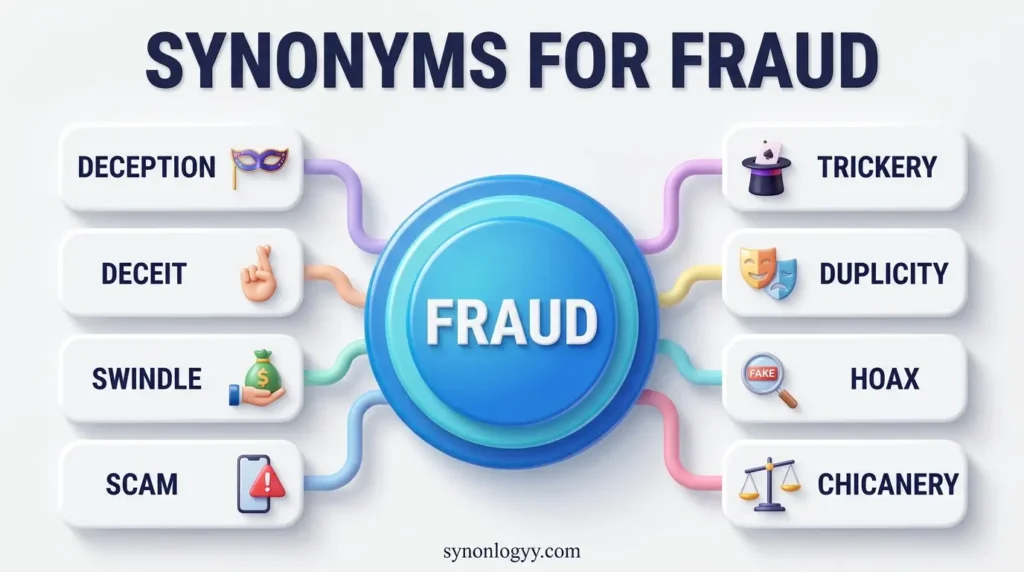
Synonyms for fraud help you describe lies, cheating, and dishonest acts more clearly. Fraud means using lies or tricks to gain money, property, or another benefit.
Imagine buying a phone online and receiving an empty box. The seller may have used fraud to steal your money.
People often use this word in news reports, legal cases, business, and daily life. However, repeating the same word can make writing dull.
Learning similar words helps ESL learners build stronger vocabulary. It also helps students and content writers express ideas with greater care.
Some words describe a lie, while others suggest theft or a planned trick. This guide explains the meaning of fraud, its history, pronunciation, and grammar.
You will also learn 30 alternatives, their meanings, and clear examples. These tips will help you choose the right word for each situation.
Quick List: Fraud Synonyms at a Glance
These words describe fraud or closely related forms of dishonest behavior, though their meanings can differ.
Deception, deceit, dishonesty, cheating, trickery, swindle, scam, con, hoax, forgery, misrepresentation, falsehood, duplicity, imposture, corruption, embezzlement, defalcation, falsification, chicanery, fraudulence, racket, confidence trick, sham, charlatanism, cheating scheme, fraudulent scheme, identity theft, financial deception, fraudulent misrepresentation, dishonest dealing.
Meaning of Fraud
Definition
Fraud (noun): A deliberate act of deception used to gain money, property, or another benefit unfairly.
Fraud often involves false claims, hidden facts, or fake documents. It may harm people, businesses, or public groups. Some forms of fraud break the law.
Examples
- The company committed fraud by hiding its true profits.
- Police investigated a fraud involving fake online stores.
Common Collocations
These phrases often appear in news reports, legal writing, and business texts.
- Commit fraud: The manager committed fraud last year.
- Detect fraud: Banks detect fraud through careful checks.
- Prevent fraud: Strong passwords help prevent online fraud.
- Alleged fraud: The court reviewed the alleged fraud case.
- Fraud investigation: The fraud investigation lasted several months.
Connotative Meaning
(Connotation means the feeling or idea a word brings to mind.)
- Positive tone: Fraud has no positive meaning when it describes dishonest conduct.
- Negative tone: Fraud suggests deliberate dishonesty, unfair gain, and possible harm.
- Neutral tone: In legal reports, fraud can name an alleged or proven offense without deciding guilt by itself.
The word is strongly negative in everyday speech. In legal writing, context matters because an accusation does not prove that fraud occurred.
Etymology of Fraud
The English word fraud comes from Latin fraus, meaning deceit, trickery, or wrongdoing. Latin fraudis is a related form used in the word’s grammatical history.
The term entered English through French and Latin influence. It came to describe dishonest acts that deceive others for unfair gain.
Its modern use often appears in law, finance, insurance, and business.
Old English (450–1100)
The modern English word fraud was not a standard Old English term. Old English had other words for deceit and wrongdoing. Therefore, the Latin history of fraud should not be presented as an Old English root.
Middle English (1100–1500)
The word entered English during the Middle English period through French and Latin influence. It was linked to deceit, trickery, and dishonest conduct.
Its use developed as English legal and written vocabulary grew.
Modern English (1500–Present)
Today, fraud has a broad range of uses. It can describe financial crime, false claims, identity theft, and dishonest business practices.
Legal systems also use specific terms for different kinds of fraud.
The meaning remains centered on deception. However, the exact legal meaning depends on the relevant law and facts.
Pronunciation of Fraud (IPA)
- IPA (US): /frɔd/
- IPA (UK): /frɔːd/
- Syllables: One syllable.
- Simple pronunciation: Frawd.
The word begins with the /fr/ sound, as in free. Its vowel sounds similar to the vowel in thought for many American speakers. Pronunciation can vary by accent.
Affixation Pattern of Fraud
Root
Fraud: The base noun refers to dishonest deception for unfair gain.
Prefix
There is no prefix in the basic word fraud. The word itself carries the central meaning.
Suffix
The word fraud has no suffix in its basic form. Related words add suffixes to form other parts of speech.
Word Formations
- Fraud (noun): An act of dishonest deception.
- Fraudster (noun): A person who commits fraud.
- Fraudulent (adjective): Involving or based on fraud.
- Fraudulently (adverb): In a way that involves fraud.
- Fraudulence (noun): The quality or state of being fraudulent.
Examples:
- The fraudster tricked several online buyers.
- The bank rejected the fraudulent claim.
- The seller acted fraudulently during the deal.
- Investigators found evidence of fraudulence in the report.
The words share a common base, but they serve different grammatical roles. Use fraud for the act, fraudster for the person, and fraudulent for something dishonest.
30 Synonyms of Fraud With Meaning & Examples
Some alternatives are direct matches in certain contexts. Others describe specific methods, related offenses, or people involved in dishonest acts. Always check the meaning before replacing fraud in a sentence.
1. Deception (noun)
Meaning: Deception is the act of making someone believe something false.
Best used when / Tone: General, formal, widely useful.
Examples:
- The seller used deception to hide the damaged goods.
- Her calm voice helped conceal the deception during the meeting.
2. Deceit (noun)
Meaning: Deceit means dishonest behavior intended to mislead another person.
Best used when / Tone: Formal, strong, often literary.
Examples:
- His deceit ended a friendship that had lasted years.
- The novel explores deceit within a wealthy family.
3. Dishonesty (noun)
Meaning: Dishonesty means acting without truth or fairness.
Best used when / Tone: Common, broad, direct.
Examples:
- The teacher punished dishonesty during the science test.
- Dishonesty at work damaged the team’s trust.
4. Cheating (noun)
Meaning: Cheating means breaking rules to gain an unfair advantage.
Best used when / Tone: Informal, familiar, common.
Examples:
- The player was suspended for cheating during the match.
- Cheating on the exam led to a school review.
5. Trickery (noun)
Meaning: Trickery means using clever tricks to fool someone.
Best used when / Tone: General, expressive, slightly informal.
Examples:
- The magician used trickery to surprise the audience.
- Online sellers sometimes use trickery to attract buyers.
6. Swindle (noun)
Meaning: A swindle is a dishonest plan that takes money or property.
Best used when / Tone: Informal, strong, money-focused.
Examples:
- The fake investment offer turned out to be a swindle.
- Retired workers lost their savings in a property swindle.
7. Scam (noun)
Meaning: A scam is a dishonest scheme designed to trick people.
Best used when / Tone: Informal, modern, widely understood.
Examples:
- A text message promised a prize but revealed a scam.
- The travel website charged customers for fake bookings.
8. Con (noun)
Meaning: A con is a trick used to cheat someone.
Best used when / Tone: Informal, conversational.
Examples:
- The stranger’s charity story was a con.
- He spotted the con before sending any money.
9. Hoax (noun)
Meaning: A hoax is a false story or trick meant to mislead people.
Best used when / Tone: Common, often linked to false claims.
Examples:
- The viral post about free tickets was a hoax.
- Officials warned residents about the fake emergency message.
10. Forgery (noun)
Meaning: Forgery involves making or changing something falsely, often a document or signature.
Best used when / Tone: Formal, legal, document-focused.
Examples:
- The bank found forgery on the loan papers.
- Investigators checked the painting for possible forgery.
11. Misrepresentation (noun)
Meaning: Misrepresentation means presenting false or misleading information.
Best used when / Tone: Formal, legal, business-focused.
Examples:
- The buyer complained about misrepresentation in the property listing.
- Misrepresentation of the product’s features caused customer complaints.
12. Falsehood (noun)
Meaning: A falsehood is a statement that is not true.
Best used when / Tone: Formal, general, statement-focused.
Examples:
- The report exposed a falsehood about the company’s income.
- One falsehood changed how readers viewed the story.
13. Duplicity (noun)
Meaning: Duplicity means hiding the truth while pretending to be honest.
Best used when / Tone: Formal, strong, character-focused.
Examples:
- The investigation revealed duplicity in the executive’s public statements.
- Her duplicity became clear when two letters appeared.
14. Imposture (noun)
Meaning: Imposture means pretending to be someone or something you are not.
Best used when / Tone: Formal, literary, identity-focused.
Examples:
- The royal imposture fooled the town for months.
- His claim to be a doctor was an imposture.
15. Corruption (noun)
Meaning: Corruption is dishonest conduct that abuses power for personal gain.
Best used when / Tone: Formal, political, institutional.
Examples:
- Reporters uncovered corruption in the local council.
- The new rules aim to reduce corruption in public offices.
16. Embezzlement (noun)
Meaning: Embezzlement is stealing money entrusted to one’s care.
Best used when / Tone: Formal, financial, legal.
Examples:
- The accountant faced charges of embezzlement after the audit.
- Embezzlement drained funds from the community charity.
17. Defalcation (noun)
Meaning: Defalcation is the misuse or theft of money entrusted to someone.
Best used when / Tone: Highly formal, specialized, legal or financial.
Examples:
- The auditor reviewed records for signs of defalcation.
- The report described defalcation within the small lending office.
18. Falsification (noun)
Meaning: Falsification means changing records or facts to make them false.
Best used when / Tone: Formal, evidence-focused.
Examples:
- Falsification of test results led to a product recall.
- The researcher denied falsification in the published study.
19. Chicanery (noun)
Meaning: Chicanery means using clever but dishonest methods to gain an advantage.
Best used when / Tone: Formal, critical, sometimes literary.
Examples:
- Voters accused the campaign of political chicanery.
- The contract hid a fee through legal chicanery.
20. Fraudulence (noun)
Meaning: Fraudulence is the state or quality of being fraudulent.
Best used when / Tone: Formal, uncommon, descriptive.
Examples:
- The review raised concerns about fraudulence in the sales process.
- Experts examined the claim for signs of fraudulence.
21. Racket (noun)
Meaning: A racket is a dishonest or illegal business run for profit.
Best used when / Tone: Informal, crime-focused.
Examples:
- Police broke up a racket involving stolen car parts.
- The newspaper exposed a ticket resale racket.
22. Confidence trick (noun)
Meaning: A confidence trick is a planned deception that exploits someone’s trust.
Best used when / Tone: British-influenced, descriptive, crime-focused.
Examples:
- The visitor used a confidence trick to steal the jewelry.
- An elderly man reported a confidence trick to police.
23. Sham (noun)
Meaning: A sham is something presented as real but actually false.
Best used when / Tone: Common, critical, broad.
Examples:
- The company called the so-called review a sham.
- The charity event proved to be a sham.
24. Charlatanism (noun)
Meaning: Charlatanism is the practice of pretending to have skills or knowledge one lacks.
Best used when / Tone: Formal, critical, expertise-focused.
Examples:
- The health writer warned readers about medical charlatanism.
- Charlatanism can thrive when people lack reliable advice.
25. Cheating scheme (noun)
Meaning: A cheating scheme is a planned method of gaining an unfair advantage.
Best used when / Tone: Plain, descriptive, general.
Examples:
- The league uncovered a cheating scheme involving fake player records.
- Students reported a cheating scheme during the contest.
26. Fraudulent scheme (noun)
Meaning: A fraudulent scheme is a plan based on deliberate deception.
Best used when / Tone: Formal, legal, business-focused.
Examples:
- Investors lost money through a fraudulent scheme.
- The court reviewed the fraudulent scheme behind the sales pitch.
27. Identity theft (noun)
Meaning: Identity theft is the illegal use of another person’s personal information.
Best used when / Tone: Modern, legal, privacy-focused.
Examples:
- A stolen email password led to identity theft.
- The bank helped her report identity theft after suspicious charges.
28. Financial deception (noun)
Meaning: Financial deception means misleading people about money or financial matters.
Best used when / Tone: Formal, finance-focused, explanatory.
Examples:
- The review found financial deception in the investment proposal.
- Clear reports can help investors spot financial deception.
29. Fraudulent misrepresentation (noun)
Meaning: Fraudulent misrepresentation means knowingly making a false statement to mislead someone.
Best used when / Tone: Highly formal, legal, specific.
Examples:
- The buyer alleged fraudulent misrepresentation in the sales contract.
- Lawyers examined the claim of fraudulent misrepresentation before trial.
30. Dishonest dealing (noun)
Meaning: Dishonest dealing means conducting business through lies or unfair practices.
Best used when / Tone: General, formal, business-focused.
Examples:
- Customers complained about dishonest dealing by the repair shop.
- The board promised to investigate dishonest dealing among suppliers.
Synonym Comparison Table
| Synonym | Tone | Formality | Best for |
|---|---|---|---|
| Deception | General | Neutral | Broad acts of misleading |
| Deceit | Strong | Formal | Intentional dishonesty |
| Dishonesty | General | Neutral | Untruthful behavior |
| Scam | Informal | Casual | Common schemes and online tricks |
| Swindle | Strong | Informal | Taking money through tricks |
| Forgery | Legal | Formal | Fake documents or signatures |
| Misrepresentation | Technical | Formal | False claims in business or law |
| Embezzlement | Legal | Formal | Misusing entrusted funds |
| Corruption | Institutional | Formal | Abuse of power for gain |
| Fraudulent scheme | Legal | Very formal | Planned acts of fraud |
Choose the term that best describes the act, not just its negative tone. For example, forgery points to fake documents, while embezzlement concerns entrusted money.
Prototype Meaning of Fraud
The most typical meaning of fraud is a planned act of deception used for unfair gain. People often picture a fake investment offer, a false insurance claim, or an online seller who takes money without delivering goods.
The central features are dishonesty, misleading conduct, and an intended benefit.
Fraud may involve money, property, personal information, or business records. However, not every lie or broken promise qualifies as fraud.
Some legal definitions require specific proof of intent, reliance, loss, or other elements.
The exact requirements depend on the relevant law. When choosing a synonym, consider the method used and the harm caused.
This helps you describe the act more accurately.
Prototype Categorization of the 30 Synonyms
The 30 terms fit into several groups. Each group highlights a different part of dishonest behavior.
- General dishonesty: Deception, deceit, dishonesty, cheating, trickery, falsehood. Use these words when discussing lies, unfair acts, or misleading behavior in general.
- Money-taking schemes: Swindle, scam, con, racket, confidence trick, cheating scheme, fraudulent scheme. These terms fit plans that aim to take money or gain an unfair benefit.
- False claims and appearances: Hoax, misrepresentation, sham, fraudulent misrepresentation, financial deception. Use these when someone presents false information or makes something fake appear real.
- Fake records and identity: Forgery, falsification, identity theft, imposture. These terms point to fake documents, altered facts, stolen identities, or false claims about who someone is.
- Abuse of trust or power: Corruption, embezzlement, defalcation, dishonest dealing. Use these for misconduct involving money, business relationships, public roles, or entrusted resources.
- Hidden or clever misconduct: Duplicity, chicanery, fraudulence, charlatanism. These words describe concealed dishonesty, manipulative methods, or false claims of expertise.
These groups help writers choose words that match the facts. A word about fake documents will not always fit a dishonest sales pitch.
Similar terms can overlap, but they are not always interchangeable. When the context is legal, use the most precise term supported by the evidence.
Antonyms of Fraud
Antonyms are words with opposite or contrasting meanings. These terms describe honesty, fairness, or protection from deception.
- Honesty (noun): The quality of being truthful. Example: Honesty helped the shop earn loyal customers.
- Integrity (noun): Strong moral principles and honest conduct. Example: Her integrity guided every business decision.
- Truthfulness (noun): The habit of telling the truth. Example: Truthfulness made the witness’s account more reliable.
- Sincerity (noun): Being genuine in words and actions. Example: His sincerity helped repair the damaged friendship.
- Fairness (noun): Treating people in a just way. Example: Fairness mattered during the hiring process.
- Transparency (noun): Being open and clear about actions or facts. Example: Transparency helped investors understand the company’s finances.
- Authenticity (noun): The quality of being genuine or real. Example: The museum confirmed the painting’s authenticity.
- Legitimacy (noun): The state of being lawful or valid. Example: The team checked the legitimacy of the charity.
- Trustworthiness (noun): The quality of being reliable and honest. Example: Trustworthiness helped the adviser keep clients.
- Good faith (noun): An honest intention to act fairly. Example: Both sides entered the deal in good faith.
Short Questions and Answers
What does fraud mean?
Fraud means using deliberate deception to gain money, property, or another benefit unfairly. It may involve false statements, fake documents, or hidden facts.
Fraud can harm individuals, companies, and public groups. Its legal meaning depends on the relevant law and the facts of the case.
When should fraud be used?
Use fraud when describing deliberate deception intended to secure an unfair benefit. It often appears in financial, business, legal, and news writing.
For a more precise description, choose a term such as forgery for fake documents or embezzlement for misused entrusted funds.
Is fraud positive or negative?
Fraud has a negative meaning because it involves dishonest conduct. It often suggests unfair gain, broken trust, or financial harm.
In legal writing, the word can describe an allegation without proving guilt. Writers should distinguish between suspected fraud and fraud established by evidence.
How is fraud different from similar words?
Fraud is a broad term for deliberate deception used to gain an unfair benefit. A scam is often a dishonest scheme, while forgery involves fake documents or signatures.
Embezzlement means misusing entrusted money. Deception is broader and does not always involve financial gain or a crime.
What is the best synonym for fraud in formal writing?
Deception is a useful general alternative in formal writing. However, the best choice depends on the facts.
Use misrepresentation for misleading claims, forgery for fake documents, and embezzlement for misused funds. In legal writing, accuracy matters more than variety.
What is a simple word to use instead of fraud?
Scam is a simple, common word for many dishonest schemes. It works well in everyday speech and online safety advice.
Cheating may fit situations involving unfair advantages. Choose deception when you want a broader term for misleading behavior.
Conclusion
Learning synonyms for fraud helps you explain dishonest acts with greater care. Words such as deception, scam, and forgery describe different forms of misleading behavior.
Choosing the right term makes your writing clearer and more useful. It also helps you avoid repeating the same word in every paragraph.
For ESL learners, these alternatives build vocabulary and improve reading skills. Students can use them in essays, while content writers can make articles more precise.
Remember that a synonym may have a narrower meaning than the original word. Always consider the facts, tone, and purpose of your sentence before choosing an alternative.
Practice with one new word each day. Write a sentence, check its meaning, and use it in conversation. With steady practice, you can express ideas with greater confidence.