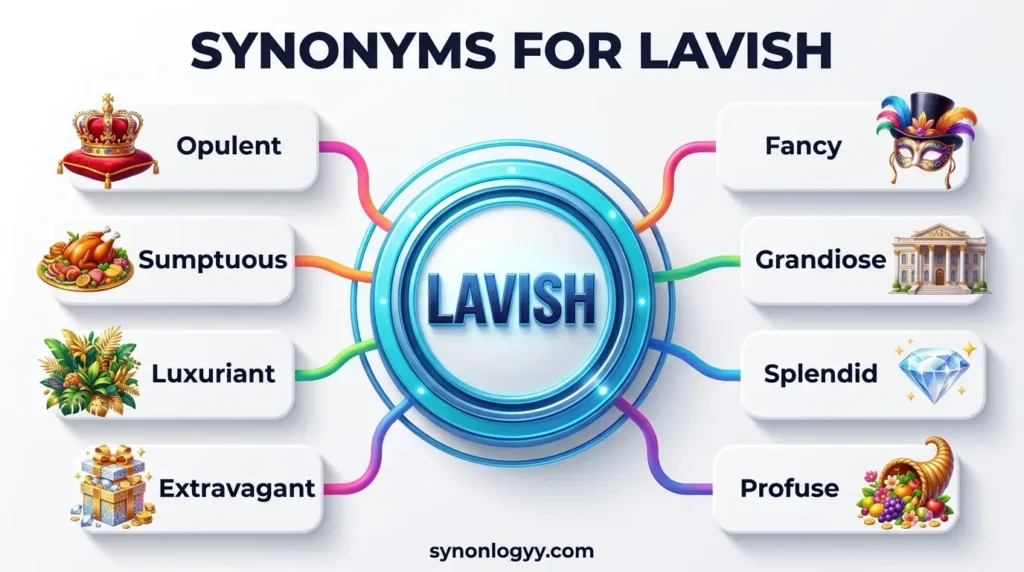
Synonyms for lavish help you describe something rich, grand, or given in large amounts. The word lavish often describes fancy homes, costly gifts, rich meals, or generous praise.
Imagine visiting a wedding with bright lights, fine clothes, and a huge dinner. You might call the event lavish because it feels grand and impressive.
People use this word when they discuss luxury, spending, gifts, and celebrations. It can also describe giving someone more care or praise than expected.
For English learners, similar words make speaking and writing easier. Content writers can use them to avoid repeating the same word. Still, each synonym has its own meaning and tone.
This guide explains the meaning, history, pronunciation, and grammar of lavish. It also shares 30 alternatives, clear examples, antonyms, and tips for choosing the right word.
Quick List: Lavish Synonyms at a Glance
These alternatives describe luxury, richness, large amounts, or generous giving, depending on context.
Luxurious, extravagant, opulent, sumptuous, grand, splendid, magnificent, rich, elaborate, ornate, deluxe, plush, lavishly appointed, impressive, extravagant, generous, abundant, ample, plentiful, profuse, excessive, excessive in spending, over-the-top, ostentatious, showy, flamboyant, lavishly decorated, bountiful, liberal, unstinting
Meaning of Lavish
Definition
Lavish (adjective/verb): As an adjective, lavish means very rich, grand, or generous in amount. As a verb, it means to give or spend something freely and in large amounts.
The adjective often describes luxury or impressive displays. A lavish hotel may have fine furniture and excellent service. A lavish meal may include many rich dishes.
The verb often appears in phrases such as lavish praise or lavish attention. In these phrases, someone gives praise or attention generously.
Examples
- Their family planned a lavish wedding at a seaside hotel.
- The coach lavished praise on the team after its win.
Common Collocations
These phrases often appear with lavish.
- Lavish lifestyle: They enjoy a lavish lifestyle abroad.
- Lavish wedding: The couple planned a lavish wedding.
- Lavish gifts: He gave her lavish gifts.
- Lavish praise: The teacher offered lavish praise after class.
- Lavish spending: Lavish spending drained the family’s savings.
Connotative Meaning
- Positive tone: Lavish can suggest beauty, comfort, generosity, or a special experience.
- Negative tone: It can suggest waste, excess, or a show of wealth meant to impress.
- Neutral tone: It can simply describe something grand or provided in large amounts.
(Connotation means the feelings or ideas a word suggests beyond its basic meaning.)
Etymology of Lavish
The word lavish entered English through Anglo-French or French forms linked to the idea of abundance or excess. Its exact early development is not fully certain, so its history should be described with care.
- Old English (450–1100): The modern word lavish is not recorded as an Old English word. Older English had other words for plenty, wealth, and generosity.
- Middle English (1100–1500): Forms related to lavish appeared in English around the late medieval period. The word developed the sense of giving or using something freely and without restraint.
- Modern English (1500–Present): Lavish came to describe both generous giving and grand displays of wealth. Today, it can describe luxury, rich decoration, large amounts, or freely given praise and attention.
Pronunciation of Lavish (IPA)
- IPA (US): /ˈlæv.ɪʃ/
- Syllables: lav-ish (two syllables)
The first syllable carries the main stress. It rhymes with the first part of lavender, while the ending sounds like fish without the first sound.
Affixation Pattern of Lavish
- Root: Lavish is the base word.
- Prefix: None in the basic word.
- Suffix: The ending -ish is part of the word’s historical form. It is not a productive suffix that you should remove to form the modern word.
- Word formations:
- Lavish (adjective): Grand, rich, or generous in amount.
- Lavish (verb): To give or spend freely.
- Lavishly (adverb): In a rich, grand, or generous way.
- Lavishness (noun): The quality of being lavish.
- Lavished (verb, past tense): Gave or spent freely.
- Lavishing (verb, present participle): Giving or spending freely.
Examples:
- Lavish: They booked a lavish hotel room.
- Lavishly: The hall was lavishly decorated for the event.
- Lavishness: The lavishness of the party surprised everyone.
- Lavished: The singer lavished praise on her band.
- Lavishing: He is lavishing attention on the new puppy.
30 Synonyms of Lavish With Meaning & Examples
The best synonym depends on what lavish describes. Some words focus on luxury, while others describe generous amounts or excessive spending. The options below are close alternatives, but a few fit only certain contexts.
1. Luxurious (adjective)
Meaning: Luxurious describes something very comfortable, costly, or rich in quality.
Best used when / Tone: Positive, common, related to comfort and wealth.
Examples:
- The hotel offered luxurious rooms with soft beds.
- For their anniversary, they booked a luxurious train journey.
2. Extravagant (adjective)
Meaning: Extravagant describes spending or behavior that goes far beyond what is needed.
Best used when / Tone: Strong, often negative, sometimes admiring.
Examples:
- His extravagant shopping habits worried his family.
- The studio built an extravagant set for the film.
3. Opulent (adjective)
Meaning: Opulent describes a place or object that shows great wealth.
Best used when / Tone: Formal, elegant, focused on wealth.
Examples:
- The palace had opulent rooms with gold details.
- Guests entered an opulent ballroom before the awards dinner.
4. Sumptuous (adjective)
Meaning: Sumptuous describes something rich, beautiful, and pleasing to the senses.
Best used when / Tone: Elegant, warm, often used for food or rooms.
Examples:
- The chef served a sumptuous meal at the charity dinner.
- Their guests admired the sumptuous velvet curtains.
5. Grand (adjective)
Meaning: Grand describes something impressive in size, style, or importance.
Best used when / Tone: Common, positive, broad.
Examples:
- The city opened a grand theater near the river.
- Their school held a grand ceremony for its graduates.
6. Splendid (adjective)
Meaning: Splendid describes something excellent, beautiful, or impressive.
Best used when / Tone: Positive, slightly formal, often admiring.
Examples:
- The garden looked splendid after the spring rain.
- Her splendid performance earned a standing ovation.
7. Magnificent (adjective)
Meaning: Magnificent describes something extremely beautiful or impressive.
Best used when / Tone: Strong, positive, expressive.
Examples:
- Tourists admired the magnificent mountain view.
- The museum displayed a magnificent collection of old paintings.
8. Rich (adjective)
Meaning: Rich describes something full, deep, costly, or high in quality.
Best used when / Tone: Common, flexible, depends on context.
Examples:
- The restaurant served rich chocolate cake for dessert.
- Their living room had rich colors and heavy fabrics.
9. Elaborate (adjective)
Meaning: Elaborate describes something made with many details or careful planning.
Best used when / Tone: Neutral to positive, detail-focused.
Examples:
- The students created an elaborate model of the solar system.
- A designer planned an elaborate stage for the concert.
10. Ornate (adjective)
Meaning: Ornate describes something covered with many decorative details.
Best used when / Tone: Formal, visual, sometimes excessive.
Examples:
- The old church had ornate wooden doors.
- She chose an ornate frame for the family portrait.
11. Deluxe (adjective)
Meaning: Deluxe describes a product or service with extra comfort or features.
Best used when / Tone: Commercial, positive, common in advertising.
Examples:
- We chose the deluxe package for our holiday.
- The store introduced a deluxe version of its popular chair.
12. Plush (adjective)
Meaning: Plush describes something soft, comfortable, or richly furnished.
Best used when / Tone: Informal, warm, focused on comfort.
Examples:
- The theater had plush seats and thick carpets.
- Their new apartment included a plush guest room.
13. Impressive (adjective)
Meaning: Impressive describes something that causes admiration or respect.
Best used when / Tone: Common, positive, broad.
Examples:
- The fundraiser raised an impressive amount of money.
- His impressive home library held thousands of books.
14. Generous (adjective)
Meaning: Generous describes giving more than expected or willingly sharing with others.
Best used when / Tone: Positive, personal, often about giving.
Examples:
- The donor made a generous gift to the local school.
- Her generous offer helped a family after the fire.
15. Abundant (adjective)
Meaning: Abundant describes something available in large quantities.
Best used when / Tone: Neutral, clear, focused on quantity.
Examples:
- Fresh fruit was abundant at the summer market.
- The report found abundant evidence of water pollution.
16. Ample (adjective)
Meaning: Ample describes an amount that is more than enough for a need.
Best used when / Tone: Neutral, practical, often reassuring.
Examples:
- The kitchen had ample space for meal preparation.
- We left ample time to reach the airport.
17. Plentiful (adjective)
Meaning: Plentiful describes something that exists in large amounts.
Best used when / Tone: Neutral, simple, useful for everyday writing.
Examples:
- Wildflowers were plentiful along the country road.
- The food bank received plentiful supplies before winter.
18. Profuse (adjective)
Meaning: Profuse describes something given or present in very large amounts.
Best used when / Tone: Formal, strong, often about thanks or apologies.
Examples:
- The guest offered profuse thanks to the hosts.
- After the match, the player gave profuse apologies for his conduct.
19. Excessive (adjective)
Meaning: Excessive describes more of something than is reasonable or needed.
Best used when / Tone: Negative, direct, focused on too much.
Examples:
- Excessive spending left little money for bills.
- The report warned about excessive use of plastic packaging.
20. Over-the-top (adjective)
Meaning: Over-the-top describes something so extreme that it seems too much.
Best used when / Tone: Informal, expressive, often critical.
Examples:
- The birthday cake had an over-the-top design.
- Viewers called the show’s finale over-the-top and silly.
21. Ostentatious (adjective)
Meaning: Ostentatious describes a display meant to attract attention to wealth or status.
Best used when / Tone: Formal, usually negative, focused on showing off.
Examples:
- His ostentatious watch drew attention at the meeting.
- The mansion’s ostentatious entrance seemed designed to impress visitors.
22. Showy (adjective)
Meaning: Showy describes something designed to attract attention through its appearance.
Best used when / Tone: Informal, sometimes negative, appearance-focused.
Examples:
- The performer wore a showy jacket covered in bright stones.
- A showy advertisement took over the entire webpage.
23. Flamboyant (adjective)
Meaning: Flamboyant describes someone or something bold, colorful, and attention-grabbing.
Best used when / Tone: Expressive, lively, sometimes critical.
Examples:
- The singer chose a flamboyant outfit for the awards.
- Her flamboyant style made the small shop stand out.
24. Bountiful (adjective)
Meaning: Bountiful describes a large and generous supply of something good.
Best used when / Tone: Warm, positive, often about food or nature.
Examples:
- The farm produced a bountiful harvest after the rain.
- Their table held a bountiful spread for the holiday.
25. Liberal (adjective)
Meaning: Liberal can mean giving or using something freely and in large amounts.
Best used when / Tone: Neutral to positive, often about amounts or giving.
Examples:
- Apply a liberal amount of sunscreen before swimming.
- The editor made liberal use of examples in the guide.
26. Unstinting (adjective)
Meaning: Unstinting describes giving help, praise, or effort without holding back.
Best used when / Tone: Formal, positive, focused on generosity.
Examples:
- Her unstinting support helped the team finish the project.
- The volunteers gave unstinting care to the rescued animals.
27. Extravagant in appearance (adjective phrase)
Meaning: Extravagant in appearance describes something with a bold and costly look.
Best used when / Tone: Descriptive, clear, focused on style.
Examples:
- The hotel lobby was extravagant in appearance.
- The designer’s new collection looked extravagant in appearance.
28. Richly decorated (adjective phrase)
Meaning: Richly decorated describes a place or object with many fine decorations.
Best used when / Tone: Neutral, visual, useful for descriptions.
Examples:
- The restaurant was richly decorated for the winter festival.
- Their home was richly decorated with carved wood.
29. Well-appointed (adjective)
Meaning: Well-appointed describes a room or place equipped with useful, often high-quality features.
Best used when / Tone: Professional, positive, common in property descriptions.
Examples:
- The rental included a well-appointed kitchen.
- Guests enjoyed the well-appointed suite during the conference.
30. Unrestrained (adjective)
Meaning: Unrestrained describes something done freely, without limits or control.
Best used when / Tone: Strong, formal, may suggest excess.
Examples:
- The crowd showed unrestrained joy after the final goal.
- His unrestrained spending caused problems by month’s end.
Synonym Comparison Table
| Synonym | Tone | Formality | Best for |
|---|---|---|---|
| Luxurious | Positive | Neutral | Comfort and high quality |
| Extravagant | Often critical | Neutral | Spending beyond normal limits |
| Opulent | Elegant | Formal | Wealth and rich interiors |
| Sumptuous | Admiring | Formal | Meals, fabrics, and rich settings |
| Grand | Positive | Neutral | Events, buildings, and scale |
| Splendid | Admiring | Semi-formal | Beauty and excellence |
| Generous | Positive | Neutral | Gifts, help, and giving |
| Abundant | Neutral | Neutral | Large amounts or supplies |
| Excessive | Negative | Neutral | More than is needed |
| Ostentatious | Critical | Formal | Showing off wealth |
Prototype Meaning of Lavish
When people hear lavish, they often picture a grand event, a costly home, or a rich meal. The word suggests more than basic comfort or simple beauty.
points to something generous, impressive, or unusually rich. A lavish wedding might have fine clothes, a large meal, and detailed decorations.
A person can also lavish praise on someone after a great achievement. In that use, the word describes giving freely rather than spending money. The shared idea is abundance: something appears or is given in a large, generous, or striking way.
Prototype Categorization of the 30 Synonyms
The best synonym depends on the kind of lavishness you mean. Use these groups to choose words with the right shade of meaning.
- Luxury and wealth: Luxurious, opulent, sumptuous, deluxe, plush. Use these words for costly items, fine rooms, rich meals, or extra comfort.
- Beauty and grandeur: Grand, splendid, magnificent, impressive. Choose these when something looks beautiful, large, or worthy of admiration.
- Detailed decoration: Elaborate, ornate, showy, flamboyant, richly decorated. These words suit clothes, rooms, art, parties, and designs with strong visual details.
- Large amounts and plenty: Abundant, ample, plentiful, profuse, bountiful. Use these when food, supplies, praise, or other things appear in large amounts.
- Giving and support: Generous, liberal, unstinting. These words fit gifts, help, praise, time, or effort given freely.
- Excess and display: Extravagant, excessive, over-the-top, ostentatious, unrestrained. Choose these when something seems too costly, too dramatic, or designed to attract attention.
- High-quality places: Well-appointed, lavishly furnished, richly decorated. These phrases help describe homes, hotels, offices, and other spaces with quality features or decorations.
- Rich style and appearance: Rich, extravagant in appearance. Use these when the overall look feels full, bold, or costly. Remember that rich can also describe taste, color, or sound.
These categories help you match each word to the message you want to share. They also reduce repetition and make descriptions more precise. Similar words are not always interchangeable: generous often describes giving, while opulent usually describes wealth or luxury.
Antonyms of Lavish
These words describe a lack of luxury, limited amounts, or careful spending. Choose the opposite that fits your sentence.
- Modest (adjective): Simple and not showy. Example: They held a modest wedding at home.
- Simple (adjective): Plain and without extra details. Example: The room had simple furniture and white walls.
- Plain (adjective): Without decoration or fancy features. Example: He wore a plain shirt to the event.
- Frugal (adjective): Careful about spending money. Example: Her frugal habits helped her save for college.
- Thrifty (adjective): Good at avoiding waste and saving money. Example: The thrifty shopper compared prices before buying.
- Economical (adjective): Using money or resources carefully. Example: The family chose an economical holiday plan.
- Sparse (adjective): Present in small amounts or spread thinly. Example: Sparse decorations gave the hall a quiet look.
- Scant (adjective): Barely enough or less than needed. Example: The shelter had scant supplies after the storm.
- Meager (adjective): Too small in amount or poor in quality. Example: The workers received a meager meal during the delay.
- Austere (adjective): Plain, strict, and without comfort or decoration. Example: The office had an austere design with bare walls.
Short Questions and Answers
What does lavish mean?
Lavish means very grand, rich, or generous in amount. It can describe a luxurious home, an elaborate party, or a large meal. As a verb, it means to give or spend freely, as in lavish praise or lavish attention.
When should lavish be used?
Use lavish when something feels unusually rich, grand, generous, or abundant. It works well for weddings, gifts, meals, homes, decorations, and praise.
Choose another word when you need a more exact meaning, such as generous for giving or ornate for decoration.
Is lavish positive or negative?
Lavish can sound positive or negative. It may praise beauty, comfort, or generosity. It may also suggest wasteful spending or too much display.
The sentence gives readers the clue. A lavish welcome sounds warm, while lavish spending may sound critical.
How is lavish different from similar words?
Lavish can describe both grand things and generous giving. Luxurious focuses on comfort and high quality, while extravagant often suggests excess.
Opulent points to visible wealth, and generous focuses on giving. Choose the word that best matches the action or object.
What is the best synonym for lavish in formal writing?
Opulent is a strong formal choice when describing wealth or luxurious settings. Sumptuous suits rich meals or beautiful surroundings. Abundant works better for large amounts, while generous fits gifts, help, or praise. The right word depends on the subject.
What is a simple word to use instead of lavish?
Use grand when describing an impressive event or place. Choose rich for deep colors, flavors, or costly styles. Use generous when someone gives a lot. These simple words are easy to understand, but each works best in a different context.
Conclusion
Learning synonyms for lavish helps you describe luxury, beauty, generosity, and excess more clearly. Words like luxurious, grand, and opulent suit rich settings.
Generous, abundant, and unstinting describe giving or having plenty. Other choices, such as extravagant and ostentatious, can suggest too much spending or showing off.
For English learners, these alternatives build vocabulary and make speaking more natural. For students and content writers, they help avoid repeated words and create sharper descriptions.
Always think about the meaning and tone before choosing a synonym. A word that fits a fancy hotel may not fit a generous gift. Practice one new word each day and use it in your own sentences.