“Their” is a common word in English. We use it to show that something belongs to two or more people, or to a person whose gender is not known or does not matter. For example, you might say,
“The students brought their books to class.” Here, “their” shows that the books belong to the students.
People use “their” in daily talks, schoolwork, emails, and online writing. But using the same word again and again can make writing sound dull. Learning synonyms and related phrases can help you express ideas in new ways.
It can also help you build your English skills and write with more confidence.
However, “their” is a possessive determiner, so it has no exact synonyms that fit every sentence. Words such as “his,” “her,” and “our” may work in some cases, but their meaning depends on who owns the item.
This guide explains the meaning, history, grammar, pronunciation, and 30 useful alternatives to “their,” with clear examples and semantic groups.
Meaning of Synonyms for Their
Their (Possessive Determiner):
“Their” shows that something belongs to or is linked to a group of people, animals, or things. It can also refer to one person when their gender is unknown, not relevant, or when they use they/them pronouns.
Examples
- The children packed their bags before the trip.
- Every student should bring their own notebook.
Connotative Meaning
- Positive tone: “Their” can show a sense of shared success or pride. Example: Their team won the match.
- Negative tone: It can appear in a sentence about blame or loss. Example: Their mistake caused a delay.
- Neutral tone: It often shows ownership without any strong feeling. Example: Their house is near the park.
(Connotation means the feeling or idea that a word brings to mind beyond its basic meaning.)
Etymology
The word “their” has roots in Old Norse and entered English through contact between Norse-speaking settlers and English speakers.
- Old English (450–1100): Old English used forms such as “hiera” to show possession. These forms were related to the older English pronoun system.
- Middle English (1100–1500): The Norse form “their” became common in northern parts of England. It gradually spread and replaced older forms in many uses.
- Modern English (1500–Present): “Their” became the standard possessive form for “they.” Today, it can show group ownership or refer to one person in a gender-neutral way.
Pronunciation (IPA)
- IPA: /ðeər/ (common British pronunciation); /ðer/ (common American pronunciation)
- Syllables: One syllable “their”
Affixation Pattern of Their
- Root: “Their” is an independent pronoun-related word, not a word built from a modern English root.
- Prefix: None.
- Suffix: None.
- Word formations and related grammatical forms:
- They (pronoun): They are waiting outside.
- Them (object pronoun): I saw them at school.
- Theirs (possessive pronoun): This bag is theirs.
- Themselves (reflexive pronoun): They made the cake themselves.
- Their own (possessive phrase): They brought their own food.
30 Synonyms for Their With Meaning & Examples
Important note: “Their” has no exact synonyms in all contexts. The words and phrases below are contextual alternatives. Choose one based on who owns the item and what the sentence means.
1. His (Possessive Determiner)
Meaning: Shows that something belongs to a male person or someone who uses he/him pronouns.
Examples:
- Jack put his coat on the chair.
- The boy finished his homework.
2. Her (Possessive Determiner)
Meaning: Shows that something belongs to a female person or someone who uses she/her pronouns.
Examples:
- Mia took her book home.
- The girl washed her hands.
3. Its (Possessive Determiner)
Meaning: Shows that something belongs to an animal, object, or other entity when referred to as “it.”
Examples:
- The dog wagged its tail.
- The tree lost its leaves.
4. Our (Possessive Determiner)
Meaning: Shows that something belongs to the speaker and one or more other people.
Examples:
- We cleaned our room.
- Our teacher gave us a task.
5. Your (Possessive Determiner)
Meaning: Shows that something belongs to the person or people being spoken to.
Examples:
- Please bring your bag.
- You should check your answers.
6. My (Possessive Determiner)
Meaning: Shows that something belongs to the speaker.
Examples:
- I left my keys at home.
- My phone needs to be charged.
7. Theirs (Possessive Pronoun)
Meaning: Shows that something belongs to them without naming the thing again with a noun.
Examples:
- That house is theirs.
- The red bags are theirs.
8. His Own (Possessive Phrase)
Meaning: Emphasizes that something belongs to a male person or someone who uses he/him pronouns.
Examples:
- He brought his own lunch.
- Liam fixed his own bike.
9. Her Own (Possessive Phrase)
Meaning: Emphasizes that something belongs to a female person or someone who uses she/her pronouns.
Examples:
- She has her own room.
- Ava wrote her own story.
10. Its Own (Possessive Phrase)
Meaning: Emphasizes that an animal, object, or entity has something belonging to it.
Examples:
- The cat has its own bed.
- The company has its own website.
11. Our Own (Possessive Phrase)
Meaning: Emphasizes that something belongs to the speaker and their group.
Examples:
- We made our own rules.
- Our own team planned the event.
12. Your Own (Possessive Phrase)
Meaning: Emphasizes that something belongs to the person or people being addressed.
Examples:
- You should make your own choice.
- Bring your own water bottle.
13. My Own (Possessive Phrase)
Meaning: Emphasizes that something belongs to the speaker.
Examples:
- I wrote my own poem.
- I have my own desk.
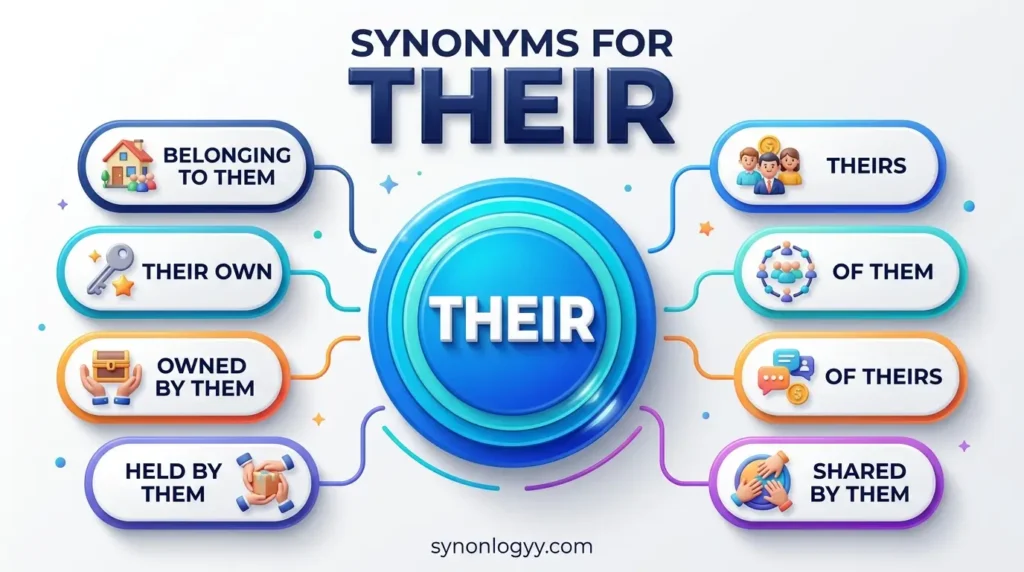
14. Belonging to Them (Phrase)
Meaning: Describes something that is owned by or connected to them.
Examples:
- The books belonging to them are on the shelf.
- We returned the bags belonging to them.
15. Owned by Them (Phrase)
Meaning: Describes something that they own.
Examples:
- The car owned by them is blue.
- The land owned by them is near the river.
16. In Their Possession (Phrase)
Meaning: Means that something is held or controlled by them.
Examples:
- The keys are in their possession.
- The papers remained in their possession.
17. Under Their Control (Phrase)
Meaning: Describes something managed or directed by them.
Examples:
- The project is under their control.
- The team placed the equipment under their control.
18. Associated With Them (Phrase)
Meaning: Describes something linked to them.
Examples:
- The name associated with them appeared on the list.
- The work associated with them received praise.
19. Linked to Them (Phrase)
Meaning: Describes something connected to them.
Examples:
- The account linked to them was closed.
- The files linked to them were reviewed.
20. Related to Them (Phrase)
Meaning: Describes something that has a connection to them.
Examples:
- The issue related to them needs attention.
- The records related to them are stored here.
21. Belonging to the Group (Phrase)
Meaning: Shows that something belongs to a particular group.
Examples:
- The tools belonging to the group are in the box.
- The room belonging to the group is upstairs.
22. Of the Group (Phrase)
Meaning: Shows a link between an item and a group, often in formal writing.
Examples:
- The views of the group were shared.
- The leader of the group spoke first.
23. Of the Team (Phrase)
Meaning: Shows a link between something and a team.
Examples:
- The goals of the team were clear.
- The coach praised the efforts of the team.
24. Of the Family (Phrase)
Meaning: Shows a connection to a family.
Examples:
- The history of the family is well known.
- The home of the family stood by the lake.
25. Of the Students (Phrase)
Meaning: Shows a link between something and the students.
Examples:
- The work of the students was neat.
- The needs of the students come first.
26. Of the Workers (Phrase)
Meaning: Shows a connection to a group of workers.
Examples:
- The safety of the workers is important.
- The tools of the workers were stored away.
27. Of the Children (Phrase)
Meaning: Shows a connection to children.
Examples:
- The toys of the children were on the floor.
- The health of the children matters.
28. Of the People (Phrase)
Meaning: Shows a connection to a group of people.
Examples:
- The needs of the people must be met.
- The voices of the people were heard.
29. Each Person’s (Possessive Phrase)
Meaning: Shows that something belongs to each person in a group, considered one by one.
Examples:
- Each person’s bag was checked.
- Each person’s choice was respected.
30. Everyone’s (Possessive Determiner)
Meaning: Shows that something belongs to or concerns every person in a group.
Examples:
- Everyone’s opinion matters.
- Everyone’s name was on the list.
Prototype Meaning
The most common meaning of “their” is to show that something belongs to or is linked to other people.
When people hear the word, they often think of items shared by a group, such as “their home,” “their books,” or “their ideas.”
It can also refer to one person in a gender-neutral way, as in “Someone left their phone here.” The exact meaning depends on the sentence and the people involved.
Prototype Categorization
The alternatives above fit into several groups. These groups help writers choose the right phrase for the meaning they want.
- Basic possessive determiners: His, her, its, our, your, my. Use these when the owner is known and the point of view fits the sentence.
- Possessive pronouns: Theirs. Use this when the noun has already been named or is clear.
- Emphasis phrases: His own, her own, its own, our own, your own, my own. Use these to stress personal ownership.
- Ownership and control phrases: Belonging to them, owned by them, in their possession, under their control. Use these when ownership or control needs to be clear.
- Connection phrases: Associated with them, linked to them, related to them. Use these when the connection is not always about ownership.
- Group-related phrases: Belonging to the group, of the group, of the team, of the family, of the students, of the workers, of the children, of the people. Use these when the group needs to be named.
- Individual and shared reference: Each person’s, everyone’s. Use these when talking about people one by one or the whole group.
Grouping alternatives by meaning helps writers avoid errors. It also makes writing clearer and less repetitive. Remember that many phrases change the sentence structure, so they cannot replace “their” word for word.
Antonyms of Their
“Their” is a possessive determiner, so it has no direct antonym. The following words and phrases can express a different owner or a lack of ownership, depending on the sentence.
- Mine (Possessive Pronoun): Shows that something belongs to me. Example: The blue bag is mine.
- Yours (Possessive Pronoun): Shows that something belongs to you. Example: This seat is yours.
- Ours (Possessive Pronoun): Shows that something belongs to us. Example: The house is ours.
- Not theirs (Phrase): States that something does not belong to them. Example: This coat is not theirs.
- Unowned (Adjective): Means that something has no owner. Example: The unowned bike was left outside.
These are not exact opposites in every sentence. The best choice depends on the intended meaning.
Short Questions and Answers
What does “their” mean?
“Their” shows that something belongs to or is connected to two or more people. It can also refer to one person in a gender-neutral way.
When should “their” be used?
Use “their” when the owner is “they” or when you refer to a person using they/them pronouns. For example, “The players packed their bags.”
Is “their” positive or negative?
“Their” is usually neutral. The rest of the sentence gives it a positive or negative tone.
How is “their” different from similar words?
“Their” shows possession linked to “they.” “There” refers to a place or introduces a statement, while “they’re” is short for “they are.” These three words sound alike but have different meanings.
Conclusion
Learning “their” and its related alternatives can improve your English vocabulary and make your writing clearer.
While “their” has no exact synonym that works in every sentence, phrases such as “belonging to them,” “owned by them,” and “associated with them” can express similar ideas in the right context.
Other possessive words, such as “his,” “her,” “our,” and “your,” work only when the owner changes.
Knowing these differences helps you avoid grammar mistakes, reduce repetition, and choose words that fit your meaning.
It can also make your speaking and writing sound more natural. Practice by writing a few sentences each day. Try using “their” in different contexts, then explore a suitable alternative when the sentence allows it.
With regular practice, you can build stronger vocabulary and greater confidence in English.