Synonyms for convenient help us describe things that save time, effort, or trouble. The word convenient means easy to use, reach, or do. Imagine finding a store near your home that stays open late.
That store is convenient because it fits your daily needs.
People use this word in daily talks, schoolwork, emails, and business writing. Yet using the same word too often can make writing feel dull.
Learning synonyms helps ESL learners express ideas with greater care. It also helps students and content writers choose words that fit each situation.
Some alternatives focus on saving time, while others stress ease or comfort. This guide explains the meaning of convenient and presents 30 useful synonyms with examples.
You will also learn about grammar, word history, pronunciation, antonyms, and groups of related words. These tips will help you choose the right word with confidence.
Quick List: Convenient Synonyms at a Glance
These words can replace convenient in some situations, but their meanings may differ slightly.
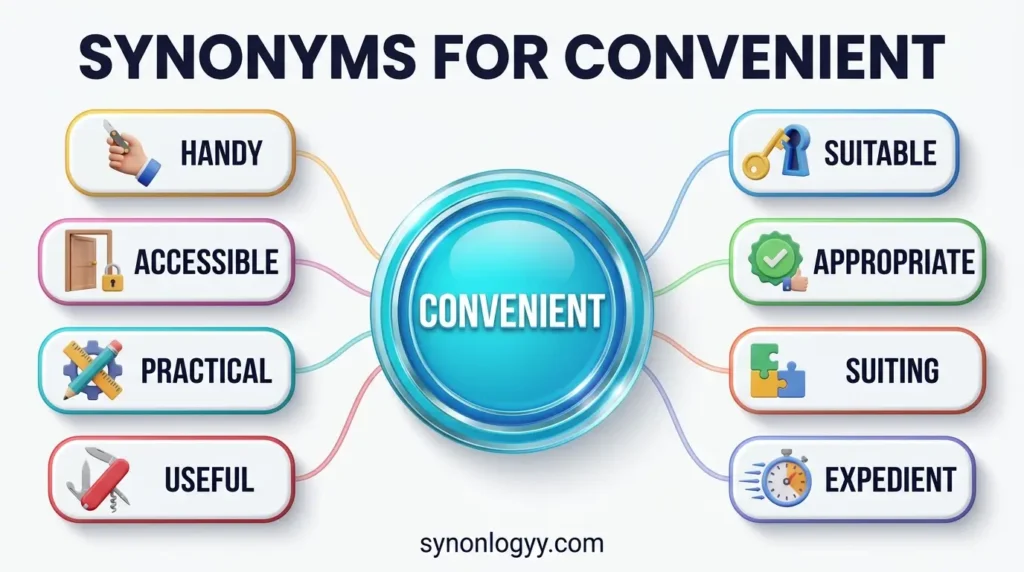
Easy, handy, practical, useful, accessible, suitable, appropriate, helpful, comfortable, effortless, trouble-free, straightforward, simple, efficient, time-saving, user-friendly, manageable, favorable, opportune, well-placed, nearby, available, ready, fitting, expedient, serviceable, functional, accommodating, hassle-free, advantageous.
Meaning of Convenient
Definition
Convenient (adjective): Easy to use, reach, or do without much trouble or wasted time.
Something is convenient when it fits your needs or makes a task easier. A nearby bus stop is convenient for daily travel.
An online form is convenient when you can complete it at home.
The word often describes places, times, services, tools, and arrangements. It can also describe a choice that fits someone’s plans.
Examples
- The grocery store is convenient for our family.
- Online classes are convenient for students with busy schedules.
Common Collocations
These phrases often appear with convenient in everyday English.
- Convenient location: Our office has a convenient location.
- Convenient time: Please choose a convenient time tomorrow.
- Convenient way: Email is a convenient way to share files.
- Convenient access: The hotel offers convenient access to downtown.
- Convenient option: Paying online is a convenient option.
Connotative Meaning
(Connotation means the feeling or idea a word suggests beyond its basic meaning.)
- Positive tone: Convenient often suggests ease, comfort, and saved time.
- Negative tone: It can suggest a choice made for personal gain. For example, someone may choose a convenient excuse instead of telling the truth.
- Neutral tone: It can simply describe an option that fits a person’s needs.
The tone depends on the context. A convenient bus route sounds helpful, while a convenient excuse may sound dishonest.
Etymology of Convenient
The word convenient comes from Latin through French and Middle English. Its history connects the idea of convenience with things that fit or come together well.
The Latin verb convenire means “to come together” or “to agree.” It combines con- (“together”) with venire (“to come”). Latin convenientem helped form the word that entered English through French.
Over time, the meaning developed to include suitability, usefulness, and ease.
- Old English (450–1100): Convenient was not an established Old English word. English speakers used other words to express ideas of fitness and suitability.
- Middle English (1100–1500): The word entered English through Anglo-French and Old French forms related to Latin convenire. It could describe something suitable or fitting.
- Modern English (1500–Present): The word gained its familiar sense of being easy, suitable, or helpful for a particular purpose.
Today, convenient often describes anything that saves effort or fits a person’s schedule.
Pronunciation of Convenient (IPA)
- IPA (US): /kənˈviːniənt/
- Syllables: con-ven-ient (three syllables)
- Stress: The second syllable receives the main stress.
Say the word slowly: kuhn-VEE-nee-uhnt. Then say it at a normal speed. Practice with this sentence: “The new app is convenient for busy people.”
Affixation Pattern of Convenient
- Root: The word traces back to Latin venire, meaning “to come,” through convenire. In modern English, convenient functions as a complete word.
- Prefix: Con- is part of the Latin source word, where it means “together.” It is not a freely removable prefix in modern convenient.
- Suffix: -ent forms adjectives in many English words and reflects the word’s historical development.
- Word formations:
- Convenient (adjective): Easy or suitable for a purpose.
- Convenience (noun): The state or quality of being convenient.
- Conveniently (adverb): In a way that saves time or effort.
- Inconvenient (adjective): Causing trouble or difficulty.
- Inconvenience (noun): Trouble or difficulty caused by something.
- Inconveniently (adverb): In a way that causes difficulty.
Examples:
- The shop is convenient for local residents.
- Online payment offers greater convenience.
- The bus stop is conveniently located nearby.
- The meeting time is inconvenient for me.
- We apologize for the inconvenience.
- The road was inconveniently closed during rush hour.
These forms share a word family, but each has a different grammatical role.
30 Synonyms of Convenient With Meaning & Examples
Not every synonym works in every sentence. Check the meaning and examples before choosing a replacement.
1. Easy (adjective)
Meaning: Requiring little effort, skill, or trouble.
Best used when / Tone: Everyday, simple, informal.
Examples:
- This recipe is easy for new cooks.
- The children found the game easy to learn.
2. Handy (adjective)
Meaning: Useful and easy to reach or use when needed.
Best used when / Tone: Friendly, informal.
Examples:
- Keep a flashlight handy during power cuts.
- This pocket guide is handy for new travelers.
3. Practical (adjective)
Meaning: Suitable for real needs and everyday use.
Best used when / Tone: Neutral, useful, thoughtful.
Examples:
- A backpack is practical for daily school trips.
- She chose practical shoes for the long walk.
4. Useful (adjective)
Meaning: Helping someone do something or meet a need.
Best used when / Tone: Neutral, broad.
Examples:
- The chart is useful for science lessons.
- His notes proved useful during the meeting.
5. Accessible (adjective)
Meaning: Easy to reach, enter, obtain, or use.
Best used when / Tone: Neutral, professional, inclusive.
Examples:
- The library is accessible by public transportation.
- The website makes lessons accessible to all users.
6. Suitable (adjective)
Meaning: Right for a particular person, purpose, or situation.
Best used when / Tone: Neutral, slightly formal.
Examples:
- This room is suitable for small meetings.
- We need a suitable date for the school trip.
7. Appropriate (adjective)
Meaning: Correct or proper for a certain situation.
Best used when / Tone: Formal, careful, professional.
Examples:
- The teacher selected appropriate books for beginners.
- Please wear appropriate clothes for the interview.
8. Helpful (adjective)
Meaning: Making a task easier or giving useful support.
Best used when / Tone: Warm, positive.
Examples:
- The librarian gave me helpful directions.
- Her checklist is helpful when packing for travel.
9. Comfortable (adjective)
Meaning: Providing ease or freedom from discomfort.
Best used when / Tone: Gentle, personal.
Examples:
- The hotel offers comfortable seating in its lobby.
- He prefers a comfortable desk for long workdays.
10. Effortless (adjective)
Meaning: Requiring little or no visible effort.
Best used when / Tone: Positive, polished.
Examples:
- The new software makes photo editing seem effortless.
- She gave an effortless answer during the interview.
11. Trouble-free (adjective)
Meaning: Happening without problems or difficulties.
Best used when / Tone: Reassuring, practical.
Examples:
- The family enjoyed a trouble-free airport transfer.
- Regular checks help keep the system trouble-free.
12. Straightforward (adjective)
Meaning: Simple to understand or complete.
Best used when / Tone: Clear, neutral, professional.
Examples:
- The application process is straightforward for most users.
- Our coach gave straightforward steps for the exercise.
13. Simple (adjective)
Meaning: Easy to understand, use, or do.
Best used when / Tone: Basic, direct, informal.
Examples:
- A simple password reset fixed the problem.
- The teacher used simple words to explain fractions.
14. Efficient (adjective)
Meaning: Achieving a result with little wasted time or effort.
Best used when / Tone: Professional, productive.
Examples:
- The team created an efficient system for orders.
- An efficient route helped the driver save fuel.
15. Time-saving (adjective)
Meaning: Reducing the time needed for a task.
Best used when / Tone: Practical, focused on speed.
Examples:
- Frozen vegetables are a time-saving choice for dinner.
- The shortcut became a time-saving tool for editors.
16. User-friendly (adjective)
Meaning: Easy for people to understand and operate.
Best used when / Tone: Technical, customer-focused.
Examples:
- The bank launched a user-friendly mobile app.
- Clear menus make the website user-friendly for seniors.
17. Manageable (adjective)
Meaning: Easy enough to handle or control.
Best used when / Tone: Reassuring, practical.
Examples:
- The teacher split the project into manageable tasks.
- A smaller loan gave the family manageable payments.
18. Favorable (adjective)
Meaning: Helpful or suitable for achieving a desired result.
Best used when / Tone: Formal, positive.
Examples:
- Favorable weather allowed the race to begin early.
- The company found favorable terms in the new contract.
19. Opportune (adjective)
Meaning: Happening at a good or useful time.
Best used when / Tone: Formal, timing-focused.
Examples:
- Her visit was opportune because help was needed.
- The reporter asked an opportune question after the speech.
20. Well-placed (adjective)
Meaning: Located in a position that offers an advantage.
Best used when / Tone: Descriptive, neutral.
Examples:
- The café is well-placed near the train station.
- A well-placed sign guided visitors toward the entrance.
21. Nearby (adjective or adverb)
Meaning: Close to a person, place, or point.
Best used when / Tone: Everyday, location-focused.
Examples:
- We found a nearby clinic after the accident.
- A nearby parking lot made the concert easier to attend.
22. Available (adjective)
Meaning: Ready to be used, obtained, or accessed.
Best used when / Tone: Neutral, practical.
Examples:
- Online support is available throughout the workday.
- Extra seats were available for late arrivals.
23. Ready (adjective)
Meaning: Prepared for use or immediate action.
Best used when / Tone: Direct, everyday.
Examples:
- Keep your travel documents ready before check-in.
- The kitchen had ready supplies for the cooking class.
24. Fitting (adjective)
Meaning: Appropriate or right for a particular purpose.
Best used when / Tone: Neutral, sometimes formal.
Examples:
- A short speech was fitting for the small ceremony.
- The coach chose a fitting exercise for beginners.
25. Expedient (adjective)
Meaning: Useful for achieving a goal in a particular situation, often quickly.
Best used when / Tone: Formal, strategic.
Examples:
- The manager chose an expedient way to resolve the delay.
- A temporary fix seemed expedient before the launch.
26. Serviceable (adjective)
Meaning: Good enough to perform a needed job.
Best used when / Tone: Practical, modest.
Examples:
- The old printer remains serviceable for basic tasks.
- A serviceable desk suited the small home office.
27. Functional (adjective)
Meaning: Designed or working to serve a practical purpose.
Best used when / Tone: Neutral, technical.
Examples:
- The apartment has a functional kitchen layout.
- The designer made the website functional on phones.
28. Accommodating (adjective)
Meaning: Willing to adjust plans or meet another person’s needs.
Best used when / Tone: Warm, polite.
Examples:
- The hotel staff were accommodating about our late arrival.
- An accommodating teacher offered another test date.
29. Hassle-free (adjective)
Meaning: Free from trouble, stress, or unwanted complications.
Best used when / Tone: Informal, promotional.
Examples:
- The travel company promised a hassle-free booking process.
- Contactless payment offers a hassle-free way to shop.
30. Advantageous (adjective)
Meaning: Giving someone a benefit or useful position.
Best used when / Tone: Formal, strategic.
Examples:
- Early registration gave students an advantageous place in line.
- The new office location proved advantageous for hiring.
Synonym Comparison Table
These ten words are useful in everyday speech, schoolwork, and professional writing.
| Synonym | Tone | Formality | Best for |
|---|---|---|---|
| Easy | Simple, direct | Informal | Tasks that need little effort |
| Handy | Friendly | Informal | Useful items close at hand |
| Practical | Sensible | Neutral | Real-life needs and choices |
| Useful | Broad, neutral | Neutral | Things that help |
| Accessible | Inclusive, precise | Formal | Places, services, and information |
| Suitable | Careful | Neutral | Choices that fit a purpose |
| Helpful | Warm | Neutral | Support and guidance |
| Efficient | Productive | Formal | Saving time or resources |
| Straightforward | Clear | Neutral | Processes and instructions |
| User-friendly | Customer-focused | Professional | Apps, tools, and websites |
Prototype Meaning of Convenient
The most typical meaning of convenient is easy to use, reach, or arrange. People often picture a nearby shop, a quick online payment, or an appointment that fits their schedule. These things reduce effort and make daily life smoother.
The central idea is a good fit between a person’s needs and an available choice. The word does not always mean the fastest or simplest option. Something can be convenient because it is close, available at the right time, or easy to manage.
Prototype Categorization of the 30 Synonyms
The 30 synonyms fit into several groups based on the type of convenience they describe.
- Ease and simplicity: Easy, straightforward, simple, effortless. Use these words when a task needs little effort or is easy to understand.
- Practical value: Handy, practical, useful, serviceable, functional. Choose these when an item or method meets a real need.
- Access and location: Accessible, nearby, well-placed, available, ready. These words fit places, services, tools, or resources that people can reach or use.
- Suitability and fit: Suitable, appropriate, fitting, favorable. Use these when something matches a purpose, person, or situation.
- Time and efficiency: Efficient, time-saving, expedient, opportune. These focus on speed, timing, or reaching a goal with less wasted effort.
- Comfort and support: Comfortable, helpful, accommodating, manageable. These describe options that reduce strain or meet someone’s needs.
- Freedom from problems: Trouble-free, hassle-free, user-friendly. These suggest an experience with fewer difficulties or barriers.
- Benefit and advantage: Advantageous. Use this when an option gives someone a useful benefit or stronger position.
These groups help writers match a word to the exact point they want to make. They also reduce repetition without changing the meaning by accident.
Remember, similar words are not always interchangeable: nearby describes distance, while efficient describes how well something uses time or effort.
Antonyms of Convenient
Antonyms describe the opposite of convenience. Choose one based on the kind of difficulty involved.
- Inconvenient (adjective): Causing trouble or difficulty. The meeting time is inconvenient for me.
- Awkward (adjective): Difficult to use or manage. The awkward handle made the bag hard to carry.
- Difficult (adjective): Needing much effort or skill. The difficult form took an hour to complete.
- Troublesome (adjective): Causing repeated problems. The troublesome printer stopped working again.
- Impractical (adjective): Unsuitable for real needs. That impractical design wastes too much space.
- Inaccessible (adjective): Hard or impossible to reach or use. The remote village became inaccessible after the storm.
- Uncomfortable (adjective): Causing physical or emotional discomfort. The uncomfortable chair made studying difficult.
- Cumbersome (adjective): Large, complex, or hard to handle. The cumbersome process delayed every order.
- Unsuitable (adjective): Not right for a purpose. The late appointment was unsuitable for working parents.
- Inefficient (adjective): Wasting time, effort, or resources. The inefficient system caused long waiting times.
Short Questions and Answers
What does convenient mean?
Convenient means easy to use, reach, or do without much trouble. It often describes something that saves time or fits a person’s needs. A nearby store, an online payment service, or a suitable meeting time can all be convenient.
When should convenient be used?
Use convenient when describing something that makes life easier or fits a person’s plans. It works well for places, times, services, tools, and arrangements.
For example, an online appointment system is convenient because people can book visits without traveling.
Is convenient positive or negative?
Convenient is usually positive or neutral. It often suggests that something saves time or effort. However, it can sound negative when someone puts personal ease above honesty or fairness.
For example, a “convenient excuse” may suggest that someone is avoiding the truth.
How is convenient different from similar words?
Each synonym highlights a different feature. Easy focuses on low effort, while accessible focuses on reaching or using something. Efficient stresses good use of time or resources.
Practical describes what works in real life, while suitable means right for a particular purpose.
What is the best synonym for convenient in formal writing?
Suitable, accessible, and efficient are strong choices in formal writing. The best option depends on the meaning. Use suitable for a good fit, accessible for ease of access, and efficient when time or resources matter.
Choose the word that matches your point.
What is a simple word to use instead of convenient?
Easy is often the simplest alternative to convenient. However, it does not always express the same idea.
Use easy when something needs little effort. Use handy when something is useful nearby, or suitable when it fits your needs.
Conclusion
Learning synonyms for convenient helps you express ideas with greater care. Words like easy, handy, and practical work well in daily conversations.
Words like accessible, efficient, and suitable can make formal writing clearer. Each word adds a slightly different meaning to your sentence.
For ESL learners, these choices build vocabulary and improve speaking confidence. Students can use them to make essays more precise.
Content writers can avoid repeated words and keep readers interested. The key is to understand the context before choosing a replacement.
Practice by writing one sentence with a new synonym each day. Read each sentence aloud and check whether the word fits.
Over time, you will find it easier to choose the right word and communicate your ideas clearly.