Synonyms for hands on help you describe practical work, direct action, and learning through experience.
Imagine fixing a bike instead of reading about its parts. You are learning in a hands-on way because you are doing the work yourself.
People often use this phrase when talking about jobs, training, teaching, and daily tasks. It can describe someone who works directly with a problem or learns by doing.
For ESL learners, knowing similar words makes English easier to use. Students can choose clearer words for schoolwork and daily talks.
Content writers can also avoid repeating the same phrase in every paragraph. The right synonym makes your message more exact and natural.
This guide explains the meaning, pronunciation, history, grammar, and best alternatives. You will also find examples, word groups, and antonyms to help you choose the right expression.
Quick List: Hands-On Synonyms at a Glance
These alternatives describe practical action, direct involvement, or learning through experience.
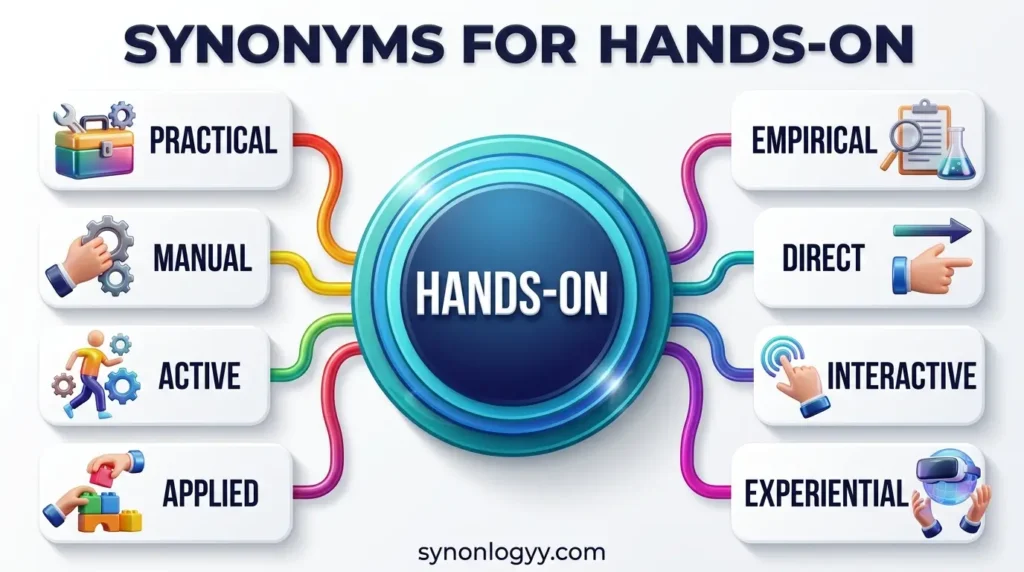
Practical, experiential, active, direct, applied, participatory, interactive, involved, engaged, manual, real-world, action-oriented, skill-based, task-based, experiential learning, learning by doing, do-it-yourself, work-based, field-based, practice-based, operational, functional, tangible, concrete, in-person, immersive, demonstrative, trial-based, labor-intensive, personally involved.
Meaning of Hands-On
Definition
Hands-on (adjective): Involving direct action, practical work, or active participation rather than only reading or watching.
The phrase can describe learning, work, training, or personal involvement. A hands-on class lets students practice a skill themselves. A hands-on manager works closely with the team and its tasks.
Examples
- Our science teacher uses hands-on experiments to explain plants.
- Dad took a hands-on approach when fixing the kitchen sink.
Common Collocations
- Hands-on experience: She gained hands-on experience during training.
- Hands-on learning: Hands-on learning helps students practice new skills.
- Hands-on approach: His hands-on approach solved the problem quickly.
- Hands-on training: New staff receive hands-on training each week.
- Hands-on work: Hands-on work keeps him busy outdoors.
Connotative Meaning
(Connotation means the feeling or idea a word suggests.)
- Positive tone: Hands-on often suggests skill, effort, and useful experience.
- Negative tone: It can suggest too much control when someone gets involved in every detail.
- Neutral tone: It can simply describe practical work or active learning.
The meaning depends on the situation. A hands-on teacher may help students learn faster. A hands-on boss may support workers or limit their freedom.
Etymology of Hands-On
The phrase hands-on comes from the ordinary English words hands and on. It describes putting one’s hands to work or becoming directly involved in an activity.
The word hand has roots in Old English. The word on also comes from Old English. Their combination later developed into the familiar adjective hands-on.
Its modern use focuses on practical action, direct experience, and active involvement.
Old English (450–1100)
The Old English word hand referred to the body part used for holding, touching, and working.
The word on expressed position or contact. These words existed separately during this period.
Middle English (1100–1500)
The words continued to develop in Middle English. People used them in many everyday settings.
The exact date when the modern compound hands-on first appeared is not established here.
Modern English (1500–Present)
Today, hands-on often describes practical training, direct work, and active participation.
It appears in education, business, technology, healthcare, and many trades.
The phrase helps distinguish doing something from only studying or discussing it.
Pronunciation of Hands-On (IPA)
- IPA (US): /ˌhændzˈɑːn/
- Syllables: Two: hands-on.
- Stress: The main stress falls on on.
Say the phrase smoothly as one unit. Keep the final sound of hands clear before saying on. The phrase usually acts as an adjective before a noun.
Examples include hands-on training, hands-on work, and hands-on experience.
Affixation Pattern of Hands-On
- Root: Hand and on are the two main parts.
- Prefix: None.
- Suffix: None in the basic compound.
- Word formations: The phrase has several related forms and expressions.
Common related words and forms include:
- Hand (noun): The body part used for holding and touching.
- Hands (plural noun): More than one hand; also workers in some contexts.
- Handful (noun): An amount that fits in one hand.
- Handy (adjective): Useful or easy to use.
- Handwork (noun): Work done by hand.
- Handmade (adjective): Made by a person rather than a machine.
- Hands-on (adjective): Involving practical action or direct participation.
- Hands-on learning (noun phrase): Learning through practical activity.
- Hands-on approach (noun phrase): A way of working through direct involvement.
The phrase hands-on is a compound adjective. It does not need an added prefix or suffix to express its main meaning.
30 Synonyms of Hands-On With Meaning & Examples
The best synonym depends on what you want to describe. Some words focus on learning, while others focus on work or personal involvement.
1. Practical (adjective)
Meaning: Practical means concerned with real tasks and useful action.
Best used when / Tone: Common, neutral, and useful in school or work.
Examples:
- The course teaches practical skills for daily life.
- We need a practical plan to repair the roof.
2. Experiential (adjective)
Meaning: Experiential describes learning through personal experience.
Best used when / Tone: Formal, educational, and professional.
Examples:
- The museum offers experiential lessons about ancient history.
- Her experiential training included real customer interviews.
3. Active (adjective)
Meaning: Active means taking part rather than remaining passive.
Best used when / Tone: Simple, broad, and neutral.
Examples:
- Active learning keeps the class involved in each lesson.
- The coach wants active support from every player.
4. Direct (adjective)
Meaning: Direct means involving immediate contact or action without an intermediary.
Best used when / Tone: Clear, neutral, and suitable for formal writing.
Examples:
- The nurse gave direct care to the patient.
- Our team had direct contact with local residents.
5. Applied (adjective)
Meaning: Applied describes knowledge used to solve real problems.
Best used when / Tone: Academic, technical, and professional.
Examples:
- Applied science connects research with daily needs.
- She studies applied mathematics at college.
6. Participatory (adjective)
Meaning: Participatory describes an activity that invites people to take part.
Best used when / Tone: Formal, educational, and community-focused.
Examples:
- The workshop uses participatory methods for group learning.
- Residents joined a participatory plan for the park.
7. Interactive (adjective)
Meaning: Interactive describes an activity where people respond and take part.
Best used when / Tone: Common in education and digital settings.
Examples:
- The app offers interactive lessons for young readers.
- Our science display includes interactive games about space.
8. Involved (adjective)
Meaning: Involved describes someone who takes an active part in something.
Best used when / Tone: Common, flexible, and neutral.
Examples:
- Maria stays involved in every stage of the project.
- Parents feel involved in the school’s reading program.
9. Engaged (adjective)
Meaning: Engaged describes someone who gives attention and takes part.
Best used when / Tone: Positive and useful for people or learning.
Examples:
- Engaged students ask questions during the lesson.
- The manager keeps workers engaged through useful tasks.
10. Manual (adjective)
Meaning: Manual describes work done mainly by hand rather than by machine.
Best used when / Tone: Neutral, technical, and task-focused.
Examples:
- The workers use manual tools to shape the wood.
- Manual cleaning removed dirt from the narrow corner.
11. Real-World (adjective)
Meaning: Real-world describes situations outside theory or practice exercises.
Best used when / Tone: Friendly, clear, and common in education.
Examples:
- Students solve real-world problems during the course.
- The report shows real-world results from the new system.
12. Action-Oriented (adjective)
Meaning: Action-oriented describes a focus on doing things and reaching goals.
Best used when / Tone: Professional and goal-focused.
Examples:
- Her action-oriented plan helped the team meet deadlines.
- The meeting ended with an action-oriented list of tasks.
13. Skill-Based (adjective)
Meaning: Skill-based describes work or learning built around specific abilities.
Best used when / Tone: Educational and professional.
Examples:
- The school offers skill-based classes in basic coding.
- Skill-based tests measure how well workers perform tasks.
14. Task-Based (adjective)
Meaning: Task-based describes learning or work organized around specific tasks.
Best used when / Tone: Technical, educational, and work-focused.
Examples:
- Task-based lessons help learners practice useful phrases.
- The company uses task-based training for new staff.
15. Experiential Learning (noun phrase)
Meaning: Experiential learning means learning through experience and reflection.
Best used when / Tone: Formal and educational.
Examples:
- Experiential learning helped the students understand farming.
- The program combines field visits with experiential learning.
16. Learning by Doing (phrase)
Meaning: Learning by doing means gaining knowledge through action.
Best used when / Tone: Simple, friendly, and easy to understand.
Examples:
- Learning by doing helped Ben master the new software.
- Our art club believes in learning by doing.
17. Do-It-Yourself (adjective)
Meaning: Do-it-yourself describes work people complete without hiring someone.
Best used when / Tone: Informal, practical, and home-focused.
Examples:
- We built a do-it-yourself shelf for the bedroom.
- Her do-it-yourself project turned old jars into lamps.
18. Work-Based (adjective)
Meaning: Work-based describes learning or training connected to a workplace.
Best used when / Tone: Professional and educational.
Examples:
- Work-based training prepared him for his first job.
- The college offers work-based learning for young adults.
19. Field-Based (adjective)
Meaning: Field-based describes activities carried out in real settings outside a classroom or office.
Best used when / Tone: Academic, scientific, and professional.
Examples:
- Field-based research helped scientists study bird behavior.
- The course includes field-based lessons about soil.
20. Practice-Based (adjective)
Meaning: Practice-based describes learning or work grounded in actual practice.
Best used when / Tone: Formal and professional.
Examples:
- Practice-based teaching helps new nurses build confidence.
- The program uses practice-based methods for language learning.
21. Operational (adjective)
Meaning: Operational describes work related to running or using a system.
Best used when / Tone: Technical and business-focused.
Examples:
- Operational training taught staff to run the equipment.
- The report explains operational problems at the factory.
22. Functional (adjective)
Meaning: Functional describes something designed to work for a practical purpose.
Best used when / Tone: Neutral, technical, and purpose-focused.
Examples:
- The designer created a functional kitchen for busy families.
- Our team tested the functional parts of the device.
23. Tangible (adjective)
Meaning: Tangible describes something real, concrete, or easy to recognize.
Best used when / Tone: Formal and focused on clear results.
Examples:
- The training produced tangible gains in reading skills.
- Customers wanted tangible proof of the product’s value.
24. Concrete (adjective)
Meaning: Concrete describes something specific rather than abstract.
Best used when / Tone: Clear, formal, and useful for examples or results.
Examples:
- The teacher gave concrete examples of safe lab work.
- We need concrete steps to improve the service.
25. In-Person (adjective or adverb)
Meaning: In-person describes an activity where people meet physically.
Best used when / Tone: Common and useful for meetings or training.
Examples:
- The company provides in-person support for new users.
- We held an in-person meeting with the design team.
26. Immersive (adjective)
Meaning: Immersive describes an experience that deeply involves someone’s attention.
Best used when / Tone: Descriptive and common in education or technology.
Examples:
- The language camp offers an immersive French experience.
- An immersive display made the history lesson feel real.
27. Demonstrative (adjective)
Meaning: Demonstrative describes teaching or showing how something works.
Best used when / Tone: Formal and instructional.
Examples:
- The instructor used a demonstrative lesson for the tool.
- A demonstrative video showed each step of the repair.
28. Trial-Based (adjective)
Meaning: Trial-based describes a process built around testing or trying something.
Best used when / Tone: Technical and experiment-focused.
Examples:
- Trial-based testing helped the team compare two designs.
- The class used trial-based methods to test paper planes.
29. Labor-Intensive (adjective)
Meaning: Labor-intensive describes work that needs much human effort.
Best used when / Tone: Formal, practical, and focused on effort.
Examples:
- Harvesting the crop remained labor-intensive without machines.
- The repair became labor-intensive because every part needed cleaning.
30. Personally Involved (phrase)
Meaning: Personally involved describes taking a direct role in an activity.
Best used when / Tone: Neutral and focused on individual participation.
Examples:
- The owner stayed personally involved in the store’s redesign.
- She became personally involved in the local food drive.
Synonym Comparison Table
| Synonym | Tone | Formality | Best for |
|---|---|---|---|
| Practical | Neutral | Everyday | Useful skills and tasks |
| Experiential | Professional | Formal | Learning through experience |
| Active | Neutral | Everyday | Participation and learning |
| Direct | Clear | Both | Immediate contact or action |
| Applied | Technical | Formal | Using knowledge in practice |
| Participatory | Inclusive | Formal | Group activities |
| Interactive | Engaging | Both | Lessons, apps, and displays |
| Manual | Technical | Both | Work done by hand |
| Real-world | Clear | Both | Actual problems and situations |
| Immersive | Descriptive | Both | Deep learning experiences |
Prototype Meaning of Hands-On
The most typical meaning of hands-on is doing something yourself. People often picture a student building a model, a worker repairing equipment, or a cook preparing food.
Each person learns or works through direct action. They do more than read instructions or watch someone else.
The phrase can also describe personal involvement. A hands-on leader joins the work instead of only giving orders. This wider meaning makes the phrase useful in many settings.
The best synonym depends on whether you mean practical work, active learning, or close involvement.
Prototype Categorization of the 30 Synonyms
These groups help you choose words based on their main meaning.
- Practical work: Practical, manual, functional, labor-intensive. Use these words for real tasks, useful skills, or physical effort.
- Learning through experience: Experiential, experiential learning, learning by doing, practice-based. Use these when someone learns by trying, practicing, and reflecting.
- Active participation: Active, participatory, interactive, involved, engaged, personally involved. Use these when people take part instead of watching.
- Real situations and application: Applied, real-world, work-based, field-based, operational. Use these for workplace tasks, actual settings, or applied knowledge.
- Task and goal focus: Action-oriented, skill-based, task-based. Use these when a process focuses on specific actions or abilities.
- Physical presence and deep experience: In-person, immersive, demonstrative. Use these when people meet directly, become deeply involved, or learn through a demonstration.
- Clear results and specific evidence: Tangible, concrete. Use these to describe visible results, specific steps, or clear examples.
- Independent work and testing: Do-it-yourself, trial-based. Use these for personal projects and learning through tests.
These categories help writers match a word to the exact situation. They also make vocabulary easier to remember. However, similar words are not always interchangeable. For example, manual focuses on work done by hand, while interactive focuses on participation.
Antonyms of Hands On
Antonyms describe the opposite idea. For hands-on, they often suggest less direct action or involvement.
- Theoretical (adjective): Based on ideas rather than practical work. Example: The class covered theoretical ideas without any experiments.
- Abstract (adjective): Focused on ideas rather than specific actions. Example: The lecture discussed abstract ideas about justice.
- Passive (adjective): Involving little active participation. Example: Students took a passive role during the talk.
- Indirect (adjective): Happening through another person or method. Example: The manager gave indirect instructions through an assistant.
- Remote (adjective): Happening from a distance rather than in person. Example: Remote training replaced the classroom session.
- Detached (adjective): Not closely involved in an activity. Example: The director remained detached from daily tasks.
- Observational (adjective): Based mainly on watching rather than doing. Example: The students completed an observational study of birds.
- Nonparticipatory (adjective): Not involving active participation. Example: The event used a nonparticipatory format with speeches only.
- Conceptual (adjective): Related mainly to ideas or concepts. Example: The team discussed a conceptual plan before building anything.
- Hands-off (adjective): Involving little direct control or intervention. Example: Her hands-off leadership gave staff more freedom.
These words are not perfect opposites in every sentence. Choose one based on the specific meaning you want to contrast.
Short Questions and Answers
What does Hands-On mean?
Hands-on means doing something directly instead of only reading or watching. It often describes practical work, training, and learning through experience. For example, students gain hands-on experience when they build a model themselves.
The phrase can also describe a person who stays closely involved in a task.
When should Hands-On be used?
Use hands-on when describing practical tasks, active learning, or direct involvement. It works well in school, work, training, and daily life.
For example, a hands-on cooking class lets students prepare meals themselves. Use a more specific synonym when you need to explain the exact activity.
Is Hands-On positive or negative?
Hands-on is usually positive when it describes useful practice, active learning, or helpful leadership. It can sound negative when someone controls every small detail.
The meaning depends on the situation. A hands-on teacher may support students, while a hands-on boss may limit workers’ freedom.
How is Hands-On different from similar words?
Hands-on focuses on direct action or involvement. Practical focuses on usefulness, while experiential often describes learning through experience.
Interactive means people respond or take part. Manual refers mainly to work done by hand. Choose the word that best matches the activity, setting, and intended meaning.
What is the best synonym for Hands-On in formal writing?
Experiential is a strong choice when discussing learning through experience. Applied works better when describing knowledge used to solve real problems.
Practice-based suits training and professional methods. The best formal synonym depends on your sentence, so check whether you mean learning, work, or direct involvement.
What is a simple word to use instead of Hands-On?
Practical is often the simplest alternative to hands-on. It describes work or learning that involves useful action. For example, you might say, “The class teaches practical skills.” You can also use active when you mean taking part, or direct when you mean immediate involvement.
Conclusion
Learning synonyms for hands-on helps you express ideas with greater care. You can describe practical work, active learning, or direct involvement without repeating one phrase.
Words like practical, applied, and experiential suit different situations. Choosing the right one makes your writing clearer and more natural.
For ESL learners, these words also build confidence in speaking and writing. Students can explain their work with greater detail.
Content writers can create useful articles with less repetition. Always check the meaning before replacing one word with another. A good synonym should fit both the sentence and its purpose.
Keep a small vocabulary list and practice using one new word each day.
Write a sentence, say it aloud, and use it in a real conversation. With steady practice, synonyms for hands on will become easier to understand and use.