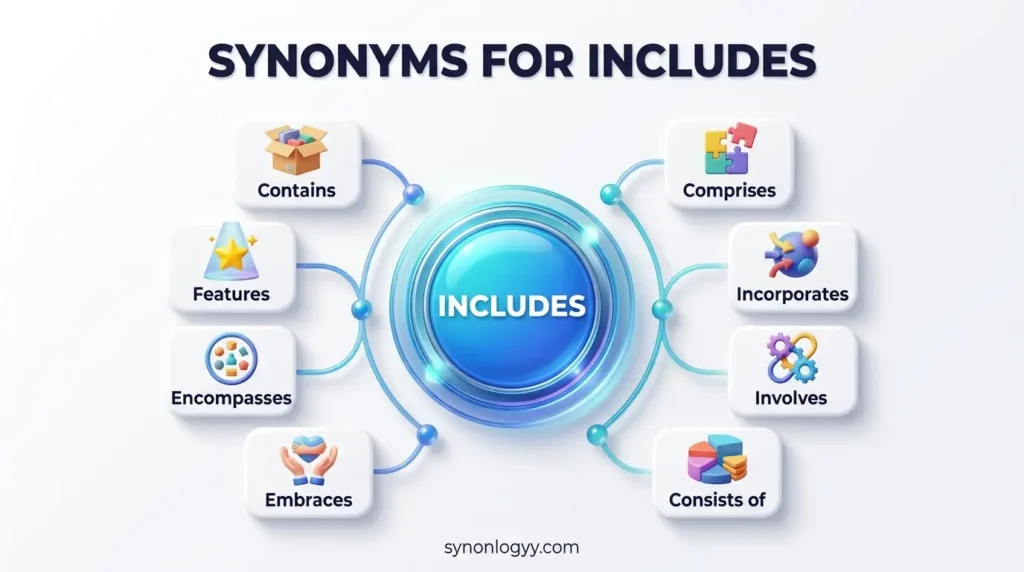
Synonyms for includes help you explain what something contains or covers. The word includes means that something forms part of a whole.
Imagine reading a school notice about a trip. It says the fee includes lunch, transport, and entry tickets. You now know what your payment covers.
People use includes in daily speech, schoolwork, business, and online content. It helps writers list parts, services, features, or people clearly.
Yet using the same word again and again can make writing dull. English learners can use synonyms to build stronger vocabulary and speak with more confidence. Content writers can also choose words that fit each sentence better.
Some alternatives mean “contains,” while others mean “covers” or “involves.” This guide explains the meaning, grammar, history, pronunciation, and 30 useful alternatives.
You will also find examples, antonyms, and tips for choosing the right word.
Quick List: Includes Synonyms at a Glance
These alternatives work in different contexts, such as lists, services, features, and activities.
Contains, has, covers, involves, features, comprises, consists of, incorporates, encompasses, embraces, entails, counts, lists, names, mentions, adds, offers, provides, supplies, carries, holds, brings, allows for, takes in, accounts for, makes up, forms part of, includes within, contains within, comprises of
Meaning of Includes
Definition
Includes (verb): Includes means that something or someone forms part of a group, set, whole, or offer.
Includes is the third-person singular form of the verb include. We use it with subjects such as he, she, it, or a singular noun.
For example, “The price includes breakfast” means breakfast is part of the price. “The class includes ten students” means ten students are part of the class. The exact meaning depends on the sentence.
Examples
- The school trip includes lunch and a museum visit.
- Her weekly plan includes time for reading and exercise.
Common Collocations
These phrases often appear with includes.
- Includes tax: The final price includes tax.
- Includes breakfast: The hotel booking includes breakfast.
- Includes features: This phone includes useful features.
- Includes information: The report includes key information.
- Includes services: The package includes several services.
Connotative Meaning
- Positive tone: Includes can suggest value, completeness, or extra benefits.
- Negative tone: It can point out an unwanted item or added cost.
- Neutral tone: It often states facts about what forms part of something.
(Connotation means the feelings or ideas a word suggests beyond its basic meaning.)
Etymology of Includes
The verb include comes from Latin includere, meaning “to shut in” or “enclose.” It combines in- (“in”) with claudere (“to shut”). Over time, the meaning grew to cover things that belong within a group, list, or whole.
- Old English (450–1100): The modern verb include was not an Old English word. English used other words to express ideas such as keeping something within a place or group.
- Middle English (1100–1500): Include entered English through French and Latin influence during the later medieval period. It carried the idea of enclosing or containing something.
- Modern English (1500–Present): The word developed its common sense of making something part of a whole. Today, people use it for lists, prices, features, groups, services, and many other things.
Pronunciation of Includes (IPA)
- IPA (US): /ɪnˈkluːdz/
- Syllables: in-cludes (two syllables)
The stress falls on the second syllable: CLUDES. The final sound is /z/, not /s/.
Affixation Pattern of Includes
- Root: Include is the base verb.
- Prefix: In- comes from the Latin form and carries the idea of “in” or “within.” In modern English, it is not usually treated as a freely removable prefix in this word.
- Suffix: -s marks the third-person singular present tense.
- Word formations:
- Include (verb): To make something part of a whole.
- Includes (verb): The form used with a singular third-person subject.
- Included (verb/adjective): Something that was made part of a whole.
- Including (verb/preposition): Used to show that something forms part of a group or list.
- Inclusion (noun): The act or state of making someone or something part of a group.
- Inclusive (adjective): Covering many people or things, or welcoming different groups.
- Inclusively (adverb): In a way that includes different people or things.
- Inclusiveness (noun): The quality of including or welcoming different people or things.
- Inclusionary (adjective): Relating to inclusion, especially in social or group settings.
Examples:
- Include: Please include your phone number.
- Includes: The plan includes two free lessons.
- Included: Parking was included in the fee.
- Including: Everyone came, including the new student.
- Inclusion: The policy supports inclusion at school.
- Inclusive: The club has an inclusive approach.
- Inclusively: The team worked inclusively with local groups.
- Inclusiveness: The event promoted inclusiveness across the community.
30 Synonyms of Includes With Meaning & Examples
The best alternative depends on what includes means in your sentence. Some words describe what something contains. Others explain what it covers, offers, or involves. Use each word only when its meaning fits.
1. Contains (verb)
Meaning: Contains means that something has an item, substance, or part inside it.
Best used when / Tone: Common, neutral, direct.
Examples:
- This bottle contains fresh orange juice.
- The folder contains all the forms for enrollment.
2. Has (verb)
Meaning: Has means that someone or something possesses or holds something.
Best used when / Tone: Simple, informal, broad.
Examples:
- Our classroom has a large whiteboard.
- The new laptop has a bright screen and fast storage.
3. Covers (verb)
Meaning: Covers means that something deals with or provides for a topic, cost, or range.
Best used when / Tone: Common, neutral, broad.
Examples:
- The lesson covers basic grammar rules.
- Her travel insurance covers medical emergencies abroad.
4. Involves (verb)
Meaning: Involves means that something requires, uses, or brings in a person or activity.
Best used when / Tone: Neutral, practical, often about activities.
Examples:
- The science project involves testing three types of soil.
- His new role involves meeting clients every week.
5. Features (verb)
Meaning: Features means that something presents or has a noticeable part or quality.
Best used when / Tone: Positive, common in marketing and descriptions.
Examples:
- The magazine features an interview with a local artist.
- This car features a rear camera and safety alerts.
6. Comprises (verb)
Meaning: Comprises means that something consists of several parts or members.
Best used when / Tone: Formal, precise, often used in reports.
Examples:
- The committee comprises five elected members.
- The course comprises six short learning units.
7. Consists of (verb phrase)
Meaning: Consists of means that something is made up of certain parts.
Best used when / Tone: Neutral, precise, useful for lists.
Examples:
- The kit consists of gloves, tape, and scissors.
- Her breakfast consists of fruit and plain yogurt.
8. Incorporates (verb)
Meaning: Incorporates means that something adds or combines a part into a larger whole.
Best used when / Tone: Formal, professional, focused on integration.
Examples:
- The design incorporates recycled wood and glass.
- The new course incorporates feedback from past students.
9. Encompasses (verb)
Meaning: Encompasses means that something covers a wide range of things.
Best used when / Tone: Formal, broad, often used for topics.
Examples:
- The study encompasses several years of local data.
- Her job encompasses training, planning, and staff support.
10. Embraces (verb)
Meaning: Embraces means that something includes or accepts a range of ideas or people.
Best used when / Tone: Positive, expressive, often about ideas or groups.
Examples:
- The festival embraces music from many cultures.
- Their teaching style embraces both art and science.
11. Entails (verb)
Meaning: Entails means that something requires or brings certain duties or results.
Best used when / Tone: Formal, serious, often about responsibilities.
Examples:
- The job entails travel twice each month.
- Buying a house entails extra costs and careful planning.
12. Lists (verb)
Meaning: Lists means that something names items one after another.
Best used when / Tone: Neutral, direct, focused on written details.
Examples:
- The notice lists the dates for each exam.
- Her profile lists three years of teaching experience.
13. Names (verb)
Meaning: Names means that something identifies people or things by name.
Best used when / Tone: Neutral, direct, useful for people or items.
Examples:
- The letter names the winners of the contest.
- The guide names several places to visit nearby.
14. Mentions (verb)
Meaning: Mentions means that something refers to a person, item, or idea briefly.
Best used when / Tone: Neutral, informal to professional, less complete than “contains.”
Examples:
- The article mentions two causes of the problem.
- Her email mentions the meeting time but gives few details.
15. Adds (verb)
Meaning: Adds means that something puts another item or detail into a group or whole.
Best used when / Tone: Common, direct, often about an extra part.
Examples:
- The chef adds fresh herbs to the soup.
- The updated plan adds a short break after lunch.
16. Offers (verb)
Meaning: Offers means that someone or something makes a service, choice, or benefit available.
Best used when / Tone: Positive, practical, common in business.
Examples:
- The library offers free computer classes.
- This package offers extra storage for a small fee.
17. Provides (verb)
Meaning: Provides means that someone or something supplies what is needed or useful.
Best used when / Tone: Neutral, professional, service-focused.
Examples:
- The handbook provides clear steps for new staff.
- The clinic provides care for local families.
18. Supplies (verb)
Meaning: Supplies means that someone or something gives items or resources for use.
Best used when / Tone: Practical, neutral, focused on resources.
Examples:
- The store supplies tools to nearby builders.
- The charity supplies clean water to remote villages.
19. Carries (verb)
Meaning: Carries means that a shop, service, or item stocks or holds something.
Best used when / Tone: Common, informal to neutral, often retail-related.
Examples:
- The small shop carries books by local writers.
- This website carries several brands of running shoes.
20. Holds (verb)
Meaning: Holds means that something has or keeps something within it.
Best used when / Tone: Neutral, simple, often about spaces or containers.
Examples:
- The drawer holds spare batteries and cables.
- The hall holds two hundred people during events.
21. Brings (verb)
Meaning: Brings means that something adds or causes a new part, feature, or result.
Best used when / Tone: Common, flexible, often about effects or benefits.
Examples:
- The new plan brings more support for parents.
- The update brings several tools to the app.
22. Allows for (verb phrase)
Meaning: Allows for means that a plan or system makes room for something.
Best used when / Tone: Neutral, practical, often about planning.
Examples:
- The schedule allows for a short lunch break.
- The budget allows for small changes during the project.
23. Takes in (verb phrase)
Meaning: Takes in means that something accepts, receives, or contains a person or thing.
Best used when / Tone: Informal, context-dependent, often about spaces or groups.
Examples:
- The shelter takes in stray cats during winter.
- The course takes in students from several age groups.
24. Accounts for (verb phrase)
Meaning: Accounts for means that something forms a part or explains a share of a total.
Best used when / Tone: Formal, analytical, often used with figures.
Examples:
- Online sales account for half the store’s income.
- The final bill accounts for labor and materials.
25. Makes up (verb phrase)
Meaning: Makes up means that people or things form part or all of a whole.
Best used when / Tone: Common, neutral, useful for groups and totals.
Examples:
- Women make up most of the class.
- These parts make up the complete machine.
26. Forms part of (verb phrase)
Meaning: Forms part of means that something belongs to a larger whole.
Best used when / Tone: Neutral, clear, slightly formal.
Examples:
- This chapter forms part of the final unit.
- The old bridge forms part of the town’s history.
27. Enlists (verb)
Meaning: Enlists means that someone brings people into a group, cause, or task.
Best used when / Tone: Formal, action-focused, not a general substitute.
Examples:
- The organizer enlists volunteers for the food drive.
- The coach enlists former players to help train beginners.
28. Adds in (verb phrase)
Meaning: Adds in means that someone puts an extra item or detail into a set.
Best used when / Tone: Informal, practical, focused on adding details.
Examples:
- The cook adds in chopped onions near the end.
- The editor adds in a note about the new policy.
29. Takes account of (verb phrase)
Meaning: Takes account of means that someone considers a fact or factor when planning or judging.
Best used when / Tone: Formal, careful, decision-focused.
Examples:
- The plan takes account of students’ different needs.
- Her estimate takes account of travel and meal costs.
30. Includes within (verb phrase)
Meaning: Includes within means that something places or treats an item as part of a larger group or boundary.
Best used when / Tone: Formal, specific, useful for boundaries or categories.
Examples:
- The policy includes within its scope all full-time staff.
- The report includes within its review several nearby towns.
Synonym Comparison Table
| Synonym | Tone | Formality | Best for |
|---|---|---|---|
| Contains | Neutral | Everyday | Items inside a container or text |
| Has | Simple | Informal | General possession or features |
| Covers | Neutral | Everyday | Topics, costs, or areas |
| Involves | Neutral | Everyday | Tasks, roles, and activities |
| Features | Positive | Neutral | Notable parts or selling points |
| Comprises | Formal | Formal | Parts that form a whole |
| Consists of | Precise | Neutral | Naming all parts of something |
| Incorporates | Professional | Formal | Adding parts into a design or plan |
| Encompasses | Broad | Formal | Wide topics or ranges |
| Provides | Helpful | Neutral | Services, tools, and resources |
Prototype Meaning of Includes
The most common meaning of includes is that something forms part of a larger whole. People often picture a list of items, a service package, or a product with several features. For example, a ticket may include entry, a meal, and transport.
The word does not always mean that the list is complete. It often names some parts without saying that nothing else exists.
This makes includes useful in everyday talk, reports, product descriptions, school notices, and business writing. When you need to stress every part, consists of may be more precise.
Prototype Categorization of the 30 Synonyms
The best alternative depends on what the sentence says is part of a whole. These groups can help you choose the right word.
- Containing items or parts: Contains, has, holds, carries. Use these for objects, containers, shops, websites, or things that have items inside or available.
- Covering topics or areas: Covers, encompasses, embraces. Choose these for reports, lessons, plans, policies, or subjects with a wide range.
- Forming a whole: Comprises, consists of, makes up, forms part of. Use these when explaining how parts combine to form a larger unit.
- Adding parts or details: Incorporates, adds, adds in, includes within. These work when a person or system puts something into a plan, design, or group.
- Providing services or benefits: Offers, provides, supplies, brings. Use these for packages, services, tools, resources, and useful features.
- Naming or referring to details: Lists, names, mentions. Choose these when a document or person states items, people, or ideas.
- Requiring or considering factors: Involves, entails, allows for, takes account of. These fit duties, planning, risks, and other factors that a task must consider.
- Showing shares or membership: Accounts for, takes in, enlists. Use these for totals, groups, membership, and the process of bringing people into a task.
These groups help writers avoid repeating the same word while keeping the meaning clear. They also show which words fit lists, features, tasks, or totals.
Similar words are not always interchangeable: mentions may refer to something briefly, while contains suggests that something is actually part of a whole.
Antonyms of Includes
The opposite of includes depends on the sentence. These words describe leaving something out, refusing it, or keeping it separate.
- Excludes (verb): Keeps someone or something out. Example: The fee excludes airport transfers.
- Omits (verb): Leaves something out of a list or text. Example: The report omits the final survey result.
- Leaves out (verb phrase): Does not add or mention something. Example: The recipe leaves out the salt.
- Removes (verb): Takes something away from a group or whole. Example: The editor removes outdated details from the guide.
- Rejects (verb): Refuses to accept something. Example: The committee rejects proposals without clear costs.
- Bars (verb): Prevents someone from entering or joining. Example: The rule bars visitors from the staff area.
- Prohibits (verb): Does not allow an action. Example: The policy prohibits food inside the lab.
- Separates (verb): Keeps things apart rather than joining them. Example: The teacher separates the two topics in class.
- Withholds (verb): Holds something back instead of giving it. Example: The company withholds payment until the work ends.
- Disregards (verb): Ignores something that should be considered. Example: The plan disregards the needs of older residents.
Short Questions and Answers
What does includes mean?
Includes means that a person, item, feature, or activity forms part of a larger whole. For example, if a price includes breakfast, breakfast is part of the price. The word is the third-person singular form of the verb include.
When should includes be used?
Use includes when stating that something forms part of a list, service, group, plan, or offer. It works well in school notices, reports, product descriptions, and everyday speech.
Choose consists of when you want to name all the parts of a whole.
Is includes positive or negative?
Includes is usually neutral because it states what belongs to something. It can sound positive when it highlights extra benefits, such as free meals or helpful features. It can also draw attention to unwanted items or costs, depending on the sentence.
How is includes different from similar words?
Includes broadly means that something forms part of a whole. Contains often suggests something inside a container or text. Covers often refers to topics or costs, while involves points to activities or requirements. The best choice depends on the relationship you mean.
What is the best synonym for includes in formal writing?
Comprises works well when describing the parts that form a whole. Encompasses suits a broad range of topics, while incorporates means adding parts into a plan or design. Use the word that matches the relationship in your sentence.
What is a simple word to use instead of includes?
Has is a simple alternative when you mean that something possesses a feature or item. Contains works for things held inside something.
For topics or costs, covers may sound more natural. Always check the sentence before choosing a replacement.
Conclusion
Learning synonyms for includes helps you describe lists, features, services, and parts with greater care. Words like contains, has, and covers suit common situations.
Comprises, encompasses, and incorporates can make formal writing more exact.
Other choices, such as offers and provides, work well for services and benefits. For English learners, these alternatives build vocabulary and make speaking easier.
For students and content writers, they help reduce repetition and improve clarity.
Remember that a synonym must fit the meaning of the sentence. A word used for a list may not work for a task or service. Practice one new word each day and write your own example sentence using it.