
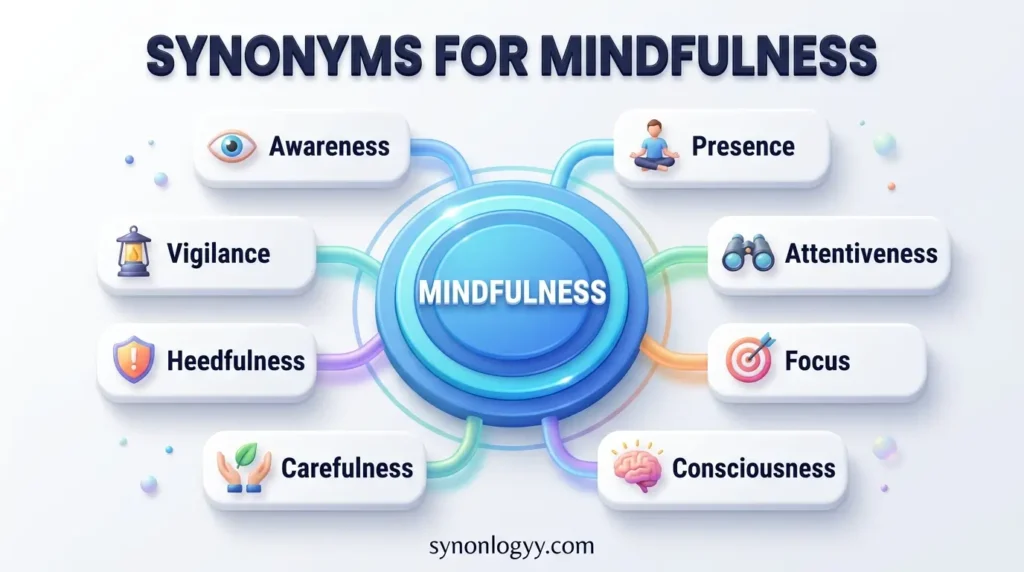
Synonyms for mindfulness help us describe awareness, attention, and careful thought. Mindfulness means paying attention to the present moment without rushing to judge it.
Imagine sitting in class while your mind keeps thinking about home. You take a breath and focus on your teacher again. That simple act shows mindfulness in daily life.
People use this word when they talk about calmness, mental focus, and self-awareness. It also appears in school, work, health, and personal growth.
For English learners, knowing similar words makes speaking easier and more natural. Content writers can also use synonyms to avoid repetition and share ideas clearly.
However, each alternative has its own meaning and tone. This guide explains the meaning, history, pronunciation, grammar, and best synonyms for mindfulness. You will also learn how to choose the right word for different situations.
Quick List: Mindfulness Synonyms at a Glance
These words describe awareness, attention, or thoughtful presence, depending on the context.
Awareness, attention, attentiveness, consciousness, presence, focus, concentration, alertness, observation, perception, self-awareness, reflection, thoughtfulness, consideration, care, heedfulness, watchfulness, vigilance, receptiveness, sensitivity, openness, calmness, composure, meditation, contemplation, introspection, deliberation, carefulness, discernment, attentiveness to the present.
Meaning of Mindfulness
Definition
Mindfulness (noun): The practice of paying attention to the present moment with awareness and without quick judgment.
Mindfulness can involve noticing thoughts, feelings, sounds, and body sensations. It does not mean forcing your mind to become empty. Instead, you notice what is happening and gently return your attention when it wanders.
The word can also describe careful awareness during everyday actions. For example, you might eat slowly and notice each bite. You might listen closely when a friend shares a problem. In both cases, you give the present moment your attention.
Examples
- Before the test, Maya practiced mindfulness by taking slow breaths.
- During lunch, Omar used mindfulness to notice the taste of his food.
Common Collocations
These phrases often appear with the word mindfulness.
- Practice mindfulness: I practice mindfulness before work.
- Mindfulness meditation: She tried mindfulness meditation after class.
- Mindfulness exercises: Our teacher shared mindfulness exercises today.
- Mindfulness training: The team began mindfulness training last week.
- Mindfulness practice: His mindfulness practice helps him pause.
Connotative Meaning
- Positive tone: Mindfulness often suggests calmness, balance, and thoughtful awareness.
- Negative tone: In some settings, the word may sound like a trend or a task that people feel pressured to perform.
- Neutral tone: It can simply describe paying attention to present thoughts, feelings, or events.
(Connotation means the feelings or ideas a word brings to mind beyond its basic meaning.)
Etymology of Mindfulness
The word mindfulness comes from the word mind and the suffix -ful, followed by -ness. Its history connects to older English words for the mind and mental awareness.
The modern word is also strongly linked to the Buddhist term sati, often translated as mindfulness or awareness.
Buddhist teachings use this concept for attentive awareness of the body, feelings, mind, and experiences. The English word later became common in discussions of meditation and mental well-being.
- Old English (450–1100): Mind has roots in Old English gemynd, which referred to memory, thought, or the mind. The exact modern compound mindfulness should not be assumed to have had the same meaning in this period.
- Middle English (1100–1500): Forms of mind continued to describe thought, memory, and mental attention. The development of related forms reflects changes in English vocabulary over time.
- Modern English (1500–Present): Mindfulness developed from mindful, meaning attentive or aware, plus -ness, which forms nouns. Today, it often refers to present-moment awareness, especially in meditation and well-being.
Pronunciation of Mindfulness (IPA)
- IPA (US): /ˈmaɪnd.fəl.nəs/
- Syllables: mind-ful-ness (three syllables)
Say the first part clearly: MIND. The word has three syllables, but the first one carries the main stress.
Affixation Pattern of Mindfulness
- Root: Mind — a noun referring to thought, memory, or mental activity.
- Prefix: None.
- Suffixes: -ful means full of or characterized by; -ness turns an adjective into a noun.
- Word formations:
- Mind (noun/verb): The mind helps us think, remember, and understand.
- Mindful (adjective): A person who is mindful pays careful attention.
- Mindfully (adverb): This describes doing something with awareness.
- Mindfulness (noun): This names the quality or practice of being mindful.
- Unmindful (adjective): This means not aware of something or not giving it attention.
- Unmindfully (adverb): This describes acting without proper awareness.
Examples:
- Mind: Her mind stayed on the lesson.
- Mindful: He was mindful of the noise.
- Mindfully: She listened mindfully to her friend.
- Mindfulness: Mindfulness helped him notice his feelings.
- Unmindful: He was unmindful of the wet floor.
- Unmindfully: She unmindfully left the door open.
30 Synonyms of Mindfulness With Meaning & Examples
Mindfulness has no single perfect replacement in every sentence. Some words describe awareness, while others focus on attention, reflection, or calm. The best choice depends on what you want to express.
1. Awareness (noun)
Meaning: Awareness is knowing what is happening around you or within you.
Best used when / Tone: Common, neutral, broad.
Examples:
- The safety talk raised awareness of road risks.
- At home, Ben showed awareness of his mother’s mood.
2. Attention (noun)
Meaning: Attention is the act of focusing your mind on something.
Best used when / Tone: Common, neutral, practical.
Examples:
- Please give your full attention to the speaker.
- Her attention shifted when the phone rang.
3. Attentiveness (noun)
Meaning: Attentiveness is the habit of noticing details and listening closely.
Best used when / Tone: Polite, professional, slightly formal.
Examples:
- The nurse showed attentiveness to every patient.
- His attentiveness helped him catch a small error.
4. Consciousness (noun)
Meaning: Consciousness is the state of being aware of yourself and your surroundings.
Best used when / Tone: Neutral, formal, sometimes scientific.
Examples:
- The film raised her consciousness of social bias.
- After the fall, the player slowly regained consciousness.
5. Presence (noun)
Meaning: Presence is giving your attention to the moment and the people with you.
Best used when / Tone: Warm, reflective, personal.
Examples:
- During dinner, his presence made everyone feel heard.
- The coach asked players to stay present during practice.
6. Focus (noun)
Meaning: Focus is the ability to direct your attention toward one thing.
Best used when / Tone: Common, direct, goal-oriented.
Examples:
- A quiet room improved Sara’s focus while studying.
- At work, clear goals helped the team keep its focus.
7. Concentration (noun)
Meaning: Concentration is the act of keeping your mind on one task.
Best used when / Tone: Neutral, practical, task-based.
Examples:
- The long math problem needed careful concentration.
- Loud music broke his concentration during the exam.
8. Alertness (noun)
Meaning: Alertness is being awake, aware, and ready to notice changes.
Best used when / Tone: Strong, practical, safety-related.
Examples:
- Drivers need alertness on icy roads.
- The guard’s alertness helped prevent a theft.
9. Observation (noun)
Meaning: Observation is the act of watching or noticing something closely.
Best used when / Tone: Neutral, analytical, evidence-based.
Examples:
- Her observation revealed a crack in the wall.
- The science class began with observation of plant growth.
10. Perception (noun)
Meaning: Perception is the way you notice and understand things.
Best used when / Tone: Thoughtful, formal, analytical.
Examples:
- His perception of the problem changed after discussion.
- Color can affect our perception of a room.
11. Self-awareness (noun)
Meaning: Self-awareness is understanding your own thoughts, feelings, and actions.
Best used when / Tone: Reflective, personal, common in personal growth.
Examples:
- Self-awareness helped Lina understand her anger.
- The manager used self-awareness to improve her leadership.
12. Reflection (noun)
Meaning: Reflection is careful thought about an experience or idea.
Best used when / Tone: Calm, thoughtful, often after an event.
Examples:
- After the match, reflection helped the captain learn.
- His journal gave him time for reflection each night.
13. Thoughtfulness (noun)
Meaning: Thoughtfulness is careful attention to ideas or to other people’s needs.
Best used when / Tone: Warm, kind, personal.
Examples:
- Her thoughtfulness showed when she checked on her neighbor.
- Thoughtfulness helped him choose a kind reply online.
14. Consideration (noun)
Meaning: Consideration is careful thought about a person, choice, or result.
Best used when / Tone: Polite, formal, decision-focused.
Examples:
- The board gave the proposal careful consideration.
- He showed consideration by asking before borrowing the car.
15. Care (noun)
Meaning: Care is attention given to doing something properly or safely.
Best used when / Tone: Simple, common, practical.
Examples:
- Handle the glass with care.
- The cook prepared each meal with care.
16. Heedfulness (noun)
Meaning: Heedfulness is paying attention to advice, warnings, or signs.
Best used when / Tone: Formal, serious, less common.
Examples:
- Heedfulness toward warnings can prevent accidents.
- Her heedfulness helped her follow the safety rules.
17. Watchfulness (noun)
Meaning: Watchfulness is staying alert and looking for possible changes or risks.
Best used when / Tone: Serious, protective, safety-focused.
Examples:
- The parents kept watchfulness near the busy pool.
- Watchfulness helped the farmer spot smoke early.
18. Vigilance (noun)
Meaning: Vigilance is careful and steady attention to possible danger or trouble.
Best used when / Tone: Strong, formal, security-related.
Examples:
- Online vigilance can help protect private information.
- The crew maintained vigilance during the storm.
19. Receptiveness (noun)
Meaning: Receptiveness is being open to new ideas, feelings, or feedback.
Best used when / Tone: Positive, open-minded, professional.
Examples:
- Her receptiveness made the team discussion useful.
- Receptiveness to feedback helped him grow as a writer.
20. Sensitivity (noun)
Meaning: Sensitivity is noticing and responding to feelings or small changes.
Best used when / Tone: Personal, emotional, sometimes technical.
Examples:
- The teacher showed sensitivity to the child’s worries.
- The sensor’s sensitivity helped it detect tiny changes.
21. Openness (noun)
Meaning: Openness is a willingness to notice or consider new ideas and experiences.
Best used when / Tone: Positive, friendly, broad.
Examples:
- Openness to new foods made travel more fun.
- The group welcomed openness during its planning meeting.
22. Calmness (noun)
Meaning: Calmness is a state of being peaceful and not upset.
Best used when / Tone: Gentle, reassuring, emotional.
Examples:
- Her calmness helped settle the frightened child.
- Calmness made it easier to answer the difficult question.
23. Composure (noun)
Meaning: Composure is the ability to stay calm and in control.
Best used when / Tone: Formal, strong, often under pressure.
Examples:
- The presenter kept her composure after the mistake.
- He regained his composure before speaking to the press.
24. Meditation (noun)
Meaning: Meditation is a practice that trains attention or awareness.
Best used when / Tone: Reflective, spiritual, wellness-related.
Examples:
- Nina tried meditation before starting her shift.
- The class used meditation to practice steady attention.
25. Contemplation (noun)
Meaning: Contemplation is deep and quiet thought about something.
Best used when / Tone: Literary, formal, thoughtful.
Examples:
- He sat in contemplation before making the choice.
- The painting invited contemplation of family and loss.
26. Introspection (noun)
Meaning: Introspection is examining your own thoughts and feelings.
Best used when / Tone: Formal, psychological, reflective.
Examples:
- Introspection helped her understand why she felt jealous.
- The writer used introspection to shape the main character.
27. Deliberation (noun)
Meaning: Deliberation is careful thought before making a decision.
Best used when / Tone: Formal, measured, decision-focused.
Examples:
- After long deliberation, the council approved the plan.
- He chose his words with deliberation during the interview.
28. Carefulness (noun)
Meaning: Carefulness is taking care to avoid mistakes or harm.
Best used when / Tone: Simple, practical, everyday.
Examples:
- Carefulness kept the child safe near the stairs.
- She checked the figures with carefulness before sending them.
29. Discernment (noun)
Meaning: Discernment is the ability to notice important differences and judge wisely.
Best used when / Tone: Formal, thoughtful, evaluative.
Examples:
- Discernment helped the editor spot weak sources.
- She showed discernment when choosing trusted news sites.
30. Attunement (noun)
Meaning: Attunement is being aware of and responsive to a person or situation.
Best used when / Tone: Reflective, relational, somewhat formal.
Examples:
- The therapist showed attunement to her client’s emotions.
- Attunement to the room helped the speaker adjust her tone.
Synonym Comparison Table
| Synonym | Tone | Formality | Best for |
|---|---|---|---|
| Awareness | Neutral | Everyday | General understanding |
| Attention | Direct | Everyday | Focusing on a task |
| Attentiveness | Positive | Semi-formal | Careful listening |
| Presence | Warm | Everyday | Being engaged now |
| Focus | Direct | Everyday | Goals and tasks |
| Concentration | Practical | Neutral | Study and work |
| Self-awareness | Reflective | Neutral | Understanding yourself |
| Reflection | Thoughtful | Neutral | Learning from events |
| Meditation | Calm | Neutral | A formal awareness practice |
| Vigilance | Serious | Formal | Risks and safety |
Prototype Meaning of Mindfulness
The most typical meaning of mindfulness is paying attention to what is happening right now. People often picture a person sitting quietly, breathing slowly, or noticing their thoughts.
Yet mindfulness does not require sitting still or meditating. You can practice it while walking, cooking, listening, or doing homework.
The central idea is to notice the present moment instead of acting without awareness. is why awareness, presence, and attention can sometimes replace mindfulness.
Still, the best choice depends on whether you mean mental awareness, focused work, or a specific meditation practice.
Prototype Categorization of the 30 Synonyms
These words belong to several related groups. Each group helps express a different part of mindfulness.
- General awareness: Awareness, consciousness, perception. Use these when you mean knowing what is happening or understanding what you notice.
- Focused attention: Attention, attentiveness, focus, concentration. Choose these for schoolwork, work tasks, listening, or careful study.
- Awareness of self: Self-awareness, reflection, introspection. Use these when thinking about your own thoughts, actions, or feelings.
- Careful judgment: Consideration, deliberation, discernment, thoughtfulness. These fit choices that need time, care, or wise judgment.
- Alertness and safety: Alertness, watchfulness, vigilance, heedfulness. Choose these when someone needs to notice risks, warnings, or changes.
- Emotional awareness and connection: Sensitivity, receptiveness, openness, attunement. These words help describe noticing feelings or responding to others.
- Calm and control: Calmness, composure, presence. Use these when the main idea is staying steady and engaged.
- Awareness practices: Meditation, contemplation. These fit deliberate practices or quiet periods of thought.
- Careful action: Care, carefulness, observation. Choose these when someone acts with care or notices details.
- Being engaged in the moment: Presence, awareness, attentiveness. These can fit situations where a person listens, notices, or responds instead of acting on autopilot.
Grouping words by meaning helps writers choose a word that matches the exact message.
It also makes vocabulary easier to remember and use. Similar words are not always interchangeable: vigilance suggests watching for danger, while mindfulness often suggests open awareness of the present moment.
Antonyms of Mindfulness
Mindfulness has no single opposite in every context. These words describe inattention, lack of awareness, or acting without thought.
- Inattention (noun): A lack of attention to something. Example: Inattention caused him to miss the final instruction.
- Distraction (noun): Something that pulls the mind away from its task. Example: Phone alerts became a distraction during homework.
- Unawareness (noun): A state of not knowing what is happening. Example: Her unawareness of the delay caused confusion.
- Carelessness (noun): A failure to take enough care. Example: Carelessness led to a spelling error in the report.
- Negligence (noun): A failure to give proper care or attention. Example: The review found negligence in the safety checks.
- Absent-mindedness (noun): A habit of forgetting or not noticing things. Example: His absent-mindedness made him leave his keys at home.
- Thoughtlessness (noun): Acting without considering the effects on others. Example: Thoughtlessness hurt her friend’s feelings.
- Mindlessness (noun): Acting without awareness or careful thought. Example: Mindlessness made him scroll through posts for hours.
- Impulsiveness (noun): Acting quickly without thinking about the results. Example: Impulsiveness led her to accept the offer too soon.
- Inattentiveness (noun): The habit or state of not paying close attention. Example: Inattentiveness during the lesson caused a missed step.
Short Questions and Answers
What does mindfulness mean?
Mindfulness means paying attention to the present moment with awareness. It includes noticing your thoughts, feelings, and surroundings without judging them too quickly.
You can practice mindfulness while breathing, eating, studying, walking, or listening to another person.
When should mindfulness be used?
Use mindfulness when talking about present-moment awareness or a practice that builds it.
The word fits conversations about meditation, daily habits, emotional awareness, and personal well-being. For simple task-based focus, attention or concentration may sound more natural.
Is mindfulness positive or negative?
Mindfulness usually has a positive meaning because it suggests awareness, calm, and thoughtful action. However, its tone depends on the sentence and context.
In some discussions, people may question whether mindfulness is useful for a particular problem or situation.
How is mindfulness different from similar words?
Mindfulness often means noticing the present moment with an open attitude. Attention means focusing on something, while concentration means keeping that focus steady. Awareness is broader and can describe simply knowing about a fact, feeling, or event.
What is the best synonym for mindfulness in formal writing?
Awareness is often a useful choice in formal writing because it is clear and widely understood. Use self-awareness when discussing personal insight, attentiveness for careful listening, or vigilance for watching risks. Choose the word that matches your exact point.
What is a simple word to use instead of mindfulness?
Awareness is one of the simplest alternatives to mindfulness. It works when you mean noticing your thoughts, feelings, or surroundings. You can also use attention when the sentence focuses on listening, studying, or completing a task.
Conclusion
Learning synonyms for mindfulness helps you explain awareness in clear and natural ways. Words like awareness, attention, and presence work in many daily situations.
Other choices, such as self-awareness, reflection, and vigilance, express more specific ideas. For English learners, these words build vocabulary and make speaking easier.
For students and content writers, they reduce repetition and help each sentence carry the right meaning. Remember that similar words can have different shades of meaning.
Always check the context before replacing one word with another. Try choosing one new synonym each day and writing two sentences with it. With regular practice, you can use these words with more skill and confidence.