
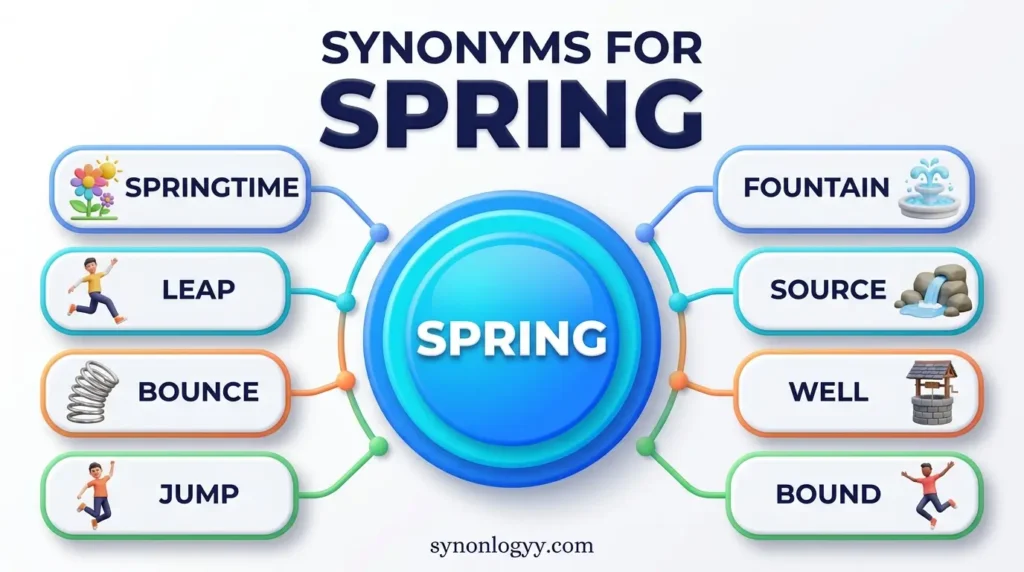
Spring is a season of new life, warm days, and blooming flowers. After a cold winter, people often enjoy the fresh air, green trees, and bright colors of spring.
But did you know that the word spring has more than one meaning? It can also mean a sudden jump, a quick movement, or a source of water.
Learning synonyms for spring helps you choose the right word for each situation. For example, blossoming can describe flowers, while leap can describe a sudden jump.
These words make your writing clearer and more interesting. They are useful for students, English learners, teachers, and content writers who want to build a stronger vocabulary.
In this guide, you will learn the meaning, history, pronunciation, and grammar of spring. You will also discover 30 related words, their meanings, and simple examples to help you use them with confidence.
Meaning of Synonyms for Spring
Spring (Noun and Verb):
As a noun, spring is the season between winter and summer. It can also mean a coil, a water source, or a sudden jump. As a verb, it means to jump, move quickly, or appear suddenly.
Examples
- Spring brings fresh flowers and warmer days.
- The cat can spring onto the table in one quick move.
Connotative Meaning
(Connotation: the feelings or ideas that a word brings to mind beyond its basic meaning.)
- Positive tone: Spring often suggests hope, growth, renewal, and fresh starts.
- Negative tone: In some contexts, a sudden spring or jump may suggest surprise or danger.
- Neutral tone: Spring can simply name a season, a metal coil, or a water source.
Etymology
The word spring comes from Old English and is linked to the idea of rising, leaping, or coming forth.
- Old English (450–1100): Springan meant to leap, burst forth, or rise.
- Middle English (1100–1500): The word developed into forms such as springen. It referred to jumping, rising, and emerging.
- Modern English (1500–Present): Spring came to refer to the season when plants begin to grow, as well as a jump, a coil, and a natural water source.
Pronunciation (IPA)
- IPA: /sprɪŋ/
- Syllables: spring (one syllable)
Affixation Pattern of Spring
- Root: spring
- Prefix: None in the basic word.
- Suffix: None in the basic word.
Word Formations
- Spring (noun): The season or a coil.
- Spring (verb): To jump or move suddenly.
- Springing (verb form/noun): The act of jumping or rising.
- Sprang (verb): The simple past form of spring.
- Sprung (verb): The past participle of spring.
- Springy (adjective): Bouncy or flexible.
- Springtime (noun): The season of spring.
- Springlike (adjective): Similar to spring in feeling or appearance.
- Upspring (verb): To rise or grow upward, a rare word.
- Springboard (noun): A board used to help someone jump.
30 Synonyms for Spring With Meaning and Examples
Spring has several meanings, so not every synonym below works in every sentence. Choose a word that matches the meaning you want.
1. Springtime (Noun)
Meaning: The season between winter and summer.
Examples:
- Springtime brings color to the garden.
- We enjoy long walks in springtime.
2. Vernal Season (Noun Phrase)
Meaning: A formal term for the spring season.
Examples:
- The vernal season brings new growth.
- Birds return during the vernal season.
3. Bloom (Noun/Verb)
Meaning: A period of flowering or the act of producing flowers.
Examples:
- The garden comes into bloom in spring.
- Roses bloom in the warm sun.
4. Blossoming (Noun/Verb)
Meaning: The process of producing flowers or developing well.
Examples:
- Blossoming trees line the road.
- The park looks beautiful during the blossoming season.
5. Rebirth (Noun)
Meaning: A fresh start or a return to life.
Examples:
- Spring feels like a rebirth for the garden.
- The new project marked a rebirth for the small town.
6. Renewal (Noun)
Meaning: The process of becoming fresh or new again.
Examples:
- Spring brings a sense of renewal.
- The rain helped the renewal of the dry fields.
7. Rejuvenation (Noun)
Meaning: The process of feeling or becoming fresh and full of energy again.
Examples:
- A walk in the spring air gave me a sense of rejuvenation.
- The garden showed signs of rejuvenation after the rain.
8. Regrowth (Noun)
Meaning: New growth after plants or other living things have been damaged or cut.
Examples:
- Spring encourages the regrowth of grass.
- The forest showed signs of regrowth after the fire.
9. Awakening (Noun)
Meaning: The start of activity or awareness after a quiet period.
Examples:
- Spring marks the awakening of nature.
- The warm weather brought an awakening to the sleepy town.
10. Flourishing (Noun/Adjective)
Meaning: Growing or developing in a healthy way.
Examples:
- Spring supports the flourishing of wild plants.
- The flourishing garden attracted many bees.
11. Leap (Noun/Verb)
Meaning: A jump from one place to another.
Examples:
- The deer made a leap over the stream.
- The athlete can leap over the hurdle.
12. Jump (Noun/Verb)
Meaning: To push yourself off the ground and move into the air.
Examples:
- The child made a jump over the puddle.
- The rabbit can jump very high.
13. Bound (Noun/Verb)
Meaning: A strong or energetic jump.
Examples:
- The dog took a bound across the lawn.
- The horse bounded over the fence.
14. Hop (Noun/Verb)
Meaning: A short jump, often on one foot or by a small animal.
Examples:
- The frog made a hop toward the pond.
- The rabbit hopped across the grass.
15. Bounce (Noun/Verb)
Meaning: To move back after hitting a surface.
Examples:
- The ball began to bounce on the path.
- The springy floor made me bounce slightly.
16. Vault (Noun/Verb)
Meaning: To jump over something with the help of your hands or body.
Examples:
- The athlete used a pole to vault over the bar.
- She vaulted over the low fence.
17. Surge (Noun/Verb)
Meaning: A sudden, strong movement or increase.
Examples:
- Water surged through the stream after the rain.
- A surge of energy helped him finish the race.
18. Burst (Noun/Verb)
Meaning: A sudden release, appearance, or movement.
Examples:
- Flowers burst into color in spring.
- The children burst through the door.
19. Emerge (Verb)
Meaning: To come out or become visible.
Examples:
- New shoots emerge from the soil in spring.
- The sun emerged from behind the clouds.
20. Rise (Verb)
Meaning: To move upward or increase.
Examples:
- Temperatures rise as spring begins.
- Mist rose from the field at dawn.
21. Eruption (Noun)
Meaning: A sudden release or appearance of something.
Examples:
- An eruption of wildflowers covered the meadow.
- The eruption of color made the garden stand out.
22. Upsurge (Noun)
Meaning: A sudden increase in something.
Examples:
- Spring brought an upsurge in park visitors.
- The warm weather caused an upsurge in outdoor activity.
23. Source (Noun)
Meaning: The place where something begins or comes from.
Examples:
- The spring is a source of fresh water.
- We found the source of the stream near the hill.
24. Water Source (Noun Phrase)
Meaning: A place where water comes from naturally or through a supply system.
Examples:
- The village depends on a nearby water source.
- The natural water source remained clear.
25. Well (Noun)
Meaning: A deep hole or structure used to obtain water.
Examples:
- The farm has a well for fresh water.
- They drew water from the old well.
26. Coil (Noun/Verb)
Meaning: A shape formed by winding something into rings.
Examples:
- The metal spring is shaped like a coil.
- The wire formed a tight coil.
27. Spiral (Noun/Verb)
Meaning: A curve that winds around a center or point.
Examples:
- The spring formed a spiral shape.
- The wire began to spiral around the rod.
28. Resilience (Noun)
Meaning: The ability to recover after difficulty or change.
Examples:
- Spring can symbolize resilience after a hard winter.
- The plants showed resilience after the frost.
29. Fresh Start (Noun Phrase)
Meaning: A new beginning without the problems of the past.
Examples:
- Spring gave the family a fresh start.
- She used the new season as a fresh start.
30. New Beginning (Noun Phrase)
Meaning: The start of a new stage or period.
Examples:
- Spring felt like a new beginning.
- Moving to a new city gave him a new beginning.
Prototype Meaning
The most common meaning of spring is the season between winter and summer. When people hear the word, they often picture flowers opening, trees growing new leaves, birds singing, and days becoming warmer.
These images make spring a symbol of life, hope, and fresh starts. In other contexts, the word may describe a jump, a coil, or a place where water rises from the ground. The sentence around the word helps readers understand which meaning is intended.
Prototype Categorization
The 30 related words fit into several semantic groups. These groups help writers choose words that match their exact meaning and tone.
- Season and time: springtime, vernal season. Use these when naming the season.
- Flowers and plant growth: bloom, blossoming, regrowth, flourishing. Use these to describe nature and gardens.
- Fresh starts and change: rebirth, renewal, rejuvenation, awakening, resilience, fresh start, new beginning. Use these when writing about hope, recovery, or change.
- Jumping and movement: leap, jump, bound, hop, bounce, vault. Use these when describing physical movement.
- Sudden movement or appearance: surge, burst, emerge, rise, eruption, upsurge. Use these for quick changes or things that appear suddenly.
- Water and natural sources: source, water source, well. Use these when discussing water that comes from the ground or a supply point.
- Shapes and structures: coil, spiral. Use these when describing a spring as a mechanical object.
Choosing a synonym from the correct group makes your writing more accurate. For example, rebirth may suit a story about personal change, while leap fits a sentence about physical movement.
Words with similar meanings are not always interchangeable, so context matters.
Antonyms of Spring
There is no single antonym for spring because the word has several meanings. The best opposite depends on how it is used.
1. Winter (Noun)
Meaning: The coldest season of the year, which comes before spring.
2. Decline (Noun/Verb)
Meaning: A decrease in strength, amount, or quality; an opposite idea to growth or renewal.
3. Decay (Noun/Verb)
Meaning: The process of breaking down or losing strength over time.
4. Withering (Noun/Adjective)
Meaning: The process of drying up or losing freshness, especially in plants.
5. Fall (Noun/Verb)
Meaning: A downward movement, which can be the opposite of rising or springing upward.
6. Sink (Verb)
Meaning: To move downward, often below a surface.
Short Questions and Answers
What does spring mean?
Spring is the season between winter and summer. It can also mean a jump, a coil, or a natural source of water.
When should spring be used?
Use spring when talking about the season, a sudden jump, a flexible coil, or a natural water source. The context tells readers which meaning you intend.
Is spring positive or negative?
Spring often has a positive tone because it suggests growth, hope, and renewal. However, its tone depends on the context.
How is spring different from similar words?
Springtime names the season, renewal describes becoming fresh again, and leap means a jump. Each word has a different use.
Conclusion
Learning synonyms for spring helps you express ideas with greater clarity and variety. Words such as springtime and vernal season describe the time of year, while bloom and regrowth focus on nature.
Other words, such as leap and surge, describe movement or sudden change. Words like renewal and rebirth can express hope and fresh starts.
Using the right synonym also helps you avoid repetition in essays, stories, blog posts, and everyday speech.
Remember that similar words do not always have the same meaning, so choose one that fits your sentence. Try learning a few new words each day, writing your own examples, and using them in conversation.
With regular practice, you can build a stronger vocabulary and speak and write English with more confidence.